
综合多组学分析:一种增进对糖尿病肾病理解的方法。
Integrated multiomic analyses: An approach to improve understanding of diabetic kidney disease.
作者信息
Hill Claire, McKnight Amy Jayne, Smyth Laura J
机构信息
Centre for Public Health, School of Medicine, Dentistry and Biomedical Science, Queen's University Belfast, Belfast, UK.
出版信息
Diabet Med. 2025 Feb;42(2):e15447. doi: 10.1111/dme.15447. Epub 2024 Oct 26.
AIM
Diabetes is increasing in prevalence worldwide, with a 20% rise in prevalence predicted between 2021 and 2030, bringing an increased burden of complications, such as diabetic kidney disease (DKD). DKD is a leading cause of end-stage kidney disease, with significant impacts on patients, families and healthcare providers. DKD often goes undetected until later stages, due to asymptomatic disease, non-standard presentation or progression, and sub-optimal screening tools and/or provision. Deeper insights are needed to improve DKD diagnosis, facilitating the identification of higher-risk patients. Improved tools to stratify patients based on disease prognosis would facilitate the optimisation of resources and the individualisation of care. This review aimed to identify how multiomic approaches provide an opportunity to understand the complex underlying biology of DKD.
METHODS
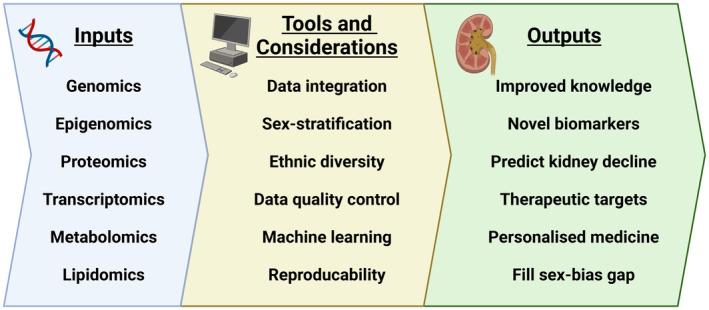
This review explores how multiomic analyses of DKD are improving our understanding of DKD pathology, and aiding in the identification of novel biomarkers to detect disease earlier or predict trajectories.
RESULTS
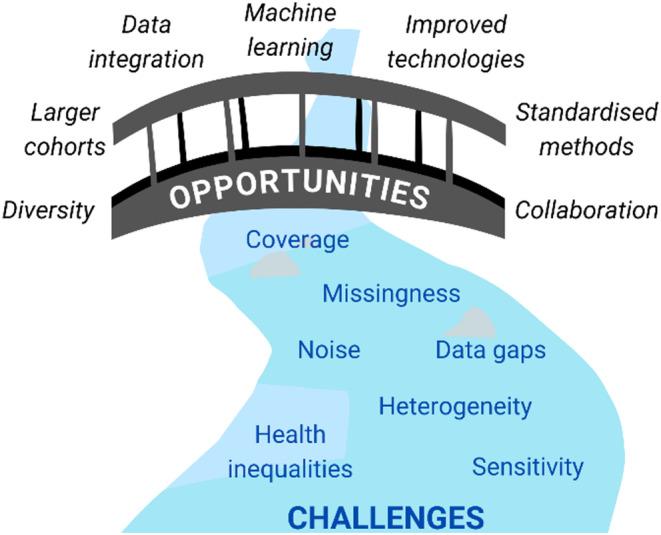
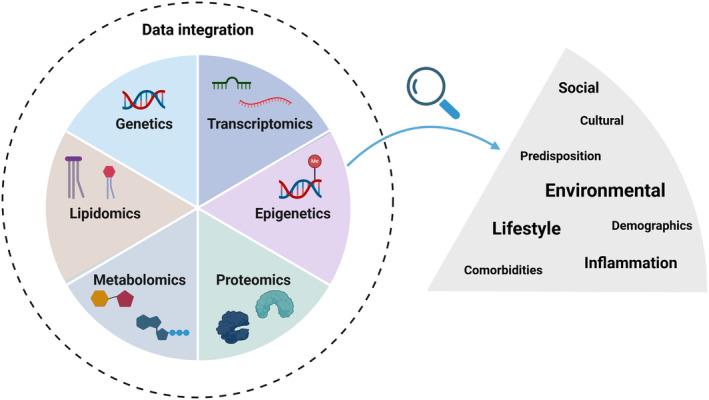
Effective multiomic data integration allows novel interactions to be uncovered and empathises the need for harmonised studies and the incorporation of additional data types, such as co-morbidity, environmental and demographic data to understand DKD complexity. This will facilitate a better understanding of kidney health inequalities, such as social-, ethnicity- and sex-related differences in DKD risk, onset and progression.
CONCLUSION
Multiomics provides opportunities to uncover how lifetime exposures become molecularly embodied to impact kidney health. Such insights would advance DKD diagnosis and treatment, inform preventative strategies and reduce the global impact of this disease.
目的
糖尿病在全球范围内的患病率正在上升,预计2021年至2030年间患病率将上升20%,这将增加并发症的负担,如糖尿病肾病(DKD)。DKD是终末期肾病的主要原因,对患者、家庭和医疗服务提供者都有重大影响。由于疾病无症状、表现不标准或进展情况不佳,以及筛查工具和/或服务不理想,DKD在晚期之前往往未被发现。需要更深入的见解来改善DKD的诊断,以便识别高风险患者。基于疾病预后对患者进行分层的改进工具将有助于优化资源和实现个性化护理。本综述旨在确定多组学方法如何为理解DKD复杂的潜在生物学机制提供机会。
方法
本综述探讨了DKD的多组学分析如何增进我们对DKD病理学的理解,并有助于识别新的生物标志物,以便更早地检测疾病或预测病程。
结果
有效的多组学数据整合能够揭示新的相互作用,并强调需要进行协调一致的研究,纳入其他数据类型,如合并症、环境和人口统计学数据,以了解DKD的复杂性。这将有助于更好地理解肾脏健康不平等现象,例如DKD风险、发病和进展方面的社会、种族和性别差异。
结论
多组学为揭示终生暴露如何在分子层面体现以影响肾脏健康提供了机会。这些见解将推动DKD的诊断和治疗,为预防策略提供信息,并减少这种疾病的全球影响。
 Zotero 插件