Centre Ambulatoire Nantais de Gérontologie Clinique, CANGC, CHU Nantes, Nantes Université, Nantes, F- 44000, France.
Direction de la Recherche et de l'innovation, Plateforme de méthodologie et biostatistique, PMB, CHU Nantes, Nantes Université, Nantes, F-44000, France.
BMC Geriatr. 2024 Oct 26;24(1):879. doi: 10.1186/s12877-024-05488-y.
Encouraging compliance with recommended levels of exercise for older adults is a public health challenge. A minimal-resource solution is telephone coaching.
Primary aim: to compare timed up and go (TUG) performance 6 months after beginning a home exercise program between a group of older individuals who received additional telephone coaching, and a control group performing the home exercise program alone. Secondary aims: to compare functional and fall-related outcomes between groups at 6 and 12 months.
Multicentre, assessor-blinded, randomised, controlled, open label, prospective study. Inclusion criteria included age ≥ 65 years, ≥ 1 fall in the past year, and discharged home from hospital rehabilitation or outpatient physiotherapy. All participants received a home exercise booklet and were asked to perform a set of exercises as often as possible (daily). The coaching group additionally received a monthly telephone call (total 5 calls) from their previous physiotherapist. Primary outcome was TUG performance at 6 months. Outcomes were measured at inclusion, and at 6 and 12 months. The primary outcome was analysed using a linear mixed model adjusted for the baseline value.
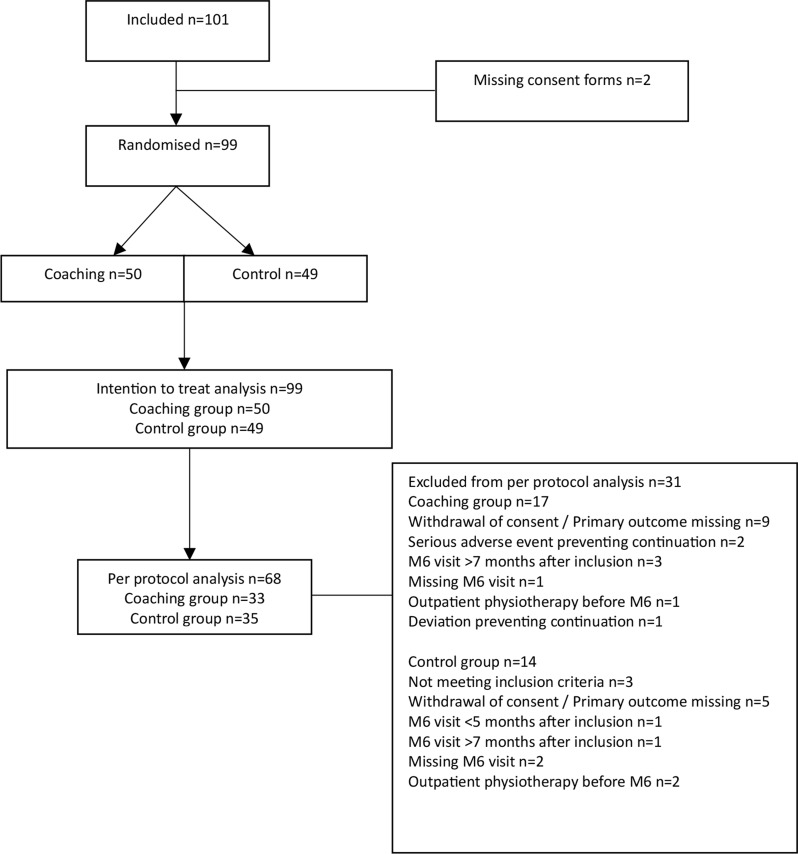
In total, 99 individuals were included (coaching group n = 50, control group, n = 49; mean [SD] age 83.1 [5.8] years and 77% women). TUG performance did not differ between groups at 6 months (adjusted difference 1.37, SE 1.32, 95% CI 1.26 to 4.01, p = 0.30). Secondary outcomes did not differ between groups at 6 or 12 months except compliance to the exercise program was higher in the coaching than the control group at 6 months (adjusted difference 1.0, SE 0.5, 95% CI 0.02 to 2.0, p = 0.05).
The lack of difference between the groups in the time taken to complete the TUG at 6 months suggests that the monthly telephone coaching sessions did not improve the effectiveness of a home exercise programme in elderly people who had suffered at least one fall. The trial was registered on ClinicalTrials.gov (NCT02828826; 11th of july 2016, last modification 16th of September 2024).
鼓励老年人遵循推荐的运动水平是公共卫生面临的挑战。一种资源较少的解决方案是电话辅导。
主要目的:比较开始家庭锻炼计划 6 个月后,接受额外电话辅导的老年组与单独进行家庭锻炼计划的对照组在计时起立行走(TUG)表现上的差异。次要目的:比较两组在 6 个月和 12 个月时的功能和跌倒相关结果。
多中心、评估者盲法、随机、对照、开放标签、前瞻性研究。纳入标准包括年龄≥65 岁、过去一年至少跌倒一次以及从医院康复或门诊物理治疗出院回家。所有参与者都收到了一本家庭锻炼手册,并被要求尽可能经常(每天)进行一组锻炼。辅导组还会收到他们之前的物理治疗师每月一次的电话(共 5 次)。主要结果是 6 个月时的 TUG 表现。结果在纳入时、6 个月和 12 个月时进行测量。主要结果采用线性混合模型进行分析,调整了基线值。
共有 99 人入组(辅导组 n=50,对照组 n=49;平均[SD]年龄 83.1[5.8]岁,77%为女性)。6 个月时,两组 TUG 表现无差异(调整差异 1.37,SE 1.32,95%CI 1.26 至 4.01,p=0.30)。次要结果在 6 个月或 12 个月时两组间无差异,除了 6 个月时辅导组的锻炼计划依从性高于对照组(调整差异 1.0,SE 0.5,95%CI 0.02 至 2.0,p=0.05)。
6 个月时 TUG 完成时间两组间无差异表明,对于至少跌倒一次的老年人,每月电话辅导课程并未提高家庭锻炼计划的效果。该试验在 ClinicalTrials.gov 注册(NCT02828826;2016 年 7 月 11 日,最后修改日期 2024 年 9 月 16 日)。