Department of Oncology, The First Affiliated Hospital of Nanjing Medical University, Nanjing, Jiangsu, China.
Department of Cardiology, Taikang Xianlin Drum Tower Hospital, Affiliated Hospital of Medical School, Nanjing University, Nanjing, China.
Medicine (Baltimore). 2024 Oct 4;103(40):e39967. doi: 10.1097/MD.0000000000039967.
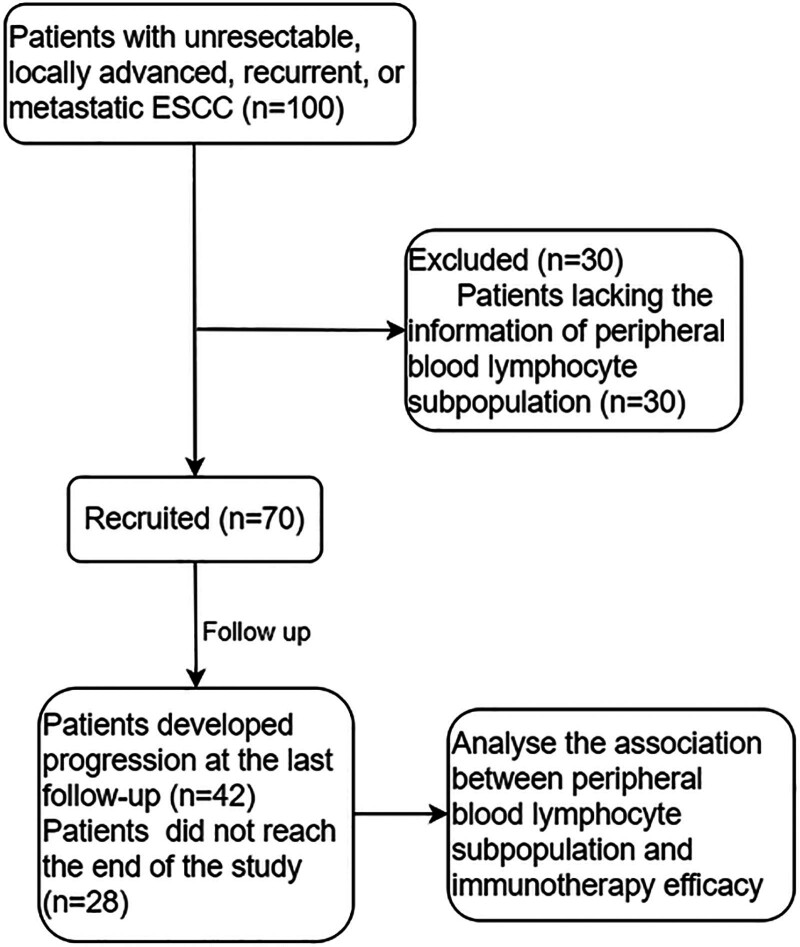
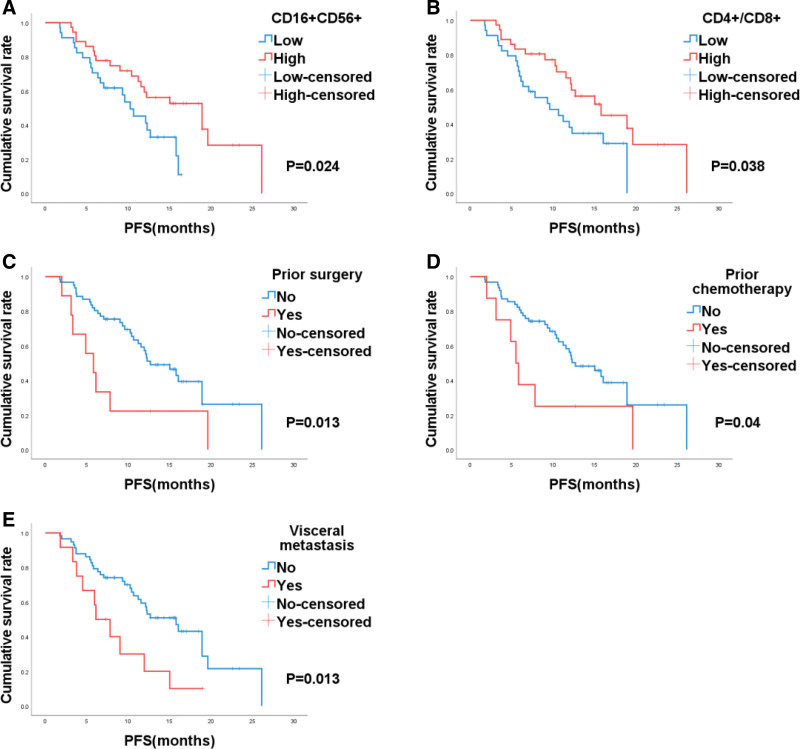
Esophageal cancer (EC) poses a significant global health burden, necessitating effective treatment strategies. Immune checkpoint inhibitors have emerged as a promising therapeutic option for EC, but the identification of predictive biomarkers remains crucial for optimizing patient outcomes. We conducted a retrospective analysis of medical records from advanced esophageal squamous cell carcinoma patients treated with first-line programmed death 1 inhibitors. Peripheral blood lymphocyte subpopulations were evaluated using flow cytometry, while hematological tests provided data on neutrophil, lymphocyte, and monocyte counts. Cox regression and logistic regression analyses were employed to explore the association between lymphocyte subpopulations, baseline characteristics, and progression-free survival (PFS). Among the 100 initially included patients, 70 met eligibility criteria. Multivariate Cox regression analysis revealed a significant association between high CD16+CD56+ lymphocyte proportions and longer PFS, independent of other clinical variables. Similarly, a high CD4+/CD8+ ratio was correlated with prolonged PFS. Kaplan-Meier survival curves supported these findings. Logistic regression analysis indicated no significant differences in the CD4+/CD8+ ratio and CD16+CD56+ lymphocytes concerning baseline characteristics, suggesting their potential as independent prognostic markers. Our study highlights the predictive value of peripheral blood CD16+CD56+ lymphocytes and the CD4+/CD8+ ratio for the efficacy of programmed death 1 inhibitors in advanced esophageal squamous cell carcinoma patients. These findings underscore the importance of peripheral blood biomarkers in guiding personalized immunotherapy strategies and improving outcomes for EC patients.
食管癌(EC)是全球重大的健康负担,需要有效的治疗策略。免疫检查点抑制剂已成为治疗 EC 的一种有前途的治疗选择,但确定预测性生物标志物仍然是优化患者预后的关键。我们对接受一线程序性死亡 1 抑制剂治疗的晚期食管鳞状细胞癌患者的病历进行了回顾性分析。使用流式细胞术评估外周血淋巴细胞亚群,而血液学测试则提供了中性粒细胞、淋巴细胞和单核细胞计数的数据。Cox 回归和逻辑回归分析用于探讨淋巴细胞亚群、基线特征与无进展生存期(PFS)之间的关系。在最初纳入的 100 名患者中,有 70 名符合入选标准。多变量 Cox 回归分析显示,高 CD16+CD56+淋巴细胞比例与更长的 PFS 显著相关,独立于其他临床变量。同样,CD4+/CD8+比值与 PFS 延长相关。Kaplan-Meier 生存曲线支持这些发现。逻辑回归分析表明,CD4+/CD8+比值和 CD16+CD56+淋巴细胞在基线特征方面没有显著差异,这表明它们可能是独立的预后标志物。我们的研究强调了外周血 CD16+CD56+淋巴细胞和 CD4+/CD8+比值对晚期食管鳞状细胞癌患者程序性死亡 1 抑制剂疗效的预测价值。这些发现强调了外周血生物标志物在指导 EC 患者个体化免疫治疗策略和改善预后方面的重要性。