Department of Pharmaceutical Microbiology, Faculty of Pharmacy and Biotechnology, German University in Cairo, New Cairo, 11835, Egypt.
Department of Pharmaceutical Biology, Faculty of Pharmacy and Biotechnology, German University in Cairo, New Cairo, 11835, Egypt.
BMC Complement Med Ther. 2024 Oct 28;24(1):377. doi: 10.1186/s12906-024-04670-4.
Quinic acid (QA), a cyclitol and cyclohexanecarboxylic acid, is a natural product that is present and can be isolated from edible herbals like tea, coffee and several fruits and vegetables. It was previously reported that QA exerted antioxidant and neuroprotective activity against dementia. However, it was not tested for its neuroprotective potential against Huntington's disease (HD). Since aging related disorders are greatly linked to oxidative stress conditions, we focused on testing the oxidative stress resistant activity and protective effect of QA against the development of HD by using the multicellular Caenorhabditis elegans (C. elegans) worm model.
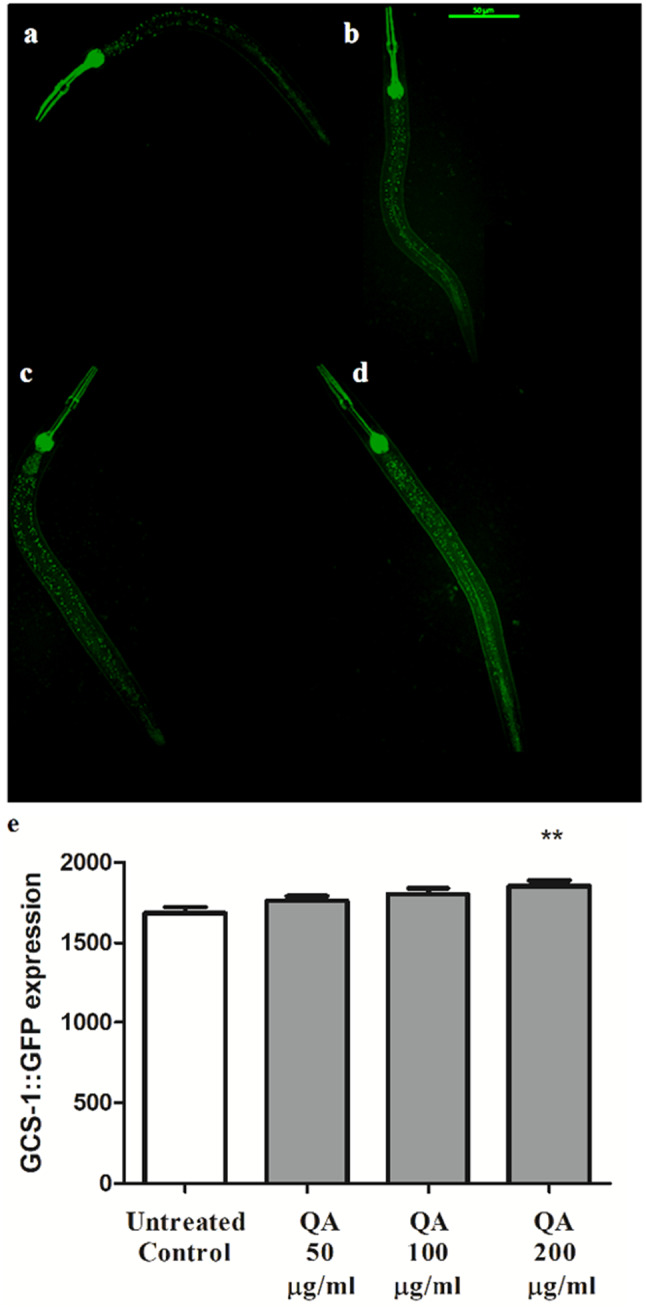
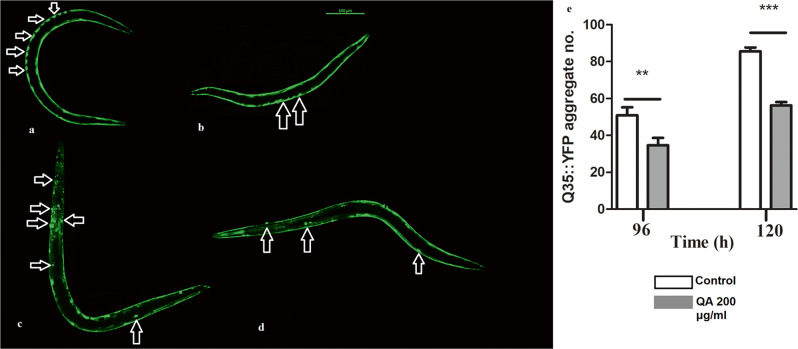
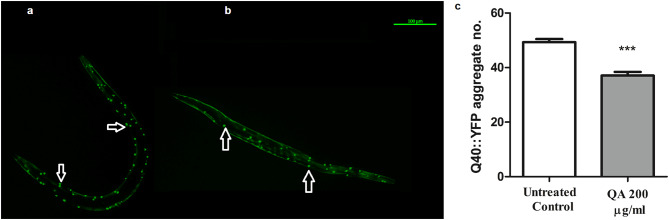
Firstly, QA was tested for its oxidative stress resistant properties. In survival assay, wild type and mutant skn-1 and daf-16 worms were exposed to oxidative stress conditions by using HO. Activation of SKN-1 pathway and expression of its downstream genes gcs-1 and gst-4 were also tested. Secondly, the effect of QA was evaluated on HD by testing its ability to decrease the formation of polyQ150 aggregates. Furthermore, its effect on the accumulation of polyglutamine (polyQ35 and polyQ40 aggregates) was tested.
Here we report that QA could improve the survival of C. elegans after exposure to oxidative stress caused by HO while also exerting antioxidant effects through the activation of SKN-1/Nrf2 pathway. Moreover, QA could be a potential candidate to protect against HD due to its effects on decreasing the formation of polyQ150, polyQ35 and polyQ40 aggregates.
This study highlights the importance of QA as a natural compound in defending against oxidative stress and the development of neurodegenerative diseases like HD.
奎尼酸(QA)是一种环己糖醇和环己烷羧酸,是一种天然产物,存在于茶叶、咖啡和几种水果和蔬菜等可食用草药中,并可从中分离出来。此前有报道称,QA 具有抗氧化和神经保护活性,可对抗痴呆症。然而,它尚未针对亨廷顿病(HD)的神经保护潜力进行测试。由于与衰老相关的疾病与氧化应激状态密切相关,我们专注于使用多细胞秀丽隐杆线虫(C. elegans)蠕虫模型来测试 QA 对 HD 发展的抗氧化应激抵抗活性和保护作用。
首先,测试 QA 的抗氧化应激抵抗特性。在生存试验中,通过使用 HO 使野生型和突变型 skn-1 和 daf-16 蠕虫暴露于氧化应激条件下。还测试了 SKN-1 途径的激活及其下游基因 gcs-1 和 gst-4 的表达。其次,通过测试 QA 降低聚 Q150 聚集物形成的能力来评估其对 HD 的影响。此外,还测试了其对聚谷氨酰胺(polyQ35 和 polyQ40 聚集物)积累的影响。
我们报告称,QA 可以提高 C. elegans 在暴露于 HO 引起的氧化应激后的存活率,同时通过激活 SKN-1/Nrf2 途径发挥抗氧化作用。此外,由于 QA 可以减少聚 Q150、聚 Q35 和聚 Q40 聚集物的形成,因此它可能是预防 HD 的潜在候选药物。
本研究强调了 QA 作为一种天然化合物在防御氧化应激和神经退行性疾病(如 HD)发展中的重要性。