Nakagawa Junichi, Ishido Keinosuke, Kimura Norihisa, Nagase Hayato, Wakasa Yusuke, Yokoyama Satoshi, Ueno Kayo, Hakamada Kenichi, Niioka Takenori
Department of Pharmacy, Hirosaki University Hospital, 53 Hon-Cho, Hirosaki, Aomori, 036-8563, Japan.
Department of Gastroenterological Surgery, Hirosaki University Graduate School of Medicine, 5 Zaifu-cho, Hirosaki, Aomori, 036-8562, Japan.
J Pharm Health Care Sci. 2024 Oct 28;10(1):66. doi: 10.1186/s40780-024-00390-6.
Edoxaban, the only factor Xa inhibitor with active metabolites, is metabolized by carboxylesterase-1 to its main active metabolite, M-4, which is a substrate of organic anion transporting polypeptide 1B1 (OATP1B1) and is excreted in bile and urine. Because the area under the plasma concentration-time curve ratio of M-4 to parent compound is typically less than 10% in healthy subjects, M-4 is generally considered to exhibit negligible antithrombotic activity in patients treated with edoxaban. However, we identified a case in which drug interactions and kidney impairment led to a substantive increase in plasma M-4 concentrations.
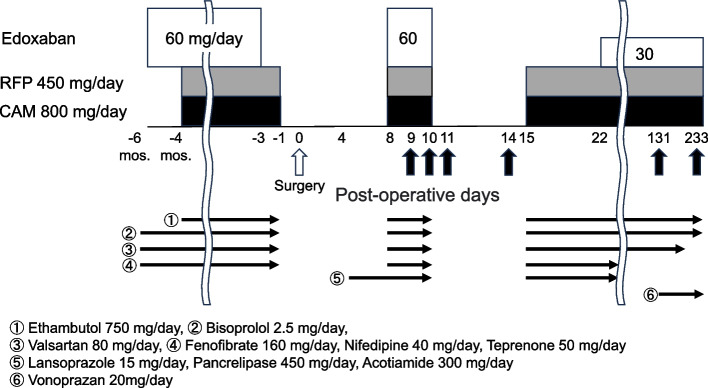
This case report involved a 68-year-old man with pancreatic cancer who was orally administered edoxaban tablets for prevention of thrombus formation in non-valvular atrial fibrillation, in addition to rifampin and clarithromycin (CAM) for treatment of mycobacterium avium complex lung disease. These medications were temporarily discontinued for a pancreaticoduodenectomy but were resumed 8 days post-surgery (POD8). On POD9, the patient developed acute kidney injury, and the trough concentrations of edoxaban and M-4 were 131.1 ng/mL and 115.8 ng/mL, respectively (M-4 ratio: 88.3%). On POD11, the M-4 trough concentration and M-4 ratio increased to 216.2 ng/mL and 186.2%, respectively. The plasma concentration of coproporphyrin-I, an endogenous biomarker of OATP1B1 activity, increased during this period.
This case suggests that in patients with impaired renal function taking edoxaban, co-administration of carboxylesterase-1 inducers such as rifampin and/or OATP1B1 inhibitors such as rifampin or clarithromycin may increase plasma concentrations of M-4 to clinically non-negligible levels.
依度沙班是唯一一种具有活性代谢物的Xa因子抑制剂,由羧酸酯酶-1代谢为其主要活性代谢物M-4,M-4是有机阴离子转运多肽1B1(OATP1B1)的底物,经胆汁和尿液排泄。在健康受试者中,M-4与母体化合物的血浆浓度-时间曲线下面积比通常小于10%,因此一般认为M-4在接受依度沙班治疗的患者中抗血栓活性可忽略不计。然而,我们发现了一例因药物相互作用和肾功能损害导致血浆M-4浓度大幅升高的病例。
本病例报告涉及一名68岁的胰腺癌男性患者,除了使用利福平及克拉霉素(CAM)治疗鸟分枝杆菌复合群肺病外,还口服依度沙班片以预防非瓣膜性心房颤动中的血栓形成。这些药物因胰十二指肠切除术而暂时停用,但在术后第8天(POD8)恢复使用。在POD9时,患者发生急性肾损伤,依度沙班和M-4的谷浓度分别为131.1 ng/mL和115.8 ng/mL(M-4比例:88.3%)。在POD11时,M-4谷浓度和M-4比例分别增至216.2 ng/mL和186.2%。在此期间,OATP1B1活性的内源性生物标志物粪卟啉-I的血浆浓度升高。
该病例表明,在服用依度沙班的肾功能受损患者中,联合使用利福平等羧酸酯酶-1诱导剂和/或利福平或克拉霉素等OATP1B1抑制剂可能会使M-4的血浆浓度升高至临床上不可忽略的水平。