Department of First Clinical Medical College, Shandong University of Traditional Chinese Medicine, Jinan, China.
Qingdao Haici Traditional Chinese Medicine Medical Group North Campus (Qingdao Hongdao People's Hospital), Preventive Medicine Department, Jinan, China.
Medicine (Baltimore). 2024 Oct 25;103(43):e40254. doi: 10.1097/MD.0000000000040254.
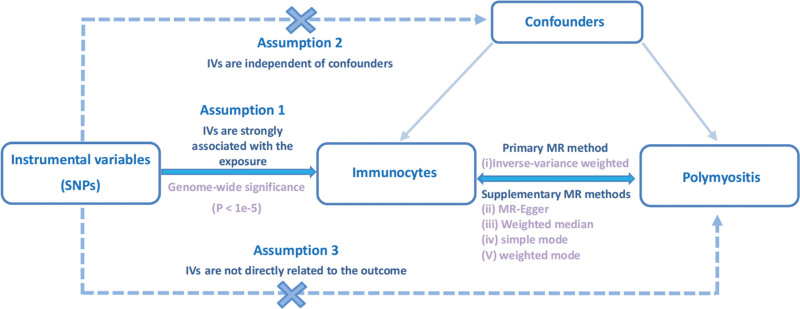
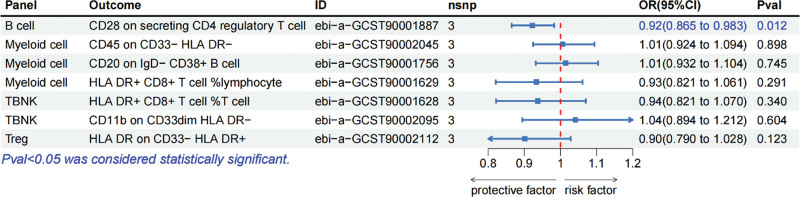
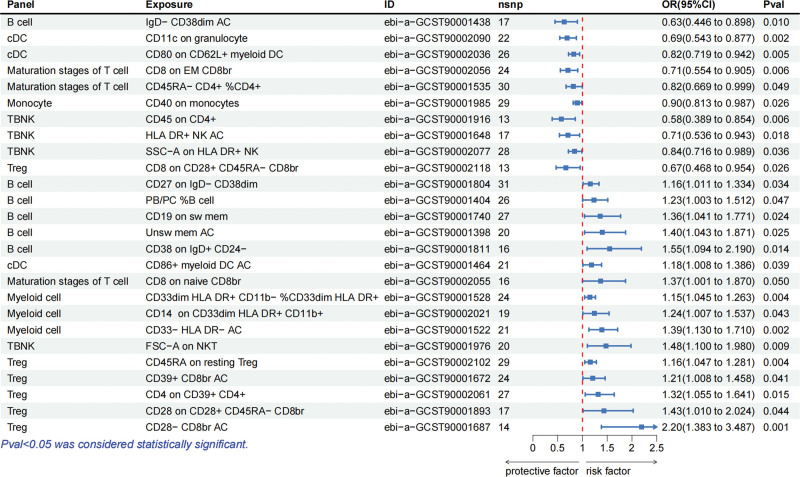
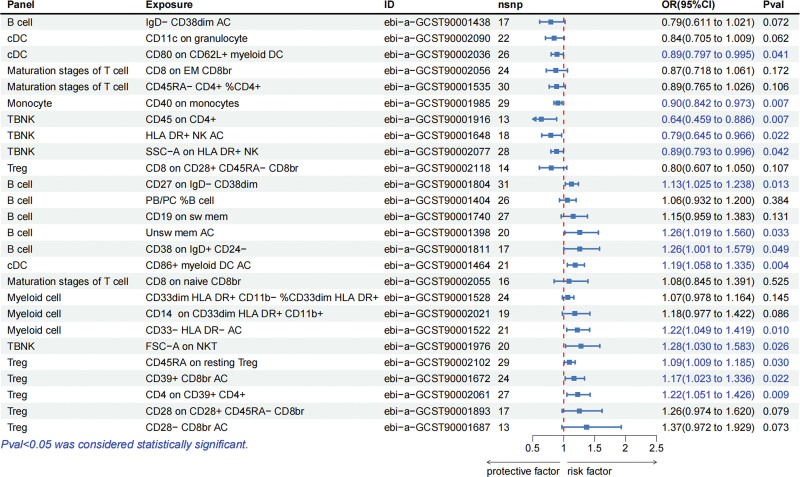
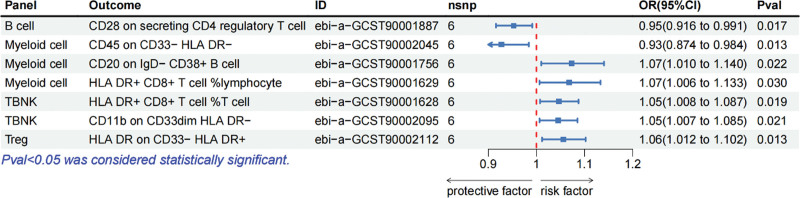
Polymyositis is a prominent subgroup of idiopathic inflammatory myopathy, considered to have an autoimmune etiology. However, research exploring the condition between immunocytes and polymyositis remains limited, indicating the need for further investigation to unravel these intricate associations. We employed bidirectional Mendelian randomization (MR) analysis to ascertain causality between 731 immunocytes and polymyositis. We also compared the positive immunocytes with dermatomyositis. Our primary analytical method was inverse variance weighted, supplemented by 4 other MR techniques. Additionally, Cochran Q test was performed to assess heterogeneity, MR-Egger to appraise pleiotropy, and MR-PRESSO to identify and eliminate potential outliers. Furthermore, the leave-one-out test evaluated the impact of each instrumental variable (IV) on the causal effect. The inverse variance weighted results revealed that 10 immunocytes exert a protective effect against polymyositis (P < .05, OR < 1), while 16 immunocytes are connected with an elevated risk of the disease (P < .05, OR > 1). In reverse MR, polymyositis was found to decrease the levels of 2 immune cells (P < .05, OR < 1) and elevate the expression of 5 immune cell phenotypes (P < .05, OR > 1). A complex correlation was found between polymyositis and the immunocyte phenotypes CD8, CD33dim, HLA-DR, CD11b, and CD45. Additionally, it was discovered that 15 types of immune cells share a causal relationship between polymyositis and dermatomyositis. All analyses demonstrated no heterogeneity or horizontal pleiotropy (P > .05). Our study provides compelling evidence regarding the intricate causal relationships between immunocytes and polymyositis. Polymyositis and dermatomyositis share common immunocytes' regulatory mechanisms. CD8, CD33dim, HLA-DR, CD11b, and CD45 may represent potential immune cell markers for polymyositis. These findings hold implications for planning prognosis and therapeutic strategies for polymyositis, offering novel insights for drug development.
多发性肌炎是特发性炎症性肌病的一个重要亚群,被认为具有自身免疫病因。然而,探索免疫细胞与多发性肌炎之间关系的研究仍然有限,这表明需要进一步研究来揭示这些复杂的关联。我们采用双向孟德尔随机化(MR)分析来确定 731 种免疫细胞与多发性肌炎之间的因果关系。我们还将阳性免疫细胞与皮肌炎进行了比较。我们的主要分析方法是逆方差加权法,同时还使用了其他 4 种 MR 技术。此外,我们还进行了 Cochran Q 检验来评估异质性,MR-Egger 检验来评估偏倚,MR-PRESSO 检验来识别和消除潜在的异常值。此外,留一法检验评估了每个工具变量(IV)对因果效应的影响。逆方差加权结果显示,10 种免疫细胞对多发性肌炎有保护作用(P<0.05,OR<1),而 16 种免疫细胞与多发性肌炎的发病风险增加有关(P<0.05,OR>1)。在反向 MR 中,我们发现多发性肌炎降低了 2 种免疫细胞的水平(P<0.05,OR<1),并增加了 5 种免疫细胞表型的表达(P<0.05,OR>1)。多发性肌炎与免疫细胞表型 CD8、CD33dim、HLA-DR、CD11b 和 CD45 之间存在复杂的相关性。此外,我们还发现 15 种免疫细胞在多发性肌炎和皮肌炎之间存在因果关系。所有分析均未显示异质性或水平性偏倚(P>0.05)。我们的研究提供了有力的证据,证明了免疫细胞与多发性肌炎之间存在复杂的因果关系。多发性肌炎和皮肌炎共享共同的免疫细胞调节机制。CD8、CD33dim、HLA-DR、CD11b 和 CD45 可能是多发性肌炎潜在的免疫细胞标志物。这些发现对多发性肌炎的预后和治疗策略的制定具有重要意义,为药物开发提供了新的思路。