Department of Neurological Surgery, University of Virginia, Box 800212, Charlottesville, VA, 22908, USA.
Department of Neurological Surgery, Hospices Civils de Lyon, Lyon, France.
Sci Rep. 2024 Oct 29;14(1):25933. doi: 10.1038/s41598-024-77140-z.
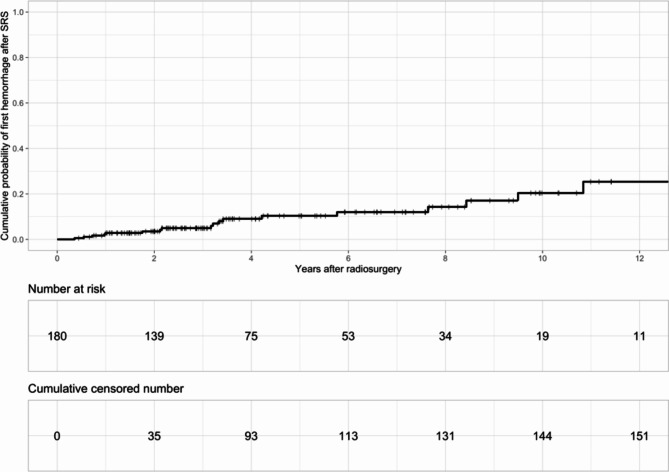
Brainstem cerebral cavernous malformations (CCM) are clinically more aggressive compared to superficial CCMs. Due to their location, resection can be challenging, making stereotactic radiosurgery (SRS) an attractive alternative for symptomatic patient. Brainstem CCM patients (n = 170) were treated with Gamma Knife SRS at 11 radiosurgical centers. Hemorrhagic risk reduction, risk factors of post-SRS hemorrhage, and clinical outcomes were retrospectively analyzed. Most patients had a single (165/170 patients) brainstem CCMs treated; the majority of CCMs (165/181) presented with bleeding. Single-session SRS decreased the risk of repeat hemorrhage in patients with hemorrhagic brainstem CCM (HR: 0.17, p < 0.001) using recurrent multivariate analysis. The annual hemorrhage rate decreased from 14.8 per 100 CCM-years before SRS to 2.3 after treatment. Using univariate Cox-analysis, the probability of a new hemorrhages after SRS was reduced for patient older than 35 years (HR = 0.21, p = 0.002) and increased with a margin dose > 13 Gy (HR = 2.57, p = 0.044). Adverse radiation effect (ARE) occurred in 9 patients (5.3%) and was symptomatic in four (2.4%). At a median follow-up of 3.4 years (Inter-quartile range: 5.4), 13 patients (8.0%) had a worsened clinical status, with the treated CCM being the cause in 5.6% (10) of the patients. Single-session SRS decreased the risk of repeat hemorrhage in patients with hemorrhagic brainstem CCM and conveyed this benefit with a low risk of advrse radiation effects (ARE) and worsening clinical status.
脑干部位的脑内海绵状血管畸形(CCM)比表浅型 CCM 更具侵袭性。由于其位置,手术切除可能具有挑战性,因此立体定向放射外科手术(SRS)成为有症状患者的一种有吸引力的替代选择。170 例脑干部位 CCM 患者在 11 个放射外科中心接受伽玛刀 SRS 治疗。回顾性分析了出血风险降低、SRS 后出血的危险因素和临床结果。大多数患者的脑干部位存在单个 CCM(170 例中有 165 例),165 例 CCM 中有 181 例发生出血。采用复发多变量分析,单次 SRS 可降低出血性脑干部位 CCM 患者再次出血的风险(HR:0.17,p<0.001)。SRS 前每年 CCM 出血率为 14.8/100 CCM 年,治疗后降至 2.3。采用单变量 Cox 分析,SRS 后发生新出血的概率在年龄大于 35 岁的患者中降低(HR=0.21,p=0.002),而在边缘剂量>13 Gy 时增加(HR=2.57,p=0.044)。9 例(5.3%)发生放射性不良反应(ARE),其中 4 例(2.4%)为症状性。中位随访时间为 3.4 年(四分位距:5.4),13 例(8.0%)患者临床状况恶化,其中 5.6%(10 例)患者恶化与治疗 CCM 有关。单次 SRS 可降低出血性脑干部位 CCM 患者再次出血的风险,同时具有低风险的放射性不良反应(ARE)和恶化的临床状况。