Zhao Yan, Song Lina, Zhang Shuxia, Hou Fei, Shan Shan, Jin Hua
Antenatal Diagnostic Center, Jinan Maternity and Child Care Hospital Affiliated Shandong First Medical University (Jinan Maternity and Child Care Hospital), Jinan, Shandong, China.
Department of Obstetrics and Gynecology, Qixia City People's Hospital, Yantai, Shandong, China.
Front Genet. 2024 Oct 15;15:1486974. doi: 10.3389/fgene.2024.1486974. eCollection 2024.
The clinical phenotypes of 16p13.11 microduplication syndrome have been extensively reported in previous studies, mostly about adults and children, with limited information available on fetal cases. This study aims to explore the genotype-phenotype correlation of fetuses with 16p13.11 microduplication syndrome and analyze the characteristics of prenatal diagnosis indications and provide clinical information for prenatal and postnatal genetic counseling.
We conducted a retrospective analysis of 3,451 pregnant women who underwent invasive prenatal diagnosis for SNP array between January 2018 and December 2022 at the Jinan Maternal and Child Health Hospital. Descriptive statistical analysis was performed on the prenatal diagnosis indications, pedigree analysis, pregnancy outcomes and postnatal follow-up of 15 fetuses with 16p13.11 microduplication syndrome.
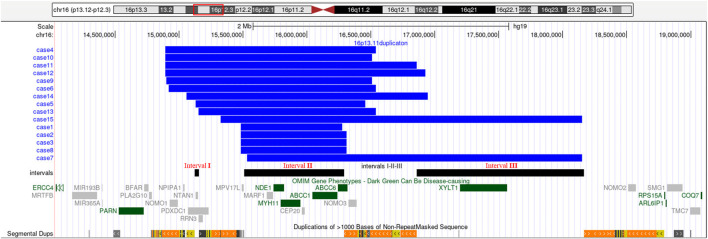
SNP array revealed that 15 fetuses had duplications in the 16p13.11 region with varying prenatal diagnosis indications. Among the cases, 6/15 exhibited ultrasound abnormalities, 5/15 had abnormal chromosomal copy number variations as indicated by non-invasive prenatal testing (NIPT), one case involved advanced maternal age, and 3/15 had other abnormalities. 16p13.11 microduplication syndrome was closely related to ultrasound abnormalities, especially structural abnormalities and soft marker anomalies (abnormal ultrasonic soft indicators), while the indication of NIPT could improve the detection rate of copy number variations (CNVs) in this region. Only 7/15 fetuses underwent pedigree verification, with one case of 16p13.11 microduplication, and the others inherited from one parent. Pregnancy was terminated in 2/15 cases and the outcome of one case is unknown due to loss to follow-up. Among the remaining cases, only one case exhibited a ventricular septal defect, while another presented with omphalocele. No other obvious abnormalities were reported postnatally.
The prenatal phenotypes of fetuses with 16p13.11 microduplication were highly associated with ultrasound abnormalities but lacked specificity. Comprehensive genetic tracing, outcome analysis, and follow-up are essential for providing accurate prenatal and postnatal genetic counseling.
既往研究已广泛报道了16p13.11微重复综合征的临床表型,大多针对成人和儿童,关于胎儿病例的信息有限。本研究旨在探讨16p13.11微重复综合征胎儿的基因型-表型相关性,分析产前诊断指征的特点,并为产前和产后遗传咨询提供临床信息。
我们对2018年1月至2022年12月在济南市妇幼保健院接受单核苷酸多态性阵列(SNP array)侵入性产前诊断的3451例孕妇进行了回顾性分析。对15例16p13.11微重复综合征胎儿的产前诊断指征、系谱分析、妊娠结局及产后随访进行描述性统计分析。
SNP array显示15例胎儿在16p13.11区域存在重复,产前诊断指征各异。其中,6/15表现为超声异常,5/15经无创产前检测(NIPT)提示染色体拷贝数变异异常,1例为高龄产妇,3/15有其他异常。16p13.11微重复综合征与超声异常密切相关,尤其是结构异常和软指标异常(超声软指标异常),而NIPT指征可提高该区域拷贝数变异(CNV)的检出率。15例胎儿中仅7例进行了系谱验证,其中1例为16p13.11微重复,其余均为从父母一方遗传而来。15例中有2例终止妊娠,1例因失访结局未知。其余病例中,仅1例表现为室间隔缺损,另1例为脐膨出。产后未报告其他明显异常。
16p13.11微重复胎儿的产前表型与超声异常高度相关,但缺乏特异性。全面的基因追踪、结局分析和随访对于提供准确的产前和产后遗传咨询至关重要。