Wong Yee Ka, Chan Wai Wai, Gu Dasa, Yu Jian Zhen, Lau Alexis K H
Division of Environment and Sustainability, The Hong Kong University of Science and Technology, Clear Water Bay, Kowloon, Hong Kong 000000, China.
Institute for the Environment, The Hong Kong University of Science and Technology, Clear Water Bay, Kowloon, Hong Kong 000000, China.
Environ Health (Wash). 2024 May 23;2(6):411-421. doi: 10.1021/envhealth.3c00209. eCollection 2024 Jun 21.
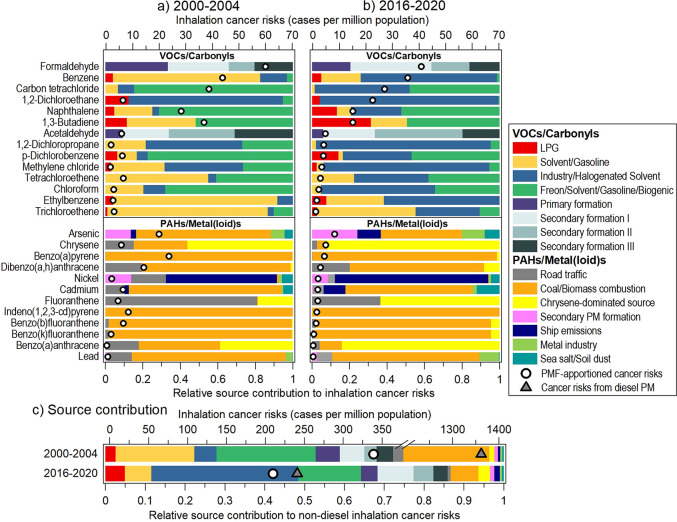
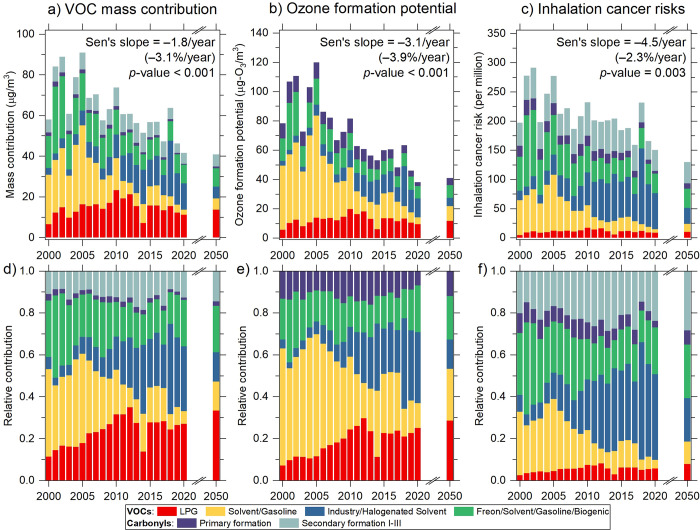
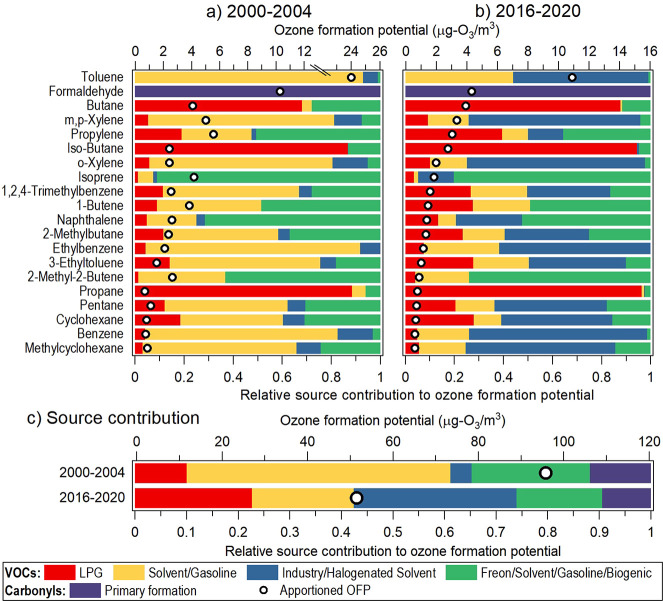
Toxic air pollutants (TAPs) are a class of airborne chemicals known or suspected to cause serious health issues. This study, applying positive matrix factorization and inhalation unit risk estimates of TAPs, quantifies the changes in significant sources contributing to inhalation cancer risks (ICRs) from 2000 to 2020 in Hong Kong, China. Total ICR decreased from 1701 to 451 cases per million between 2000-2004 and 2016-2020, largely attributed to the reduction in diesel particulate matter (DPM), gasoline and solvent use-related volatile organic compounds (VOCs), and coal/biomass combustion-related polycyclic aromatic hydrocarbons and metal(loid)s. The regional contribution of VOCs associated with industrial and halogenated solvent sources increased substantially, representing the largest non-DPM ICR contributor (37%) in 2016-2020, stressing the need for a more comprehensive risk evaluation across the fast-growing and densely populated Greater Bay Area (GBA). ICRs in Hong Kong and the GBA will likely remain over 100 cases per million by 2050. The contributions to ozone formation potential of VOC/carbonyl sources were quantified, which show a notable shift from being solvent/gasoline-dominant in 2000-2004 to being more evenly shared by various sources in 2016-2020. Establishing a similar TAP monitoring network in the GBA is anticipated to provide the monitoring data needed to facilitate the development of more informed air quality management strategies.
有毒空气污染物(TAPs)是一类已知或疑似会引发严重健康问题的空气传播化学物质。本研究运用正矩阵分解法和TAPs的吸入单位风险估计值,对2000年至2020年期间中国香港吸入性癌症风险(ICRs)的主要来源变化进行了量化。2000 - 2004年至2016 - 2020年期间,总ICR从每百万1701例降至451例,这主要归因于柴油颗粒物(DPM)、汽油和溶剂使用相关的挥发性有机化合物(VOCs)以及煤炭/生物质燃烧相关的多环芳烃和金属(类金属)的减少。与工业和卤代溶剂源相关的VOCs的区域贡献大幅增加,在2016 - 2020年成为最大的非DPM ICR贡献源(37%),这凸显了在快速发展且人口密集的大湾区(GBA)进行更全面风险评估的必要性。到2050年,香港和大湾区的ICRs可能仍将超过每百万100例。对VOC/羰基源对臭氧形成潜力的贡献进行了量化,结果显示从2000 - 2004年以溶剂/汽油为主导到2016 - 2020年各来源贡献更为均衡的显著转变。预计在大湾区建立类似的TAP监测网络将提供所需监测数据,以促进制定更明智的空气质量管理策略。