Ji Ye, Wang Junwu
Department of Neurosurgery, Shengjing Hospital of China Medical University, Shenyang, Liaoning, China.
Front Neurol. 2024 Oct 15;15:1406602. doi: 10.3389/fneur.2024.1406602. eCollection 2024.
This study aims to compare the efficacy and long-term prognosis of microvascular decompression (MVD) versus percutaneous balloon compression (PBC) in patients with idiopathic V2 (maxillary branch) trigeminal neuralgia.
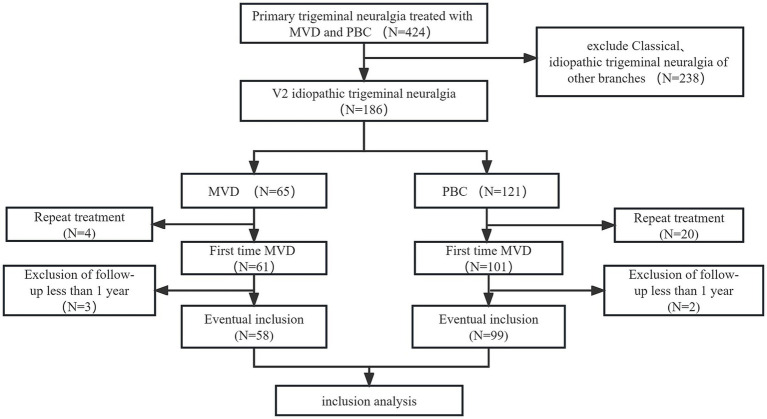
We retrospectively analyzed the clinical information and follow-up data of patients who underwent surgical treatment for V2 idiopathic trigeminal neuralgia from January 2020 to January 2023. A total of 58 patients were included in the MVD group and 99 in the PBC group. All surgeries were performed by two physicians at the same center, with follow-up conducted by a separate, trained researcher. We compared the initial versus 12-month postoperative pain relief rates (scored using the BNI), surgical complications, and described pain relief rates after long-term follow-up in both groups using Kaplan-Meier analysis.
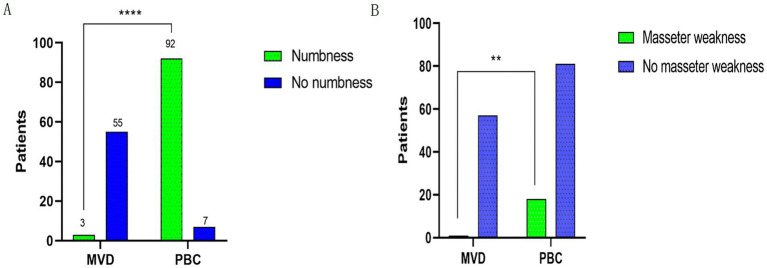
The study included a total of 157 patients (MVD 58, PBC 99). The median age of patients in the MVD group was lower than that in the PBC group (58 [51-65] vs. 63 [58-69], = 0.002). There was no significant difference between the two groups in terms of pain relief rates initially after surgery and at 12 months ( = 0.521, = 0.713). However, the MVD group had significantly better outcomes regarding postoperative facial numbness ( < 0.0001), masticatory weakness ( = 0.0017), and other complications ( = 0.04). Kaplan-Meier analysis showed that MVD provided a longer duration of pain relief than PBC ( = 0.0323), with most recurrences in both groups occurring within 1-2 years after surgery.
There were no significant differences in significant pain relief rates between the two groups initially after surgery and at 12 months. However, the MVD group showed a clear advantage over PBC regarding postoperative facial numbness, masticatory weakness, and other complications; moreover, Kaplan-Meier analysis revealed that MVD offers a longer duration of pain relief for patients.
本研究旨在比较微血管减压术(MVD)与经皮球囊压迫术(PBC)治疗特发性V2(上颌支)三叉神经痛患者的疗效及长期预后。
我们回顾性分析了2020年1月至2023年1月接受V2特发性三叉神经痛手术治疗患者的临床信息和随访数据。MVD组纳入58例患者,PBC组纳入99例患者。所有手术均由同一中心的两名医生进行,由另一名经过培训的研究人员进行随访。我们比较了术后初始与12个月时的疼痛缓解率(使用BNI评分)、手术并发症,并使用Kaplan-Meier分析描述了两组长期随访后的疼痛缓解率。
该研究共纳入157例患者(MVD组58例,PBC组99例)。MVD组患者的中位年龄低于PBC组(58[51 - 65]岁 vs. 63[58 - 69]岁,P = 0.002)。两组术后初始及12个月时的疼痛缓解率无显著差异(P = 0.521,P = 0.713)。然而,MVD组在术后面部麻木(P < 0.0001)、咀嚼肌无力(P = 0.0017)及其他并发症(P = 0.04)方面的结局明显更好。Kaplan-Meier分析显示,MVD的疼痛缓解持续时间比PBC长(P = 0.0323),两组大多数复发发生在术后1 - 2年内。
两组术后初始及12个月时的显著疼痛缓解率无显著差异。然而,MVD组在术后面部麻木、咀嚼肌无力及其他并发症方面比PBC组具有明显优势;此外,Kaplan-Meier分析显示,MVD为患者提供了更长的疼痛缓解持续时间。