Health System and Reproductive Health Research Directorate, Ethiopian Public Health Institute, Addis Ababa, Ethiopia.
Department of Health Policy and Management, Institute of Health, Jimma University, Jimma, Ethiopia.
J Glob Health. 2024 Nov 1;14:04243. doi: 10.7189/jogh.14.04243.
Despite the increasing number of primary studies on the quality of health care for sick children in Ethiopia, the findings have not been systematically synthesised to inform quality improvement in policies or strategies. This systematic review provides a narrative synthesis of published evidence on the quality of care provided to sick children in Ethiopia's health facilities and on related barriers and enablers.
We searched studies that measured the structure, process, and outcome measures of quality of care as proposed by Donabedian's framework. We searched in PubMed/Medline, EMBASE, and Web of Science using the Population, Concept, and Context (PCC) framework. Grey literature was searched in Google Scholar and institutional websites. We appraised the studies' quality using the Mixed Method Quality Appraisal Tool version 2018. Data were analysed using content thematic analysis and presented using a narrative approach.
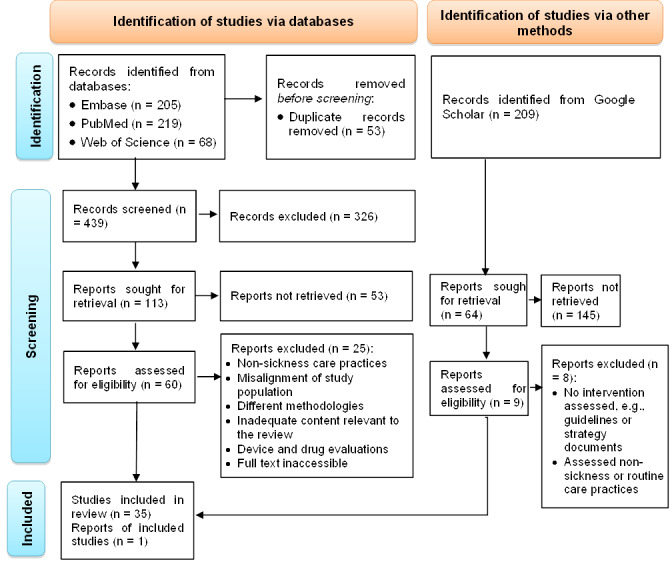
We included 36 of 701 studies. Thirty (83.3%) were nonexperimental including 21 (70%) cross-sectional studies and five (16.7%) qualitative studies. Of the 31 facility-based studies, 29 (93.5%) were conducted in public facilities. The structural, technical, and interpersonal processes of care were low quality. While some studies reported the effectiveness of interventions in reducing child mortality, the uptake of services and providers' and caretakers' experiences were suboptimal. The major structural barriers to providing quality care included inadequacy of essential drugs, supplies and equipment, training, clinical guidelines, and ambulance services. Caretakers' non-compliance to referral advice was a common demand-side barrier. The enabling factors were implementing various health system strengthening interventions including quality improvement strategies such as user-centred service delivery and optimising engagement of community-level structures such as health promotors and religious leaders to create demand.
The quality of care provided to sick children in health facilities is generally low in Ethiopia. Shortages of essential drugs, supplies and equipment, physical space, water, and electricity; and human resource-related challenges such as shortage, training, supervision, and retention were common structural barriers. Various health systems strengthening and quality improvement interventions, ranging from enhanced demand creation to realising a reliable and consumer-centred service delivery were key enablers. More research is needed on the quality of care provided in private facilities.
PROSPERO: CRD42021285064.
尽管埃塞俄比亚针对儿童疾病的医疗保健质量进行了越来越多的初级研究,但这些研究结果尚未进行系统综合,以告知政策或战略的质量改进。本系统评价对埃塞俄比亚卫生机构中提供给患病儿童的护理质量以及相关障碍和促进因素的已发表证据进行了叙述性综合。
我们按照 Donabedian 框架中提出的结构、过程和结果措施,对研究进行了检索。我们使用人群、概念和背景(PCC)框架在 PubMed/Medline、EMBASE 和 Web of Science 中进行了检索。在 Google Scholar 和机构网站中对灰色文献进行了检索。我们使用混合方法质量评估工具 2018 版对研究质量进行了评估。使用内容主题分析对数据进行分析,并采用叙述性方法进行呈现。
我们纳入了 701 项研究中的 36 项。其中 30 项(83.3%)为非实验性研究,包括 21 项(70%)横断面研究和 5 项(16.7%)定性研究。在 31 项基于机构的研究中,29 项(93.5%)在公立机构进行。护理的结构、技术和人际过程质量较差。虽然一些研究报告了干预措施在降低儿童死亡率方面的有效性,但服务的利用率和提供者及照护者的经验并不理想。提供优质护理的主要结构性障碍包括基本药物、用品和设备、培训、临床指南和救护车服务不足。照护者不遵守转诊建议是常见的需求方障碍。促进因素包括实施各种卫生系统强化干预措施,包括以用户为中心的服务提供以及优化社区一级结构(如健康促进者和宗教领袖)的参与以创造需求等质量改进策略。
埃塞俄比亚卫生机构中为患病儿童提供的护理质量普遍较低。基本药物、用品和设备、物理空间、水和电以及人力资源相关挑战(如短缺、培训、监督和留用)等短缺现象普遍存在。各种卫生系统强化和质量改进干预措施,从增强需求创造到实现可靠和以用户为中心的服务提供,是关键的促进因素。需要进一步研究私营机构提供的护理质量。
PROSPERO:CRD42021285064。