Department of Anesthesiology and Critical Care, University of Pennsylvania Perelman School of Medicine, Philadelphia.
Center for Perioperative Outcomes Research and Transformation, University of Pennsylvania Perelman School of Medicine, Philadelphia.
JAMA Netw Open. 2024 Oct 1;7(10):e2442207. doi: 10.1001/jamanetworkopen.2024.42207.
Despite guidelines recommending avoidance of benzodiazepine administration to older patients, many of them now receive benzodiazepines as a part of anesthesia care. The effectiveness of clinician- and patient-facing interventions to discourage such use remains insufficiently characterized.
To evaluate the effect of clinician peer comparison, patient informational mail, or a combination of these interventions compared with usual care on the rate of perioperative benzodiazepine administration to older patients.
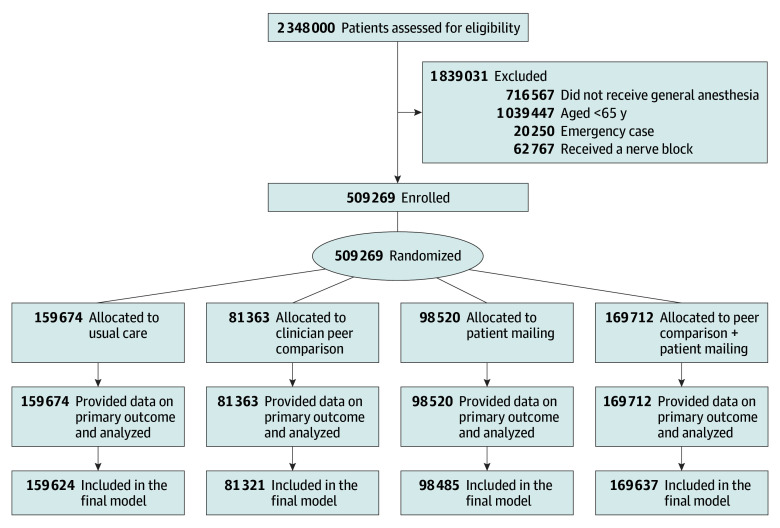
DESIGN, SETTING, AND PARTICIPANTS: This 2 × 2 factorial, stepped-wedge, cluster randomized clinical trial of a corporate quality improvement initiative was conducted between August 8, 2022, and May 28, 2023, across 415 hospitals, surgery centers, and physician offices in 8 US states served by anesthesia clinicians from a national anesthesia practice. Participants were adults aged 65 years or older who underwent an elective surgical or endoscopic procedure with general anesthesia. Data analyses followed the intention-to-treat principle.
Patients were randomly assigned to 1 of 4 groups-clinician peer comparison (wherein clinicians received feedback regarding their performance compared with other clinicians in the practice), patient informational mail (wherein patients received an informational letter encouraging them to have a discussion regarding medication selection with their clinician on the day of surgery), both interventions, or usual care (no intervention).
Rate of benzodiazepine administration during anesthesia care and patient satisfaction with anesthesia care (measured by the Anesthesia Patient Satisfaction Questionnaire, version 2).
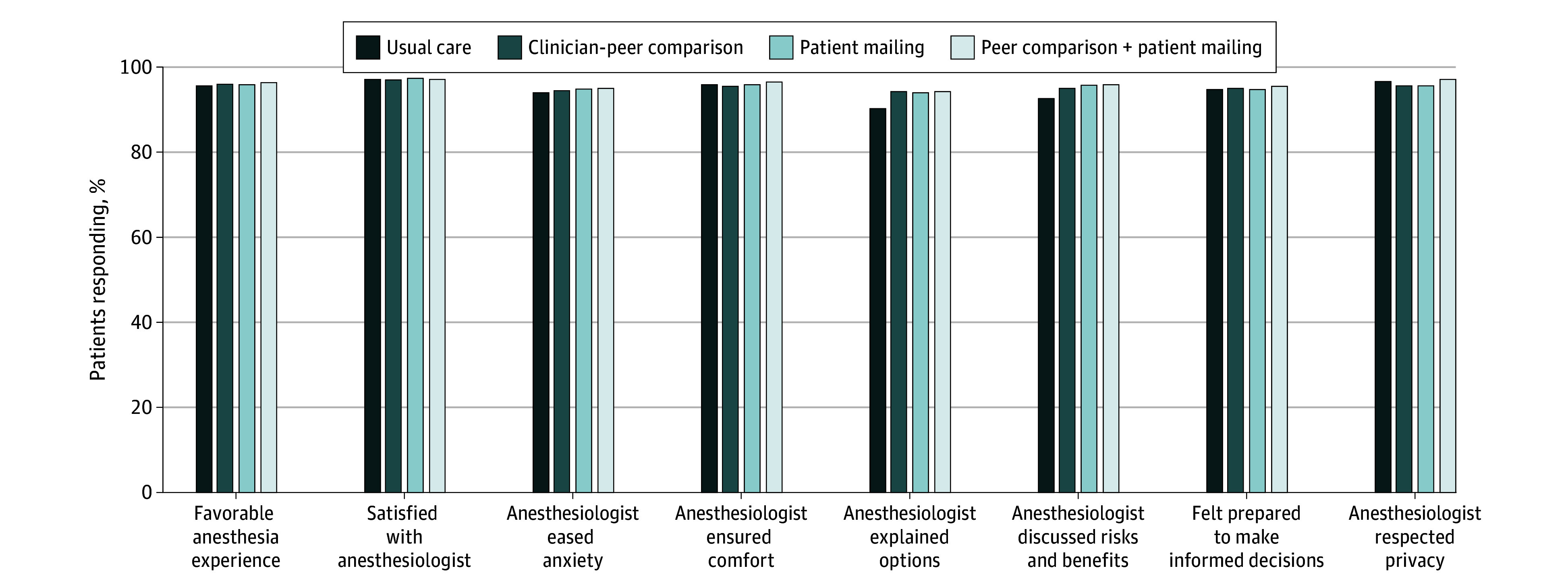
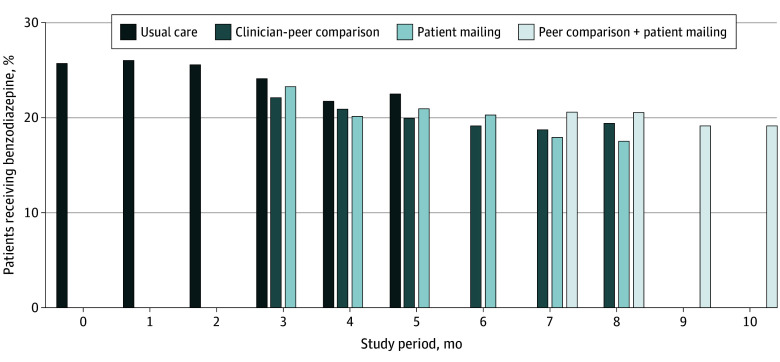
Among the 509 269 enrolled participants (255 871 females [50.2%]; mean [SD] age, 74 [7] years), 81 363 (16.0%) were assigned to clinician peer comparison, 98 520 (19.3%) to patient informational mail, 169 712 (33.3%) to both interventions, and 159 674 (31.4%) to usual care. Among patients who received benzodiazepine during anesthesia care, 24.5% were in the usual care group compared with 19.7% in the clinician peer comparison group, 20.0% in the patient informational mail group, and 19.7% in the combination group. After adjustment for time, none of the study interventions were associated with lower odds of benzodiazepine administration compared with usual care (odds ratio [OR], 1.02 [95% CI, 0.98-1.07]; P = .35 for clinician peer comparison; OR, 1.01 [95% CI, 0.96-1.05]; P = .81 for patient informational mail; and OR, 1.11 [95% CI, 1.05-1.16]; P < .001 for combined interventions). Satisfaction scores were high in all groups and did not vary by treatment assignment.
This randomized clinical trial found that clinician peer comparison, patient informational mail, or a combination of both interventions did not reduce benzodiazepine administration to older patients compared with usual care; patient satisfaction remained high throughout the study. Overall, the findings suggest a need to explore other patient-targeted interventions to improve anesthesia care.
Clinicaltrials.gov Identifier: NCT05436392.
尽管指南建议避免为老年患者开具苯二氮䓬类药物,但现在许多患者在接受麻醉护理时仍会使用苯二氮䓬类药物。为了减少这种使用,临床医生和患者都采取了干预措施,但这些干预措施的效果仍未得到充分描述。
评估与常规护理相比,临床医生同行比较、患者信息邮件或这两种干预措施的组合对老年患者围手术期使用苯二氮䓬类药物的比率的影响。
设计、地点和参与者:这是一项由全国麻醉实践的麻醉医生参与的公司质量改进计划的 2×2 析因、逐步楔形、群组随机临床试验,于 2022 年 8 月 8 日至 2023 年 5 月 28 日在 8 个美国州的 415 家医院、手术中心和医生办公室进行。参与者为年龄在 65 岁或以上、接受全身麻醉的择期手术或内镜检查的成年人。数据分析遵循意向治疗原则。
患者被随机分配到 4 个组中的 1 个组-临床医生同行比较(其中临床医生收到关于其在实践中与其他临床医生的表现比较的反馈)、患者信息邮件(其中患者收到一封鼓励他们在手术当天与临床医生讨论药物选择的信息信)、两者的组合或常规护理(无干预)。
麻醉护理期间苯二氮䓬类药物的使用率和患者对麻醉护理的满意度(通过麻醉患者满意度问卷第 2 版衡量)。
在 509269 名登记参与者中(255871 名女性[50.2%];平均[标准差]年龄为 74[7]岁),81363 名(16.0%)被分配到临床医生同行比较组,98520 名(19.3%)到患者信息邮件组,169712 名(33.3%)到两者的组合组,159674 名(31.4%)到常规护理组。在接受苯二氮䓬类药物麻醉护理的患者中,24.5%在常规护理组,19.7%在临床医生同行比较组,20.0%在患者信息邮件组,19.7%在联合组。调整时间后,与常规护理相比,研究中的任何干预措施均与较低的苯二氮䓬类药物使用率无关(比值比[OR],1.02[95%CI,0.98-1.07];P=0.35 对于临床医生同行比较;OR,1.01[95%CI,0.96-1.05];P=0.81 对于患者信息邮件;和 OR,1.11[95%CI,1.05-1.16];P<0.001 对于联合干预)。在所有组中,满意度评分均较高,且不因治疗分配而异。
这项随机临床试验发现,与常规护理相比,临床医生同行比较、患者信息邮件或两者的组合并不能减少老年患者使用苯二氮䓬类药物;患者满意度在整个研究中保持较高水平。总体而言,研究结果表明需要探索其他以患者为中心的干预措施来改善麻醉护理。
Clinicaltrials.gov 标识符:NCT05436392。