Ravi Katherine Scovner, Tumlin James A, Roy-Chaudhury Prabir, Koplan Bruce A, Costea Alexandru I, Kher Vijay, Williamson Don, McClure Candace K, Charytan David M, Mc Causland Finnian R
Renal Division, Department of Medicine, Brigham and Women's Hospital, Boston, Massachusetts.
Harvard Medical School, Boston, Massachusetts.
Kidney360. 2024 Oct 1;5(10):1490-1499. doi: 10.34067/KID.0000000000000537. Epub 2024 Aug 6.
Sudden death accounts for approximately 25% of deaths among maintenance hemodialysis patients, occurring more frequently on hemodialysis days. Higher dialysate bicarbonate (DBIC) may predispose to alkalemia and arrhythmogenesis.
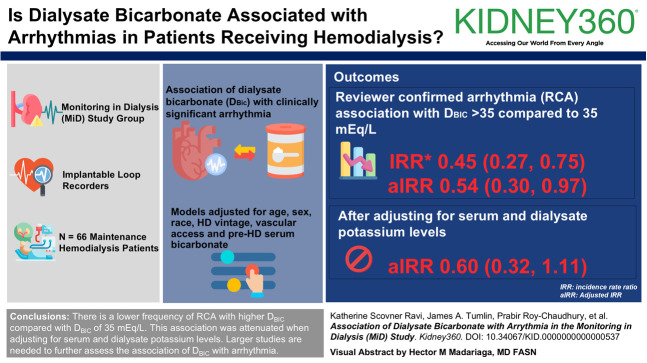
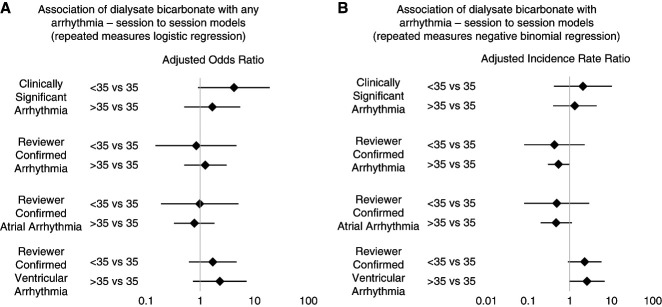
We conducted a 12-month analysis of session-level data from 66 patients with implantable loop recorders. We fit logistic regression and negative binomial mixed-effects regression models to assess the association of DBIC with clinically significant arrhythmia (ventricular tachycardia ≥115 beats per minute [BPM] for at least 30 seconds, bradycardia ≤40 BPM for at least 6 seconds, or asystole for at least 3 seconds) and reviewer confirmed arrhythmia (RCA—implantable loop recorder-identified or patient-marked event for which a manual review of the stored electrocardiogram tracing confirmed the presence of atrial fibrillation, supraventricular tachycardia, sinus tachycardia with rate >130 BPM, ventricular tachycardia, asystole, or bradycardia). Models adjusted for age, sex, race, hemodialysis vintage, vascular access, and prehemodialysis serum bicarbonate and additionally for serum and dialysate potassium levels.
The mean age was 56±12 years, 70% were male, 53% were Black, and 35% were Asian. Fewer RCA episodes were associated with DBIC >35 than 35 mEq/L (incidence rate ratio 0.45 [0.27 to 0.75] and adjusted incident rate ratio 0.54 [0.30 to 0.97]), but the association was not significant when adjusting for serum and dialysate potassium levels (adjusted incident rate ratio, 0.60 [0.32 to 1.11]). Otherwise, no associations between DBIC and arrhythmia were identified.
We observed a lower frequency of RCA with higher DBIC, compared with DBIC of 35 mEql/L, contrary to our original hypothesis, but this association was attenuated in fully adjusted models. Validation of these findings in larger studies is required, with a further need for interventional studies to explore the optimal DBIC concentration.
猝死约占维持性血液透析患者死亡人数的25%,在血液透析日更频繁发生。较高的透析液碳酸氢盐(DBIC)可能易导致碱血症和心律失常的发生。
我们对66例植入式环路记录器患者的单次透析数据进行了为期12个月的分析。我们拟合了逻辑回归和负二项混合效应回归模型,以评估DBIC与具有临床意义的心律失常(室性心动过速≥115次/分钟[BPM]至少30秒、心动过缓≤40 BPM至少6秒或心脏停搏至少3秒)以及经审查确认的心律失常(RCA——植入式环路记录器识别或患者标记的事件,对存储的心电图描记图进行人工审查确认存在房颤、室上性心动过速、心率>130 BPM的窦性心动过速、室性心动过速、心脏停搏或心动过缓)之间的关联。模型对年龄、性别、种族、血液透析年限、血管通路、透析前血清碳酸氢盐进行了校正,另外还对血清和透析液钾水平进行了校正。
平均年龄为56±12岁,70%为男性,53%为黑人,35%为亚洲人。与DBIC≤35 mEq/L相比,DBIC>35 mEq/L时RCA发作较少(发病率比0.45[0.27至0.75],校正发病率比0.54[0.30至0.97]),但在校正血清和透析液钾水平后,该关联不显著(校正发病率比0.60[0.32至1.11])。否则,未发现DBIC与心律失常之间存在关联。
与35 mEq/L的DBIC相比,我们观察到较高DBIC时RCA的发生率较低,这与我们最初的假设相反,但在完全校正的模型中这种关联减弱。需要在更大规模的研究中验证这些发现,并且进一步需要进行干预性研究以探索最佳的DBIC浓度。