Lee Su Jeong, Kim Ju Ang, Ihn Hye Jung, Choi Je-Yong, Kwon Tae-Yub, Shin Hong-In, Cho Eui-Sic, Bae Yong Chul, Jiang Rulang, Kim Jung-Eun, Park Eui Kyun
Department of Oral Pathology and Regenerative Medicine, School of Dentistry, Institute for Hard Tissue and Bio‑tooth Regeneration (IHBR), Kyungpook National University, Daegu, Republic of Korea.
Cell and Matrix Research Institute, Kyungpook National University, Daegu, Republic of Korea.
Exp Mol Med. 2024 Nov;56(11):2436-2448. doi: 10.1038/s12276-024-01341-9. Epub 2024 Nov 1.
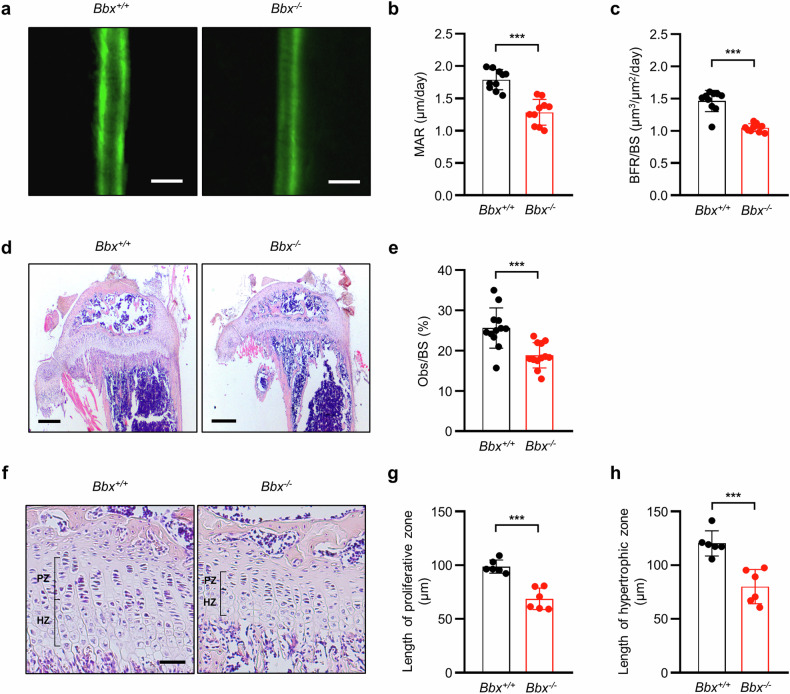
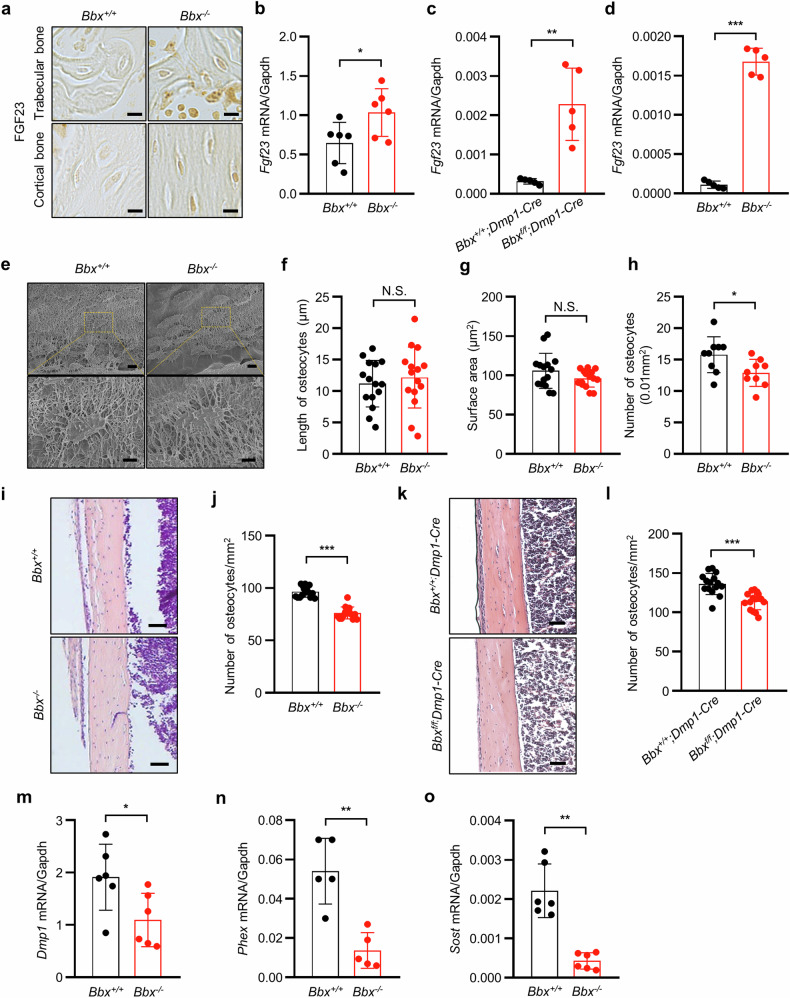
Fibroblast growth factor 23 (FGF23) plays an important role in phosphate homeostasis, and increased FGF23 levels result in hypophosphatemia; however, the molecular mechanism underlying increased FGF23 expression has not been fully elucidated. In this study, we found that mice lacking the bobby sox homolog (Bbx) presented increased FGF23 expression and low phosphate levels in the serum and skeletal abnormalities such as a low bone mineral density (BMD) and bone volume (BV), as well as short and weak bones associated with low bone formation. Osteocyte-specific deletion of Bbx using Dmp-1-Cre resulted in similar skeletal abnormalities, elevated serum FGF23 levels, and reduced serum phosphate levels. In Bbx mice, the expression of sodium phosphate cotransporter 2a (Npt2a) and Npt2c in the kidney and Npt2b in the small intestine, which are negatively regulated by FGF23, was downregulated, leading to phosphate excretion/wasting and malabsorption. An in vitro Fgf23 promoter analysis revealed that 1,25-dihydroxyvitamin D (1,25(OH)D)-induced transactivation of the Fgf23 promoter was significantly inhibited by BBX overexpression, whereas it was increased following Bbx knockdown. Interestingly, 1,25(OH)D induced an interaction of the 1,25(OH)D receptor (VDR) with BBX and downregulated BBX protein levels. Cycloheximide (CHX) only partially downregulated BBX protein levels, indicating that 1,25(OH)D regulates BBX protein stability. Furthermore, the ubiquitination of BBX followed by proteasomal degradation was required for the increase in Fgf23 expression induced by 1,25(OH)D. Collectively, our data demonstrate that BBX negatively regulates Fgf23 expression, and consequently, the ubiquitin-dependent proteasomal degradation of BBX is required for FGF23 expression, thereby regulating phosphate homeostasis and bone development in mice.
成纤维细胞生长因子23(FGF23)在磷酸盐稳态中起重要作用,FGF23水平升高会导致低磷血症;然而,FGF23表达增加背后的分子机制尚未完全阐明。在本研究中,我们发现缺乏芭比袜同源物(Bbx)的小鼠FGF23表达增加,血清磷酸盐水平降低,且存在骨骼异常,如低骨矿物质密度(BMD)和骨体积(BV),以及与低骨形成相关的短小脆弱骨骼。使用Dmp-1-Cre进行骨细胞特异性敲除Bbx导致了类似的骨骼异常、血清FGF23水平升高和血清磷酸盐水平降低。在Bbx基因敲除小鼠中,受FGF23负调控的肾脏中的磷酸钠共转运蛋白2a(Npt2a)和Npt2c以及小肠中的Npt2b的表达下调,导致磷酸盐排泄/流失和吸收不良。体外Fgf23启动子分析显示,1,25-二羟基维生素D(1,25(OH)D)诱导的Fgf23启动子反式激活被BBX过表达显著抑制,而在Bbx基因敲低后则增强。有趣的是,1,25(OH)D诱导1,25(OH)D受体(VDR)与BBX相互作用并下调BBX蛋白水平。环己酰亚胺(CHX)仅部分下调BBX蛋白水平,表明1,25(OH)D调节BBX蛋白稳定性。此外,1,25(OH)D诱导的Fgf23表达增加需要BBX的泛素化随后经蛋白酶体降解。总的来说,我们的数据表明BBX负调控Fgf23表达,因此,BBX的泛素依赖性蛋白酶体降解是FGF23表达所必需的,从而调节小鼠的磷酸盐稳态和骨骼发育。