Hill Michael C, Legg Kaitlyn, Ardati Amer, Groo Vicki
Division of Cardiology, Department of Medicine, University of Illinois Chicago College of Medicine, Chicago, IL, USA.
Department of Pharmacy, University of Maryland Medical Center, USA.
Int J Cardiol Heart Vasc. 2024 Oct 15;55:101535. doi: 10.1016/j.ijcha.2024.101535. eCollection 2024 Dec.
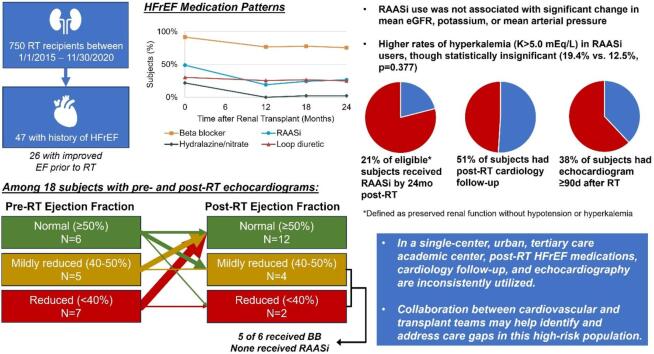
The role of medical therapy for heart failure with reduced ejection fraction (HFrEF) in subjects with end-stage renal disease receiving renal transplantation (RT) is understudied. Here, we describe post-RT HFrEF medical management practices at a single urban, academic tertiary care center.
RT recipients between January 1, 2015 and November 30, 2020 with history of ejection fraction (EF) <40 % prior to RT were included. Medications, renal function, blood pressure, cardiology follow-up, and echocardiograms ≥90d post-RT were retrospectively collected for 2 years post-RT.
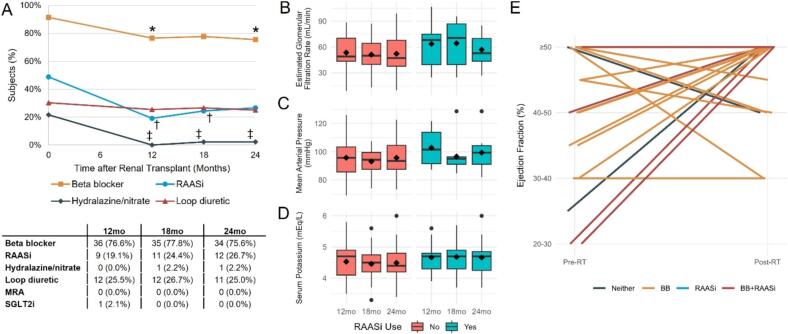
47/750 (6.3 %) of RT recipients had prior HFrEF diagnosis, of whom 26 experienced improvement in EF prior to RT. Pre-RT medical therapy included beta blocker (BB) in 43 (92 %) of subjects and renin-angiotensin-aldosterone inhibitors (RAASi) in 23 (49 %). By 24 months post-RT, BB were used in 34 (76 %) and RAASi were used in 12 (27 %) of subjects. Rates of post-RT cardiology follow-up (51 %) and echocardiogram (38 %) were lower than expected in this cohort. Of 29 subjects potentially eligible for RAASi based on preserved renal function and no hyperkalemia or hypotension episodes during follow-up, only 6 (21 %) received RAASi. Of 6 subjects with post-RT EF <50 %, 4 were eligible but did not receive RAASi. Multidisciplinary collaboration between cardiology and transplant teams may help improve care for this high-risk patient population.
射血分数降低的心力衰竭(HFrEF)在接受肾移植(RT)的终末期肾病患者中的药物治疗作用研究不足。在此,我们描述了一家城市学术三级医疗中心肾移植后HFrEF的药物管理实践。
纳入2015年1月1日至2020年11月30日期间接受肾移植且肾移植前射血分数(EF)<40%的患者。回顾性收集肾移植后2年的药物使用情况、肾功能、血压、心脏科随访情况以及肾移植后≥90天的超声心动图检查结果。
47/750(6.3%)的肾移植受者曾被诊断为HFrEF,其中26例在肾移植前EF有所改善。肾移植前的药物治疗包括43例(92%)患者使用β受体阻滞剂(BB),23例(49%)患者使用肾素 - 血管紧张素 - 醛固酮抑制剂(RAASi)。到肾移植后24个月时,34例(76%)患者使用BB,12例(27%)患者使用RAASi。该队列中肾移植后心脏科随访率(51%)和超声心动图检查率(38%)低于预期。在29例根据肾功能保留且随访期间无高钾血症或低血压发作可能适合使用RAASi的患者中,只有6例(21%)接受了RAASi。在6例肾移植后EF<50%的患者中,4例符合条件但未接受RAASi。心脏科和移植团队之间的多学科协作可能有助于改善对这一高危患者群体的护理。