Zeuchner Jakob, Elander Louise, Frisk Jessica, Chew Michelle S
Department of Anaesthesia and Intensive Care in Norrköping, Norrköping, Sweden.
Department of Biomedical and Clinical Sciences, Linköping University, Linköping, Sweden.
BJA Open. 2024 Oct 14;12:100345. doi: 10.1016/j.bjao.2024.100345. eCollection 2024 Dec.
Postoperative acute kidney injury is a common occurrence among patients undergoing major abdominal surgery and is associated with adverse outcomes. The effect of an incremental increase in serum creatinine concentration not meeting the KDIGO criteria for acute kidney injury is poorly studied. We evaluated the incidence and trajectories of postoperative subclinical acute kidney injury (sPO-AKI), acute kidney injury (PO-AKI), acute kidney disease (PO-AKD), and their relationships with chronic kidney disease (CKD), major adverse kidney events (MAKE30), and all-cause mortality at 30 days after surgery.
In a pre-planned, nested cohort sub study of the Myocardial Injury in Noncardiac Surgery in Sweden (MINSS) study, we included 588 patients from two hospitals. We determined the incidence of PO-AKI, PO-AKD, and CKD according to the ADQI-POQI consensus criteria. sPO-AKI was defined as a 25-49% increase in serum creatinine concentration within 7 days of surgery.
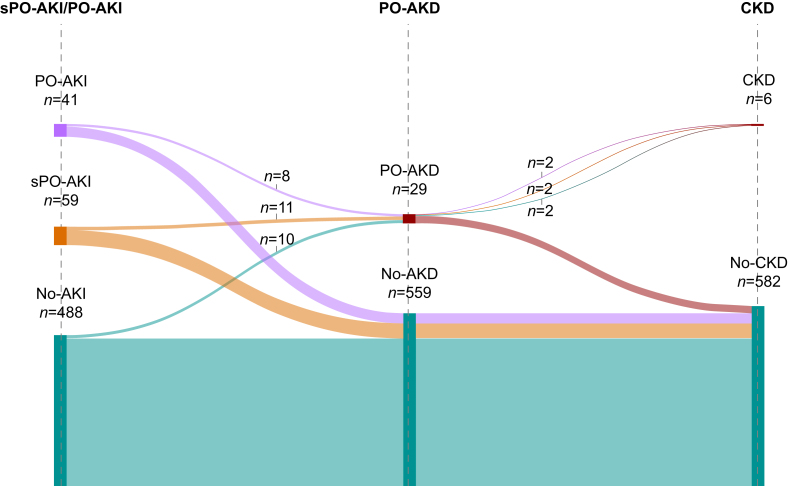
A total of 59 (10.2%) patients fulfilled the criteria for sPO-AKI, 41 (7.1%) patients for PO-AKI, 29 (6.2%) for PO-AKD, and 6 (1.2%) for CKD. Similar proportions of patients with sPO-AKI and PO-AKI developed PO-AKD. An association was identified between the combined group of sPO-AKI and PO-AKI and 30-day mortality (Cramer's V: 0.1, =0.037). PO-AKD (Cramer's V: 0.4, <0.001) was associated with MAKE30 and 30-day mortality. All patients with CKD had pre-existing PO-AKD.
Subclinical postoperative kidney injury not fulfilling the KDIGO criteria occurred in every 10th patient, and one in 14 suffered from PO-AKI after major abdominal surgery. A majority of PO-AKD cases was preceded by sPO-AKI and PO-AKI. Early kidney injuries were associated with longer-term adverse outcomes including MAKE30, 30-day mortality, and CKD.
术后急性肾损伤在接受大型腹部手术的患者中很常见,且与不良预后相关。血清肌酐浓度逐渐升高但未达到急性肾损伤的KDIGO标准的影响研究较少。我们评估了术后亚临床急性肾损伤(sPO-AKI)、急性肾损伤(PO-AKI)、急性肾病(PO-AKD)的发生率和病程,以及它们与慢性肾脏病(CKD)、主要不良肾脏事件(MAKE30)和术后30天全因死亡率的关系。
在瑞典非心脏手术心肌损伤(MINSS)研究的一项预先计划的巢式队列亚研究中,我们纳入了来自两家医院的588例患者。我们根据ADQI-POQI共识标准确定PO-AKI、PO-AKD和CKD的发生率。sPO-AKI定义为术后7天内血清肌酐浓度升高25%-49%。
共有59例(10.2%)患者符合sPO-AKI标准,41例(7.1%)患者符合PO-AKI标准,29例(6.2%)患者符合PO-AKD标准,6例(1.2%)患者符合CKD标准。sPO-AKI和PO-AKI患者发生PO-AKD的比例相似。sPO-AKI和PO-AKI联合组与30天死亡率之间存在关联(克莱默V值:0.1,P=0.037)。PO-AKD(克莱默V值:0.4,P<0.001)与MAKE30和30天死亡率相关。所有CKD患者术前均存在PO-AKD。
每10例患者中就有1例发生未达到KDIGO标准的亚临床术后肾损伤,14例患者中有1例在大型腹部手术后发生PO-AKI。大多数PO-AKD病例之前有sPO-AKI和PO-AKI。早期肾损伤与包括MAKE30、30天死亡率和CKD在内的长期不良预后相关。