Lara Aparicio Sandra Yasbeth, Laureani Fierro Ángel de Jesús, Aranda Abreu Gonzalo Emiliano, Toledo Cárdenas Rebeca, García Hernández Luis Isauro, Coria Ávila Genaro Alfonso, Rojas Durán Fausto, Aguilar María Elena Hernández, Manzo Denes Jorge, Chi-Castañeda Lizbeth Donají, Pérez Estudillo César Antonio
Instituto en Investigaciones Cerebrales, Universidad Veracruzana, Xalapa de Enríquez, Veracruz C.P. 91190, Mexico.
Laboratorio de Neurofisiología, Instituto de Investigaciones Cerebrales, Universidad Veracruzana, Av. Luis Castelazo S/N, Col. Industrial Las Ánimas, Xalapa de Enríquez, Veracruz C.P. 91190, Mexico.
NeuroSci. 2022 Dec 19;3(4):687-702. doi: 10.3390/neurosci3040050. eCollection 2022 Dec.
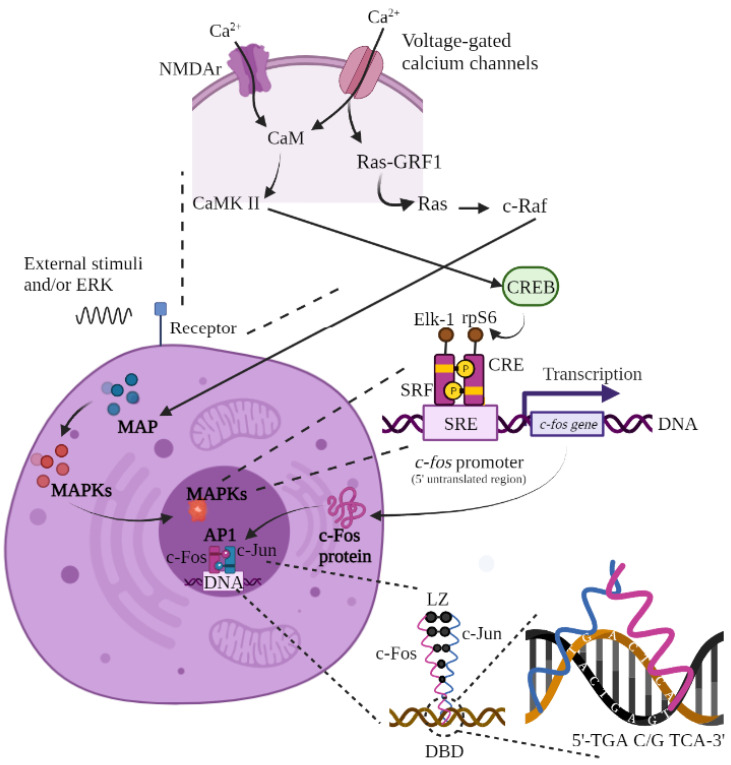
For years, the biochemical processes that are triggered by harmful and non-harmful stimuli at the central nervous system level have been extensively studied by the scientific community through numerous techniques and animal models. For example, one of these techniques is the use of immediate expression genes, which is a useful, accessible, and reliable method for observing and quantifying cell activation. It has been shown that both the gene and its protein c-Fos have rapid activation after stimulus, with the length of time that they remain active depending on the type of stimulus and the activation time depending on the stimulus and the structure studied. Fos requires the participation of other genes (such as ) for its expression (during hetero-dimer forming). c-Fos dimerizes with c-Jun protein to form factor AP-1, which promotes the transcription of various genes. The production and removal of c-Fos is part of cellular homeostasis, but its overexpression results in increased cell proliferation. Although Fos has been used as a marker of cellular activity since the 1990s, which molecular mechanism participates in the regulation of the expression of this protein is still unknown because the gene and the protein are not specific to neurons or glial cells. For these reasons, this work has the objective of gathering information about this protein and its use in neuroscience.
多年来,科学界通过众多技术和动物模型,对中枢神经系统层面由有害和无害刺激引发的生化过程进行了广泛研究。例如,其中一项技术是使用即刻早期基因,这是一种用于观察和量化细胞激活的有用、可及且可靠的方法。研究表明,该基因及其蛋白c-Fos在受到刺激后会迅速激活,其保持活跃的时间长度取决于刺激的类型,激活时间则取决于刺激以及所研究的结构。Fos的表达需要其他基因(如 )的参与(在异源二聚体形成过程中)。c-Fos与c-Jun蛋白二聚化形成因子AP-1,后者促进各种基因的转录。c-Fos的产生和清除是细胞稳态的一部分,但其过表达会导致细胞增殖增加。尽管自20世纪90年代以来Fos一直被用作细胞活性的标志物,但参与该蛋白表达调控的分子机制仍不清楚,因为该基因和蛋白并非神经元或神经胶质细胞所特有。基于这些原因,这项工作的目的是收集有关这种蛋白及其在神经科学中的应用的信息。