Instituto Agroforestal Mediterráneo, Universitat Politècnica de València, Valencia, Spain.
Instituto Valenciano de Investigaciones Agrarias, G. Valenciana, Moncada, Valencia, Spain.
Sci Rep. 2024 Nov 3;14(1):26482. doi: 10.1038/s41598-024-78310-9.
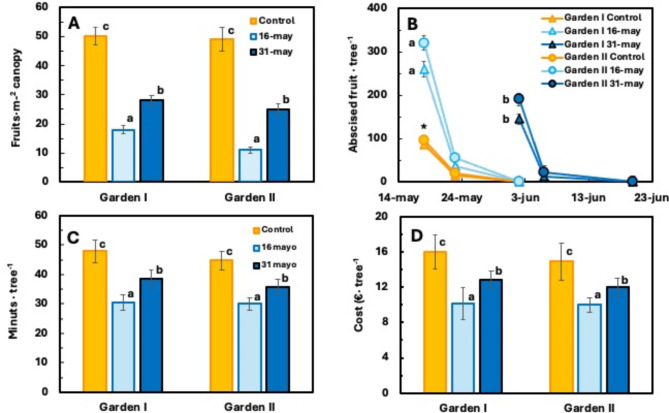
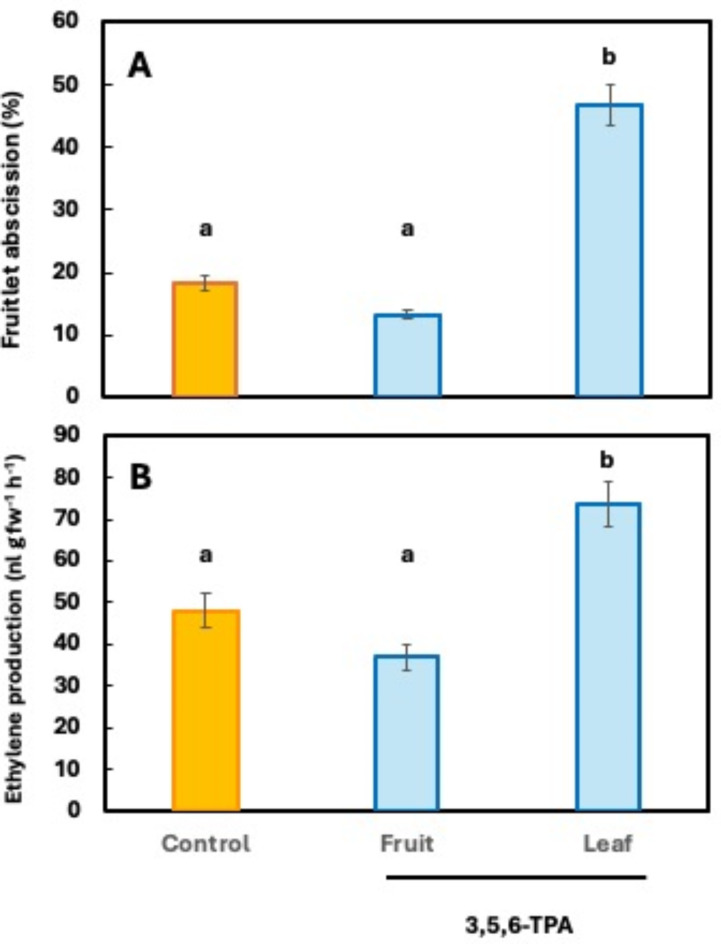
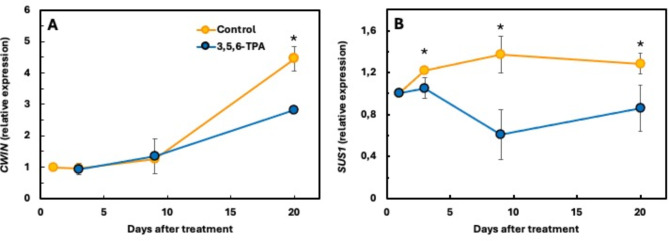
In citrus, the synthetic auxin 3,5,6-trichloro-2-pyridyloxyacetic acid (3,5,6-TPA), applied as a foliar spray at a concentration of 15 mg l during physiological fruitlet abscission, caused additional fruitlet drop and reduced the number of fruits reaching maturity. The effect was much more pronounced at full physiological abscission than after. In this study, this thinning effect was successfully exploited for the first time in sour orange trees grown in an urban environment, reducing harvesting costs by up to almost 40%. This effect is mediated by the leaves, which alter their photosynthetic activity. Our results show a reduction of carbon fixation and sucrose synthesis in the leaf, by 3,5,6-TPA repression of the RbcS, SUS1 and SUSA genes, its transport to the fruit, as shown by the reduced expression of the sucrose transporter genes SUT3 and SUT4, and its hydrolysis in the fruit, mainly by repression of the SUS1 gene expression. Genes involved in auxin homeostasis in the fruit, TRN2 and PIN1, were also repressed. The coordinated repression of all these genes is consistent with the decrease in the fruit cell division rate, as shown by the repression of CYCA1-1 gene, leading to the production of ethylene, which ultimately induces fruitlet abscission.
在柑橘中,合成生长素 3,5,6-三氯-2-吡啶氧基乙酸(3,5,6-TPA),以 15mg/L 的浓度作为叶面喷雾在生理落果期间使用,会导致额外的幼果掉落,并减少达到成熟的果实数量。在完全生理脱落时,这种效果比之后更为明显。在这项研究中,这种疏果效果首次在城市环境中生长的酸橙树上成功利用,将收获成本降低了近 40%。这种效果是通过叶片介导的,叶片改变了它们的光合作用活性。我们的结果表明,通过 3,5,6-TPA 对 RbcS、SUS1 和 SUSA 基因的抑制,以及其向果实的运输,减少了叶片中的碳固定和蔗糖合成,这表现为蔗糖转运基因 SUT3 和 SUT4 的表达减少,以及其在果实中的水解,主要通过抑制 SUS1 基因的表达。在果实中参与生长素稳态的基因 TRN2 和 PIN1 也被抑制。所有这些基因的协调抑制与果实细胞分裂率的下降一致,这表现为 CYCA1-1 基因的抑制,导致乙烯的产生,最终诱导幼果脱落。