Bakhribah Ahmad, Leumas Jordan, Helland Gregg, Guttman Joshua, Arfaj Yara, Alharbi Rawan, Bakhsh Abdullah
Faculty of Medicine, Department of Emergency medicine, King Abdulaziz University, Jeddah, Saudi Arabia.
Department of Emergency medicine, Emory University School of Medicine, Atlanta, USA.
Int J Emerg Med. 2024 Nov 4;17(1):168. doi: 10.1186/s12245-024-00742-x.
For patients with blunt abdominal trauma, the Focused Assessment with Sonography in Trauma (FAST) exam is the initial imaging modality employed to diagnose and risk stratify. A positive FAST exam in this patient population denotes intraperitoneal hemorrhage. In a hemodynamically unstable patient, it necessitates rapid surgical intervention. Ultrasound is highly dependent on the operator's ability to obtain quality images for interpretation. Failure to obtain adequate images prevents accurate interpretation and reduce its diagnostic accuracy. Previous studies evaluating whether the FAST exam can be improved solely by experience had conflicting results. None of those studies used an objective method to evaluate the FAST exam's quality. Our study aimed to objectively determine the number of FAST exams required by an emergency medicine (EM) resident to reach sufficient quality for independent scanning.
59 first-year EM residents from a single site were included in this study. All FAST exams that were saved in the Qpath archival system by the 59 EM residents, whether the exam was performed for educational or clinical purposes, were reviewed, and scored using a Task-Specific Checklist (TSC) score. This score is an objective way to assess the proficiency and quality of the FAST scan. The TSC was based on whether the imaging of 24 specific anatomic landmarks, split into four anatomic regions, was completed successfully or not. The AEMUS (Advanced EM Ultrasonography) faculty provided feedback to trainees wither electronically via Qpath or at the bedside. According to the quality of ultrasound imaging and competence (QUICK Score), if the average TSC score for the first 10 exams was 18 or higher, the resident was considered an expert. However, if the resident failed to achieve that score, we skipped the first exam performed by the resident and the average score for the second through eleventh exams was then calculated. If the resident did not achieve the desired result, the first and second exams were skipped and the average score for the remaining 10 exams was determined. This sequence was repeated until the resident achieved an average score of 18 or higher on their TSC score.
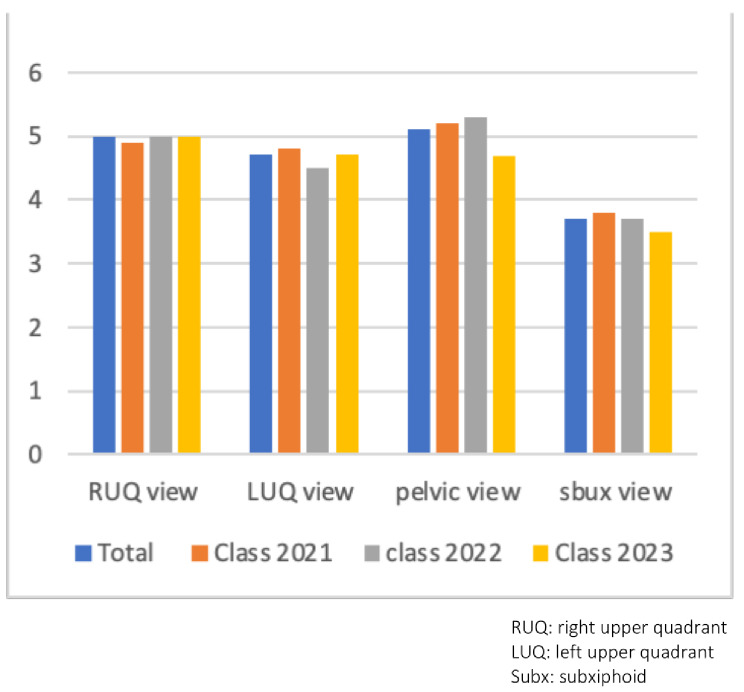
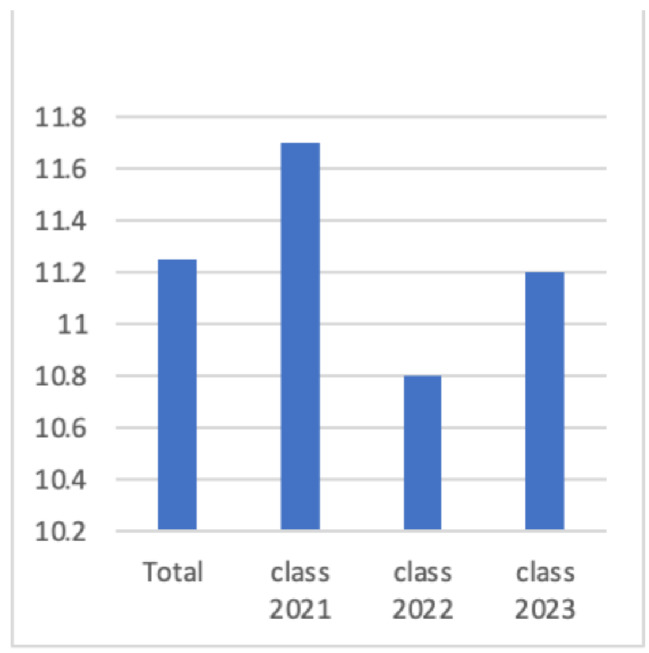
In total, 663 FAST scans performed by EM residents were scored. The average number of FAST exams needed for independent scanning is 11.23 (95% CI, 10.6-11.85). 66.1% of enrolled residents achieved an average score of 18 or higher in their first 10 FAST exams, and 33.8% of residents required more than 10 scans. The average scores for the right upper quadrant (RUQ), left upper quadrant (LUQ), pelvic, and subxiphoid views were 5 (95% CI, 4.88-5.1), 4.7 (95% CI, 4.59-4.8), 5.1 (95% CI, 4.96-5.24), and 3.7 (95% CI 3.6-3.8) respectively.
This study demonstrated that when constructive feedback on each FAST exam was given, the average first-year emergency medicine resident achieves competency in performing FAST exams independently after completing 10-12 (average of 11.23) FAST exams. Further research is required to validate the findings.
对于钝性腹部创伤患者,创伤重点超声评估(FAST)检查是用于诊断和风险分层的初始成像方式。在该患者群体中,FAST检查结果呈阳性表示腹腔内出血。对于血流动力学不稳定的患者,这需要迅速进行手术干预。超声高度依赖操作者获取高质量图像以进行解读的能力。未能获取足够的图像会妨碍准确解读并降低其诊断准确性。以往评估FAST检查是否仅通过经验就能得到改善的研究结果相互矛盾。这些研究均未使用客观方法来评估FAST检查的质量。我们的研究旨在客观确定急诊医学(EM)住院医师达到足以独立扫描的质量所需进行的FAST检查次数。
本研究纳入了来自单一机构的59名一年级EM住院医师。对这59名EM住院医师保存在Qpath存档系统中的所有FAST检查进行回顾,无论该检查是用于教学目的还是临床目的,并使用特定任务清单(TSC)评分进行评分。该评分是评估FAST扫描熟练程度和质量的一种客观方式。TSC基于24个特定解剖标志(分为四个解剖区域)的成像是否成功完成。高级急诊医学超声(AEMUS)教员通过Qpath以电子方式或在床边为学员提供反馈。根据超声成像质量和能力(QUICK评分),如果前10次检查的平均TSC评分为18分或更高,则该住院医师被视为专家。然而,如果住院医师未达到该分数,我们跳过该住院医师进行的第一次检查,然后计算第二次至第十一次检查的平均分数。如果住院医师未达到预期结果,则跳过第一次和第二次检查,确定其余10次检查的平均分数。重复此顺序,直到住院医师的TSC评分达到18分或更高。
EM住院医师共进行了663次FAST扫描并进行了评分。独立扫描所需的FAST检查平均次数为11.23次(95%置信区间,10.6 - 11.85)。66.1%的入选住院医师在前10次FAST检查中平均得分达到18分或更高,33.8%的住院医师需要进行超过10次扫描。右上腹(RUQ)、左上腹(LUQ)、盆腔和剑突下视图的平均分数分别为5分(95%置信区间,4.88 - 5.1)、4.7分(95%置信区间,4.59 - 4.8)、5.1分(95%置信区间,4.96 - 5.24)和3.7分(95%置信区间3.6 - 3.8)。
本研究表明,当对每次FAST检查给予建设性反馈时,一年级急诊医学住院医师在完成10 - 12次(平均11.23次)FAST检查后能够独立胜任FAST检查。需要进一步研究来验证这些发现。