Liu Shanghao, Li Jia, Wong Yujun, Yim Hyung Joon, Hirooka Masashi, Enomoto Hirayuki, Xie Qing, Dai Erhei, Hanafy Amr Shaaban, Cao Zhujun, Zhao Lili, Teh Kok Ban, Kim Tae Hyung, Jung Young Kul, Koizumi Yohei, Hiasa Yoichi, Nishimura Takashi, Iijima Hiroko, Tian Qingyi, Guo Xinru, Jia Yansheng, Sun Jinfang, Liu Chuan, Qi Xiaolong
Liver Disease Center of Integrated Traditional Chinese and Western Medicine Department of Radiology Zhongda Hospital Medical School Southeast University Nurturing Center of Jiangsu Province for State Laboratory of AI Imaging & Interventional Radiology (Southeast University) Nanjing China.
Basic Medicine Research and Innovation Center of Ministry of Education Zhongda Hospital, Southeast University State Key Laboratory of Digital Medical Engineering Nanjing China.
MedComm (2020). 2024 Nov 3;5(11):e781. doi: 10.1002/mco2.781. eCollection 2024 Nov.
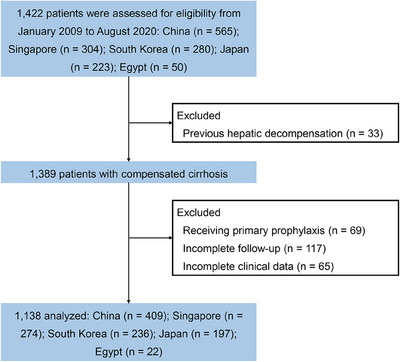
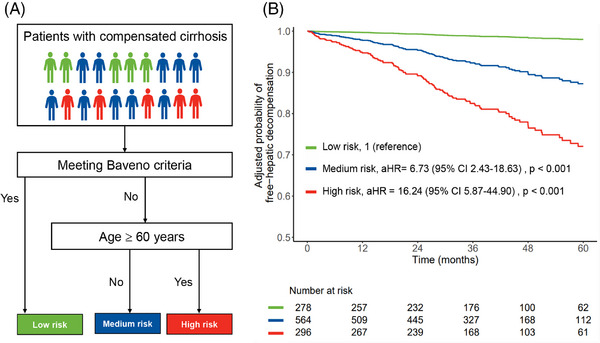
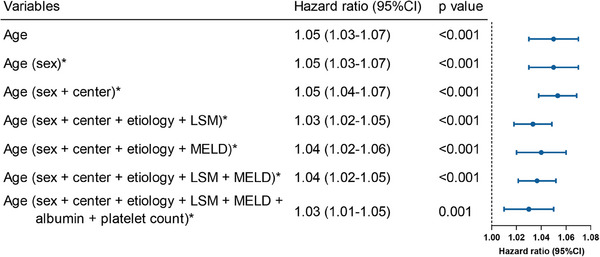
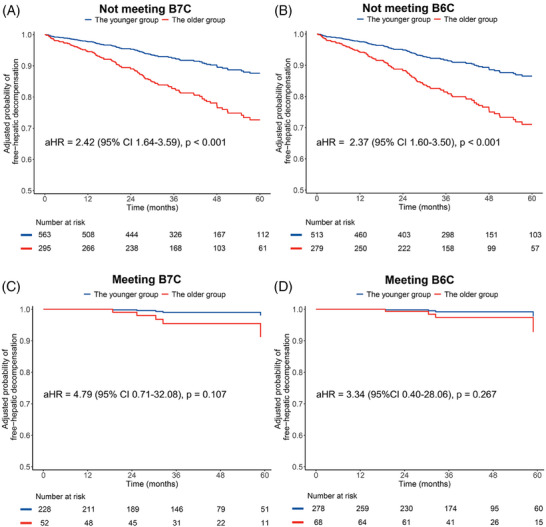
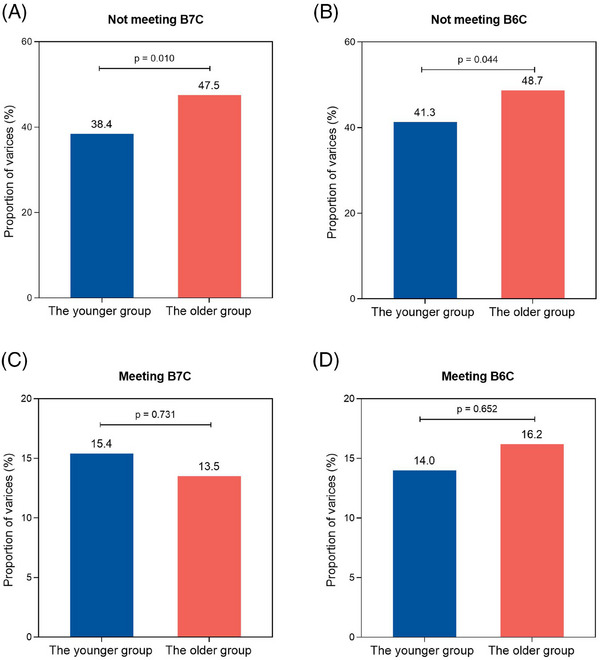
Baveno VII criteria (B7C) and Baveno VI criteria (B6C) have been widely used to estimate the risk of hepatic decompensation. However, the impact of age on these criteria warrants further investigation. The international, multicenter cohort study included 1138 patients with compensated cirrhosis (median follow-up of 40.6 months), aiming to evaluate the value of age in predicting hepatic decompensation. We identified age as an independent predictor of hepatic decompensation, with 60 years determined as the optimal cut-off value. The occurrence of decompensation was 18.7% and 6.7% in the older (age ≥60 years) and younger (age <60 years) groups, respectively ( < 0.001). We subsequently integrated age into the existing Baveno criteria. In patients not meeting Baveno criteria (defined as not meeting B6C or B7C), the older group exhibited a significantly elevated risk of decompensation compared to the younger group ( < 0.05). However, no significant difference was observed between the older and younger groups in patients meeting Baveno criteria ( > 0.05). In conclusion, our study demonstrated that integrating age into the Baveno criteria could enhance the assessment of hepatic decompensation. Age should be considered before discharging patients with compensated cirrhosis from the surveillance of hepatic decompensation.
巴韦诺 VII 标准(B7C)和巴韦诺 VI 标准(B6C)已被广泛用于评估肝失代偿风险。然而,年龄对这些标准的影响值得进一步研究。这项国际多中心队列研究纳入了1138例代偿期肝硬化患者(中位随访时间为40.6个月),旨在评估年龄在预测肝失代偿方面的价值。我们确定年龄是肝失代偿的独立预测因素,将60岁确定为最佳临界值。老年组(年龄≥60岁)和年轻组(年龄<60岁)的失代偿发生率分别为18.7%和6.7%(<0.001)。我们随后将年龄纳入现有的巴韦诺标准。在未达到巴韦诺标准(定义为未达到B6C或B7C)的患者中,老年组与年轻组相比失代偿风险显著升高(<0.05)。然而,在达到巴韦诺标准的患者中,老年组和年轻组之间未观察到显著差异(>0.05)。总之,我们的研究表明,将年龄纳入巴韦诺标准可增强对肝失代偿的评估。在将代偿期肝硬化患者从肝失代偿监测中出院之前,应考虑年龄因素。