Magodoro Itai M, Castle Alison C, Tshuma Ndumiso, Goedecke Julia H, Sewpaul Ronel, Manasa Justen, Manne-Goehler Jennifer, Ntusi Ntobeko Ab, Nyirenda Moffat J, Siedner Mark J
Department of Medicine, University of Cape Town, Cape Town, Republic of South Africa.
Africa Health Research Institute, Mtubatuba, Republic of South Africa.
J Multimorb Comorb. 2024 Oct 28;14:26335565241293691. doi: 10.1177/26335565241293691. eCollection 2024 Jan-Dec.
It is unclear how rising obesity among people with HIV (PWH) impacts their risk of type 2 diabetes mellitus (diabetes). We examined associations between HIV, prevalent diabetes and adiposity among South African PWH and their peers without HIV (PWOH).
HIV status was ascertained by antibody testing. Diabetes was defined as current use of oral hypoglycemics, insulin, and/or HbA1c ≥6.5%. Adiposity was measured by body mass index (BMI), waist circumference and waist-to-height ratio. Their associations were examined using sex-stratified multivariable fractional polynomial generalized linear models, reporting adjusted prevalence and prevalence ratios (adjPR).
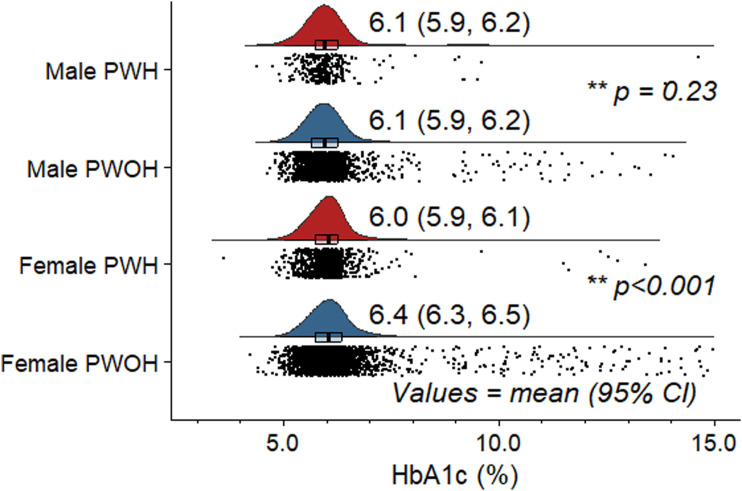
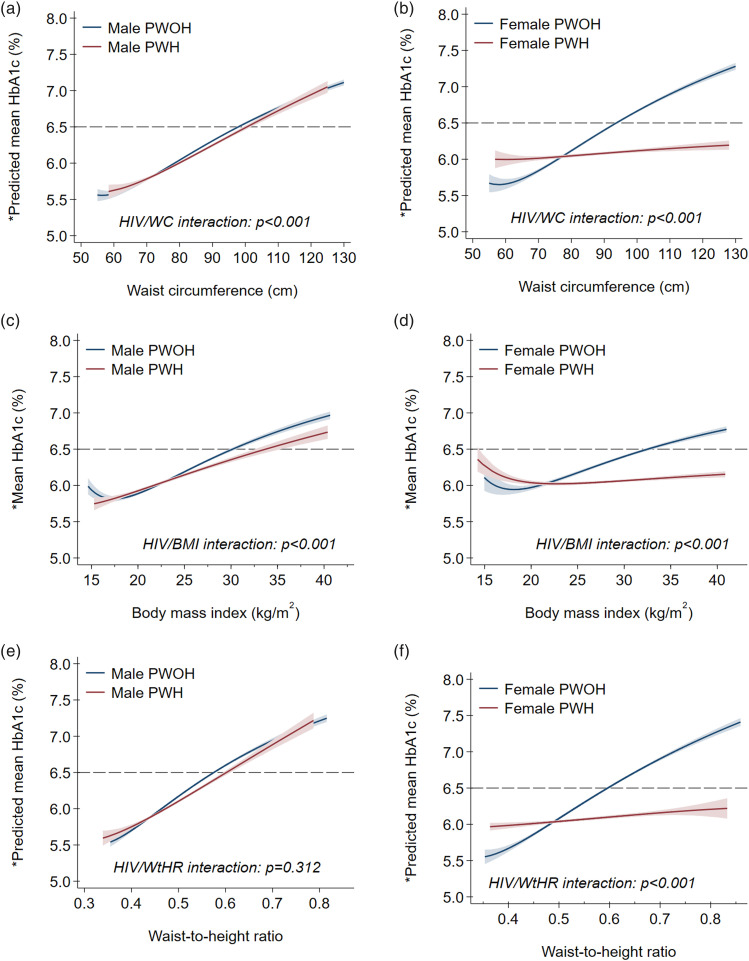
The mean age among 1,254 PWH and 4,381 PWOH was 41 years (95%CI 28, 56). The prevalence of diabetes among males was similar between PWH [11.3% (7.1, 15.5)] and PWOH [9.8% (8.5, 11.1); p=0.740]. By contrast, diabetes prevalence was higher among female PWOH [15.7% (14.4, 17.0)] than female PWH [10.5 (8.3, 12.8)%; adjPR: 0.67 (0.51, 0.82); p<0.001]. This difference was accentuated with obesity but reversed with leanness. At BMI ≥25 kg/m, female PWH had lower diabetes prevalence [adjPR: 0.58 (0.41, 0.76); p<0.001] than female PHIV. In contrast, at BMI <18 kg/m, female PWH had higher prevalence [adjPR: 1.72 (-1.53, 4.96); p=0.756] than female PWOH.
We found sex-specific differences in the relationship between adiposity and diabetes prevalence by HIV serostatus in South Africa. Notably, females living with obesity and HIV had lower prevalence of diabetes than females living with obesity and without HIV, which may have particular implications for diabetes prevention programs in the region.
尚不清楚感染艾滋病毒者(PWH)中肥胖率上升如何影响其患2型糖尿病(糖尿病)的风险。我们研究了南非PWH及其未感染艾滋病毒的同龄人(PWOH)中艾滋病毒、糖尿病患病率与肥胖之间的关联。
通过抗体检测确定艾滋病毒感染状况。糖尿病定义为目前使用口服降糖药、胰岛素和/或糖化血红蛋白(HbA1c)≥6.5%。通过体重指数(BMI)、腰围和腰高比来衡量肥胖程度。使用按性别分层的多变量分数多项式广义线性模型检验它们之间的关联,报告调整后的患病率和患病率比(adjPR)。
1254名PWH和4381名PWOH的平均年龄为41岁(95%置信区间28,56)。男性中,PWH的糖尿病患病率[11.3%(7.1,15.5)]与PWOH的患病率[9.8%(8.5,11.1);p = 0.740]相似。相比之下,女性PWOH的糖尿病患病率[15.7%(14.4,17.0)]高于女性PWH[10.5(8.3,12.8)%;调整患病率比:0.67(0.51,0.82);p<0.001]。这种差异在肥胖者中更为明显,但在瘦人中则相反。在BMI≥25kg/m²时,女性PWH的糖尿病患病率[调整患病率比:0.58(0.41,0.76);p<0.001]低于女性PHIV。相反,在BMI<18kg/m²时,女性PWH的患病率[调整患病率比:1.72(-1.53,4.96);p = 0.756]高于女性PWOH。
我们发现,在南非,肥胖与糖尿病患病率之间的关系因艾滋病毒血清学状态存在性别差异。值得注意的是,肥胖且感染艾滋病毒的女性糖尿病患病率低于肥胖但未感染艾滋病毒 的女性,这可能对该地区的糖尿病预防项目有特殊意义。