
年轻和老年供体来源的循环外泌体对脐血造血干细胞中缺氧诱导因子1α基因表达和P21蛋白的影响。
The Influence of Circulating Exosomes Derived From Younger and Older Donors on Hypoxia-Inducible Factor 1 Alpha Gene Expression and P21 Protein in Cord Blood Hematopoietic Stem Cells.
作者信息
Rasti Zahra, Afrisham Reza, Bahrami Vahdat Elahe, Kashanikhatib Zahra, Mousavi Seyed Hadi, Alizadeh Shaban
机构信息
Department of Hematology, School of Allied Medical Sciences, Tehran University of Medical Sciences, Tehran, Iran.
Department of Medical Laboratory Sciences, School of Allied Medical Sciences, Tehran University of Medical Sciences, Tehran, Iran.
出版信息
J Hematol. 2024 Oct;13(5):192-199. doi: 10.14740/jh1291. Epub 2024 Oct 21.
BACKGROUND
Exosomes are a group of extracellular vesicles that are influential in intercellular signaling and can affect aging. Hypoxia-inducible factor 1α (HIF-1α) is the principal mediator in response to hypoxia and can regulate aging. Moreover, P21 is a part of the downstream signaling pathway of hypoxia and is elevated during aging. Therefore, this research was conducted to investigate the effect of plasma exosomes of younger and older individuals on the expression of gene and P21 protein in hematopoietic stem cells (HSCs).
METHODS
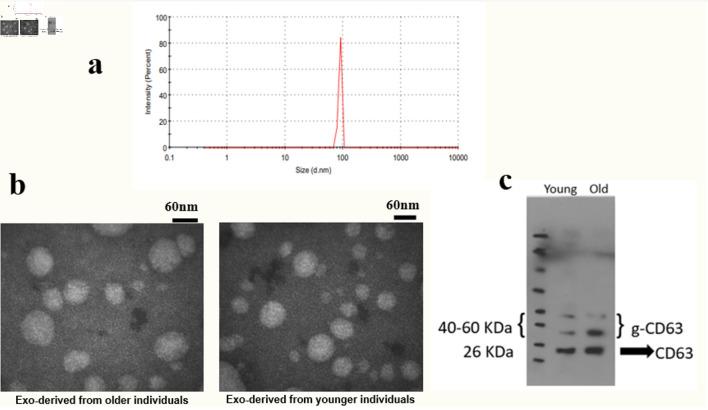
Plasma exosomes were derived from older and younger men and were characterized. Then, HSCs were isolated from cord blood samples and treated with exosomes of older and younger men. The 3-(4,5-dimethylthiazol-2-yl)-2,5-diphenyl tetrazolium bromide (MTT) assay was performed to evaluate cell viability. Next, the expression of gene and P21 protein were evaluated by quantitative real-time polymerase chain reaction (qRT-PCR) and Western blot, respectively.
RESULTS
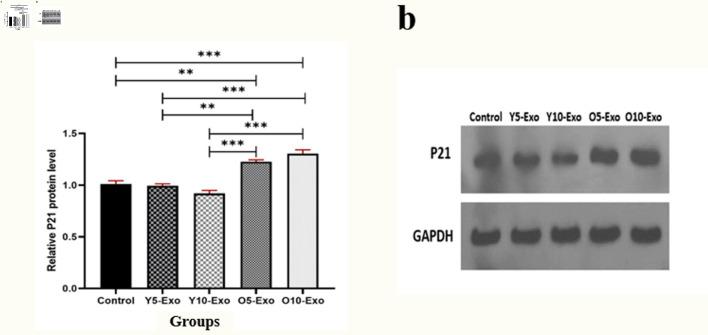
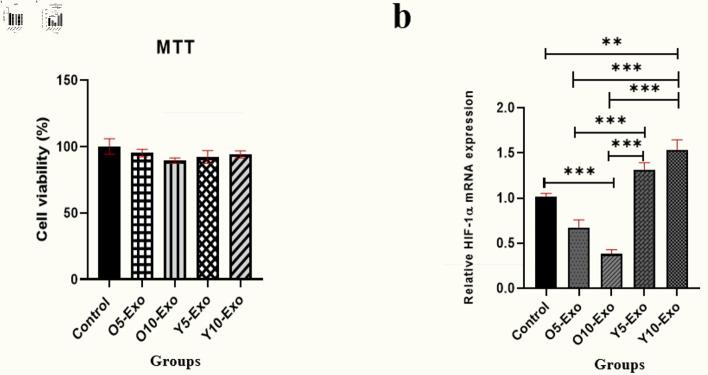
gene expression was considerably increased in HSCs treated with 10 µg/mL of exosomes isolated from younger men (Y10-Exo) compared to the untreated group (P = 0.002). Moreover, gene expression was remarkably decreased in HSCs treated with 10 µg/mL of exosomes obtained from older men (O10-Exo) in comparison with the untreated group (P < 0.001). Additionally, the expression of P21 protein was significantly increased in HSCs treated with 5 µg/mL of exosomes derived from older individuals (O5-Exo) and O10-Exo compared to the untreated group (P = 0.000 and P = 0.002, respectively).
CONCLUSIONS
Our findings showed that exosomes isolated from younger participants cause elevation in HIF-1α and may lead to delayed aging in HSCs. In addition, exosomes isolated from older participants can probably lead to aging through the reduction in HIF-1α and elevation in P21.
背景
外泌体是一组在细胞间信号传导中具有影响力且可影响衰老的细胞外囊泡。缺氧诱导因子1α(HIF-1α)是对缺氧反应的主要介导因子,可调节衰老。此外,P21是缺氧下游信号通路的一部分,在衰老过程中会升高。因此,本研究旨在探讨年轻个体和老年个体的血浆外泌体对造血干细胞(HSC)中基因表达和P21蛋白表达的影响。
方法
从老年男性和年轻男性中获取血浆外泌体并进行表征。然后,从脐带血样本中分离出造血干细胞,并用老年男性和年轻男性的外泌体进行处理。采用3-(4,5-二甲基噻唑-2-基)-2,5-二苯基四氮唑溴盐(MTT)法评估细胞活力。接下来,分别通过定量实时聚合酶链反应(qRT-PCR)和蛋白质印迹法评估基因表达和P21蛋白表达。
结果
与未处理组相比,用10μg/mL从年轻男性分离的外泌体(Y10-Exo)处理的造血干细胞中基因表达显著增加(P = 0.002)。此外,与未处理组相比,用10μg/mL从老年男性获得的外泌体(O10-Exo)处理的造血干细胞中基因表达显著降低(P < 0.001)。另外,与未处理组相比,用5μg/mL来自老年个体的外泌体(O5-Exo)和O10-Exo处理的造血干细胞中P21蛋白表达显著增加(分别为P = 0.000和P = 0.002)。
结论
我们的研究结果表明,从年轻参与者分离的外泌体可导致HIF-1α升高,并可能导致造血干细胞衰老延迟。此外,从老年参与者分离的外泌体可能通过降低HIF-1α和升高P21导致衰老。
 Zotero 插件