• 文献检索
  • 文档翻译
  • 深度研究
  • 学术资讯
  • Suppr Zotero 插件Zotero 插件
  • 邀请有礼
  • 套餐&价格
  • 历史记录
应用&插件
Suppr Zotero 插件Zotero 插件浏览器插件Mac 客户端Windows 客户端微信小程序
定价
高级版会员购买积分包购买API积分包
服务
文献检索文档翻译深度研究API 文档MCP 服务
关于我们
关于 Suppr公司介绍联系我们用户协议隐私条款
关注我们

Suppr 超能文献

核心技术专利:CN118964589B侵权必究
粤ICP备2023148730 号-1Suppr @ 2026

文献检索

告别复杂PubMed语法,用中文像聊天一样搜索,搜遍4000万医学文献。AI智能推荐,让科研检索更轻松。

立即免费搜索

文件翻译

保留排版,准确专业,支持PDF/Word/PPT等文件格式,支持 12+语言互译。

免费翻译文档

深度研究

AI帮你快速写综述,25分钟生成高质量综述,智能提取关键信息,辅助科研写作。

立即免费体验

用户对在线性健康症状检查工具的看法:定性研究。

User Views on Online Sexual Health Symptom Checker Tool: Qualitative Research.

机构信息

Faculty of Medicine, Nursing and Health Sciences, School of Translational Medicine, Monash University, Melbourne, Australia.

Melbourne Sexual Health Centre, Alfred Health, Carlton, Australia.

出版信息

JMIR Form Res. 2024 Nov 4;8:e54565. doi: 10.2196/54565.

DOI:10.2196/54565
PMID:39496164
原文链接:https://pmc.ncbi.nlm.nih.gov/articles/PMC11574491/
Abstract

BACKGROUND

Delayed diagnosis and treatment of sexually transmitted infections (STIs) contributes to poorer health outcomes and onward transmission to sexual partners. Access to best-practice sexual health care may be limited by barriers such as cost, distance to care providers, sexual stigma, and trust in health care providers. Online assessments of risk offer a novel means of supporting access to evidence-based sexual health information, testing, and treatment by providing more individualized sexual health information based on user inputs.

OBJECTIVE

This developmental evaluation aims to find potential users' views and experiences in relation to an online assessment of risk, called iSpySTI (Melbourne Sexual Health Center), including the likely impacts of use.

METHODS

Individuals presenting with urogenital symptoms to a specialist sexual health clinic were given the opportunity to trial a web-based, Bayesian-powered tool that provides a list of 2 to 4 potential causes of their symptoms based on inputs of known STI risk factors and symptoms. Those who tried the tool were invited to participate in a once-off, semistructured research interview. Descriptive, action, and emotion coding informed the comparative analysis of individual cases.

RESULTS

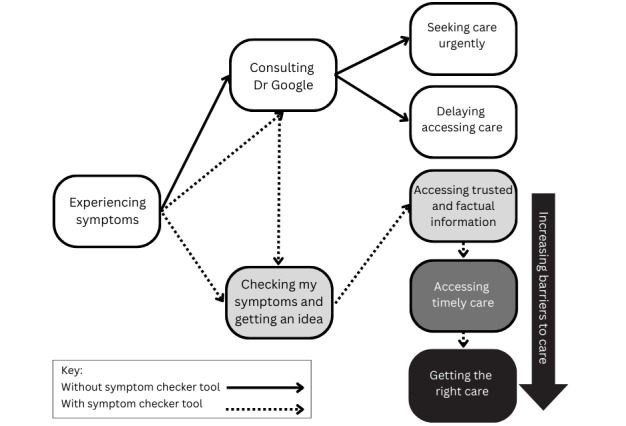
Findings from interviews with 14 people who had used the iSpySTI tool support the superiority of the online assessment of STI risk compared to existing sources of sexual health information (eg, internet search engines) in providing trusted and probabilistic information to users. Additionally, potential users reported benefits to their emotional well-being in the intervening period between noticing symptoms and being able to access care. Differences in current and imagined urgency of health care seeking and emotional impacts were found based on clinical diagnosis (eg, non-STI, curable and incurable but treatable STIs) and whether participants were born in Australia or elsewhere.

CONCLUSIONS

Online assessments of risk provide users experiencing urogenital symptoms with more individualized and evidence-based health information that can improve their health care-seeking and provide reassurance in the period before they can access care.

摘要

背景

性传播感染(STIs)的诊断和治疗延迟会导致更差的健康结果,并向性伴侣传播。获得最佳实践的性健康护理可能会受到障碍的限制,例如成本、距离护理提供者、性耻辱和对医疗保健提供者的信任。在线风险评估提供了一种新的方法,可以通过根据用户输入提供更个性化的性健康信息来支持获得基于证据的性健康信息、测试和治疗。

目的

这项发展评估旨在了解潜在用户对在线风险评估(称为 iSpySTI(墨尔本性健康中心))的看法和经验,包括使用的可能影响。

方法

向在专门的性健康诊所出现泌尿生殖症状的个体提供试用基于网络的贝叶斯动力工具的机会,该工具根据已知的性传播感染风险因素和症状输入,为其症状提供 2 到 4 种潜在原因的列表。试用该工具的人被邀请参加一次性半结构化研究访谈。描述性、行动性和情感编码为个案比较分析提供了信息。

结果

对 14 名使用过 iSpySTI 工具的人的访谈结果支持在线 STI 风险评估优于现有的性健康信息来源(例如,互联网搜索引擎),为用户提供值得信赖和概率性的信息。此外,潜在用户报告说,在能够获得护理之前,他们的情感健康在注意到症状和能够获得护理之间的间隔期间得到了改善。基于临床诊断(例如,非 STI、可治愈和不可治愈但可治疗的 STI)和参与者是否在澳大利亚或其他地方出生,发现了当前和想象中的医疗保健寻求紧迫性以及情绪影响方面的差异。

结论

在线风险评估为出现泌尿生殖症状的用户提供了更个性化和基于证据的健康信息,这可以改善他们的医疗保健寻求,并在他们能够获得护理之前提供保证。
https://cdn.ncbi.nlm.nih.gov/pmc/blobs/64a6/11574491/8ecc4b0765a9/formative_v8i1e54565_fig1.jpg

相似文献

1
User Views on Online Sexual Health Symptom Checker Tool: Qualitative Research.用户对在线性健康症状检查工具的看法:定性研究。
JMIR Form Res. 2024 Nov 4;8:e54565. doi: 10.2196/54565.
2
How does online postal self-sampling (OPSS) shape access to testing for sexually transmitted infections (STIs)? A qualitative study of service users.在线邮政自我采样 (OPSS) 如何影响性传播感染 (STI) 的检测机会?一项服务使用者的定性研究。
BMC Public Health. 2024 Aug 28;24(1):2339. doi: 10.1186/s12889-024-19741-x.
3
Information-seeking behavior on sexually transmitted infections and its associated factors among university students in Ethiopia: a cross-sectional study.埃塞俄比亚大学生对性传播感染的信息寻求行为及其影响因素:一项横断面研究。
Reprod Health. 2022 Jan 29;19(1):25. doi: 10.1186/s12978-022-01340-x.
4
Help-seeking for genitourinary symptoms: a mixed methods study from Britain's Third National Survey of Sexual Attitudes and Lifestyles (Natsal-3).寻求泌尿生殖系统症状相关帮助:来自英国第三次全国性态度和生活方式调查(Natsal-3)的混合方法研究。
BMJ Open. 2019 Oct 30;9(10):e030612. doi: 10.1136/bmjopen-2019-030612.
5
Engaging End Users to Inform the Design and Social Marketing Strategy for a Web-Based Sexually Transmitted Infection/Blood-Borne Virus (STI/BBV) Testing Service for Young People in Victoria, Australia: Qualitative Study.让终端用户参与,为澳大利亚维多利亚州的年轻人设计基于网络的性传播感染/血源性病毒(STI/BBV)检测服务并制定社会营销策略:定性研究
J Med Internet Res. 2025 Mar 27;27:e63822. doi: 10.2196/63822.
6
Use of the Internet for Sexual Health Among Sexually Experienced Persons Aged 16 to 44 Years: Evidence from a Nationally Representative Survey of the British Population.16至44岁有性经验者利用互联网获取性健康信息:来自英国全国代表性人口调查的证据。
J Med Internet Res. 2016 Jan 20;18(1):e14. doi: 10.2196/jmir.4373.
7
Young people's perceptions of smartphone-enabled self-testing and online care for sexually transmitted infections: qualitative interview study.年轻人对智能手机辅助的性传播感染自我检测及在线护理的看法:定性访谈研究
BMC Public Health. 2016 Sep 13;16(1):974. doi: 10.1186/s12889-016-3648-y.
8
Internet-based HIV and sexually transmitted infection testing in British Columbia, Canada: opinions and expectations of prospective clients.加拿大不列颠哥伦比亚省基于互联网的艾滋病毒和性传播感染检测:潜在客户的意见和期望
J Med Internet Res. 2012 Mar 6;14(2):e41. doi: 10.2196/jmir.1948.
9
Linking young men who have sex with men (YMSM) to STI physicians: a nationwide cross-sectional survey in China.将男男性行为者(YMSM)与性病科医生联系起来:中国全国性横断面调查。
BMC Infect Dis. 2018 May 18;18(1):228. doi: 10.1186/s12879-018-3145-2.
10
Young Aboriginal people's engagement with STI testing in the Northern Territory, Australia.澳大利亚北领地原住民年轻人参与性传播感染检测
BMC Public Health. 2020 Apr 6;20(1):459. doi: 10.1186/s12889-020-08565-0.

引用本文的文献

1
Sexual health service users' perspectives on artificial intelligence applications for identification of lesions associated with sexually transmissible infections: A qualitative study.性健康服务使用者对人工智能应用于识别性传播感染相关病变的看法:一项定性研究。
Digit Health. 2025 Jul 24;11:20552076251361749. doi: 10.1177/20552076251361749. eCollection 2025 Jan-Dec.
2
Getting Everyone on Board to Break the Cycle of Bacterial Vaginosis (BV) Recurrence: A Qualitative Study of Partner Treatment for BV.让所有人参与进来以打破细菌性阴道病(BV)复发的循环:一项关于BV伴侣治疗的定性研究
Patient. 2025 May;18(3):279-290. doi: 10.1007/s40271-025-00731-z. Epub 2025 Mar 14.
3

本文引用的文献

1
Facilitators of and Barriers to the Use of a Digital Self-Management Service for Diagnostic Testing: Focus Group Study With Potential Users.促进和阻碍使用数字自我管理服务进行诊断检测的因素:对潜在用户的焦点小组研究。
JMIR Hum Factors. 2024 May 10;11:e45115. doi: 10.2196/45115.
2
Australian Sexual Health Service Users' Perspectives on Reducing the Oral Transmission of Bacterial STIs: A Qualitative Study.澳大利亚性健康服务使用者对减少细菌性性传播感染口腔传播的看法:一项定性研究。
J Sex Res. 2023 Nov 28:1-12. doi: 10.1080/00224499.2023.2278528.
3
Young Australians' receptiveness to discussing sexual health with a general practitioner.
Accuracy of symptom checker for the diagnosis of sexually transmitted infections using machine learning and Bayesian network algorithms.
使用机器学习和贝叶斯网络算法的症状检查器对性传播感染的诊断准确性。
BMC Infect Dis. 2024 Dec 18;24(1):1408. doi: 10.1186/s12879-024-10285-4.
澳大利亚年轻人对与全科医生讨论性健康的接受程度。
Aust J Prim Health. 2023 Dec;29(6):587-595. doi: 10.1071/PY23083.
4
Time to healthcare seeking following the onset of symptoms among men and women attending a sexual health clinic in Melbourne, Australia.澳大利亚墨尔本一家性健康诊所中,男性和女性出现症状后寻求医疗护理的时间。
Front Med (Lausanne). 2022 Oct 25;9:915399. doi: 10.3389/fmed.2022.915399. eCollection 2022.
5
Neurosyphilis, Ocular Syphilis, and Otosyphilis: Detection and Treatment.神经梅毒、眼梅毒和耳梅毒:检测与治疗
Am Fam Physician. 2022 Aug;106(2):122-123.
6
Accessible health care is critical to the effective control of sexually transmitted infections.可及的医疗保健对于有效控制性传播感染至关重要。
Sex Health. 2022 Aug;19(4):255-264. doi: 10.1071/SH22042.
7
Digital sexually transmitted infection and HIV services across prevention and care continuums: evidence and practical resources.数字性传播感染和 HIV 服务贯穿预防和护理连续体:证据和实用资源。
Sex Health. 2022 Aug;19(4):278-285. doi: 10.1071/SH22023.
8
Photodiagnosis of genital herpes and warts: a sociomaterial perspective on users' experiences of online sexual health care.生殖器疱疹和疣的光诊断:关于用户在线性健康护理体验的社会物质视角
Cult Health Sex. 2023 Feb;25(2):192-205. doi: 10.1080/13691058.2022.2031297. Epub 2022 Feb 17.
9
Photodiagnosis of genital herpes and warts within a specialist online sexual health service: an observational (mixed methods) study of user experience and clinical outcomes.在一家专业的在线性健康服务机构中对生殖器疱疹和疣进行光诊断:一项关于用户体验和临床结果的观察性(混合方法)研究。
BMJ Open. 2021 Nov 11;11(11):e042160. doi: 10.1136/bmjopen-2020-042160.
10
Chlamydia and Gonorrhea.衣原体和淋病。
Ann Intern Med. 2021 Oct;174(10):ITC145-ITC160. doi: 10.7326/AITC202110190. Epub 2021 Oct 12.