Wang Dan, Hu Jing-Hui, Shi Hai-Jing, Zhuang Min-Yuan, Dou Wei, Ji Fu-Hai, Peng Ke
Department of Anesthesiology, First Affiliated Hospital of Soochow University, Suzhou, Jiangsu, People's Republic of China.
Institute of Anesthesiology, Soochow University, Suzhou, Jiangsu, People's Republic of China.
Int J Gen Med. 2024 Oct 29;17:4991-4998. doi: 10.2147/IJGM.S490244. eCollection 2024.
Emergence agitation (EA) is a state of psychomotor hyperactivity following general anesthesia and is associated with postoperative complications. Patients undergoing ear, nose, and throat (ENT) surgery are at a high risk for EA. We aim to assess whether preoperative dexmedetomidine nasal spray reduces the occurrence of EA for patients undergoing ENT surgery.
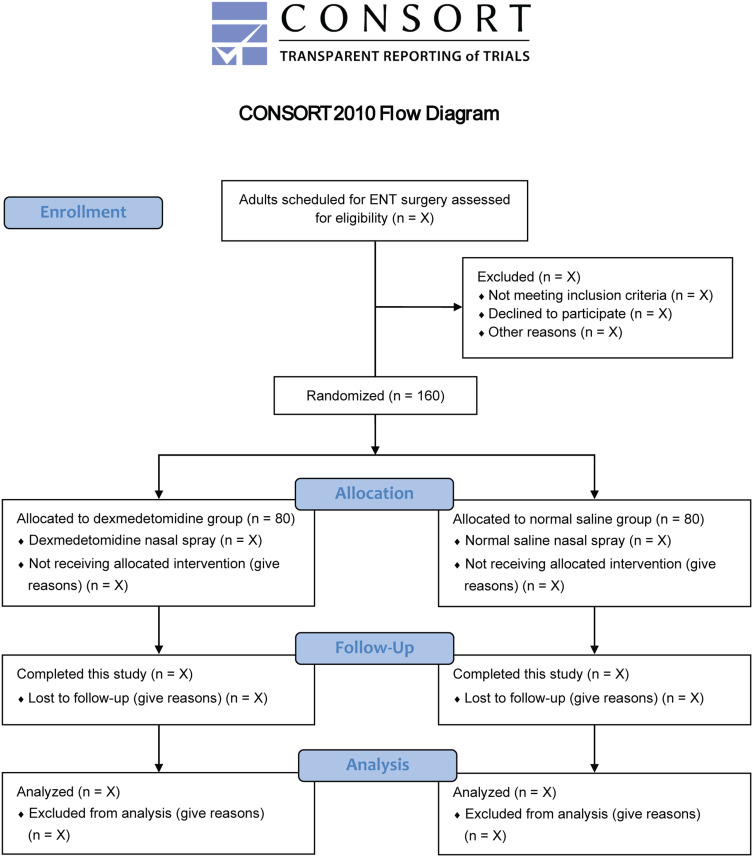
This is a protocol for a randomized, double-blind, controlled trial that will include 160 adults scheduled for ENT surgery. Patients will be randomly assigned, in a 1:1 ratio, to receive dexmedetomidine nasal spray (100 μg) or a same volume of normal saline approximately 30 min before general anesthesia induction. The primary endpoint is the incidence of EA, defined as a Riker sedation agitation scale (RSAS) score ≥5 from discontinuation of sevoflurane until 5 min after tracheal extubation. Secondary endpoints include (1) the maximal RSAS score during emergence; (2) the incidence of agitation in the postoperative care unit (PACU); (3) pain at rest and while coughing in the PACU and at 24 h postoperatively; (4) postoperative sleep disturbance on the first night after surgery; (5) anxiety within 24 h postoperatively; and (6) postoperative delirium during the first 24 h after surgery. All analyses will be performed on a modified intention-to-treat basis. For the primary endpoint, subgroup analysis will be conducted on sex, age, and type of surgery.
We expect that preoperative dexmedetomidine nasal spray would reduce the incidence of EA after ENT surgery. Our results offer clinical evidence for improving anesthetic care for patients undergoing ENT surgery.
Chinese Clinical Trial Registry (Identifier: ChiCTR2400086731).
苏醒期躁动(EA)是全身麻醉后出现的一种精神运动性多动状态,与术后并发症相关。接受耳鼻喉(ENT)手术的患者发生EA的风险较高。我们旨在评估术前右美托咪定鼻喷雾剂是否能降低接受ENT手术患者的EA发生率。
这是一项随机、双盲、对照试验方案,将纳入160例计划接受ENT手术的成年人。患者将按1:1比例随机分配,在全身麻醉诱导前约30分钟接受右美托咪定鼻喷雾剂(100μg)或相同体积的生理盐水。主要终点是EA的发生率,定义为从停用七氟醚至气管拔管后5分钟期间里克尔镇静躁动量表(RSAS)评分≥5。次要终点包括:(1)苏醒期的最大RSAS评分;(2)术后监护病房(PACU)的躁动发生率;(3)PACU及术后24小时静息和咳嗽时的疼痛;(4)术后第一晚的睡眠障碍;(5)术后24小时内的焦虑;(6)术后24小时内的谵妄。所有分析将在改良意向性分析的基础上进行。对于主要终点,将按性别、年龄和手术类型进行亚组分析。
我们预计术前右美托咪定鼻喷雾剂可降低ENT手术后的EA发生率。我们的结果为改善接受ENT手术患者的麻醉护理提供了临床证据。
中国临床试验注册中心(标识符:ChiCTR2400086731)