Institute of Marine & Environmental Technology, Department of Marine Biotechnology, University of Maryland Baltimore County, Baltimore, MD 21202, USA.
Department of Animal Sciences, The Robert H. Smith Faculty of Agriculture, Food, and Environment, The Hebrew University of Jerusalem, Rehovot 76100, Israel.
Endocrinology. 2024 Oct 30;165(12). doi: 10.1210/endocr/bqae151.
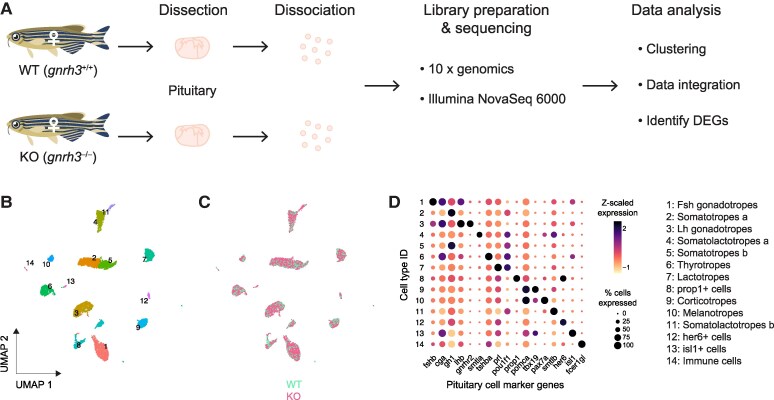
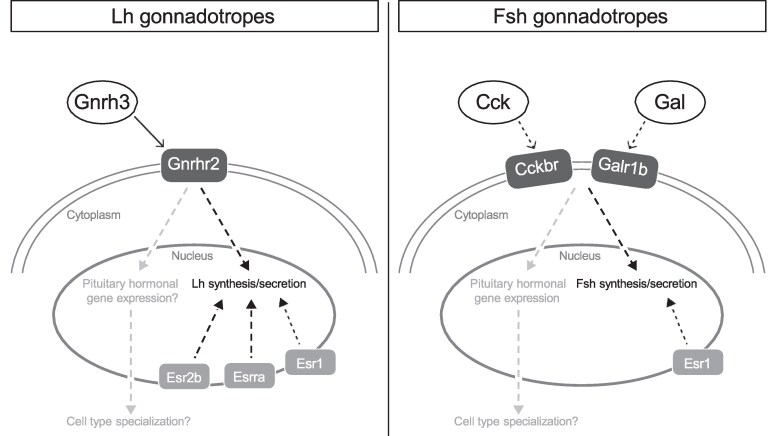
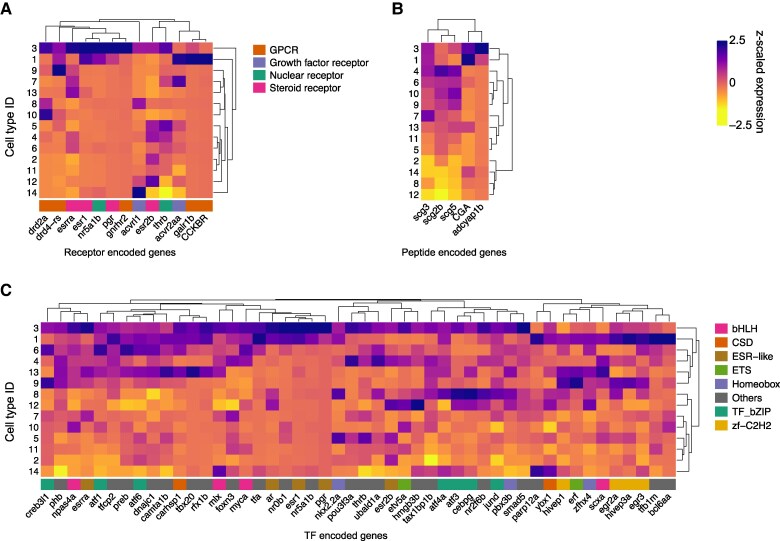
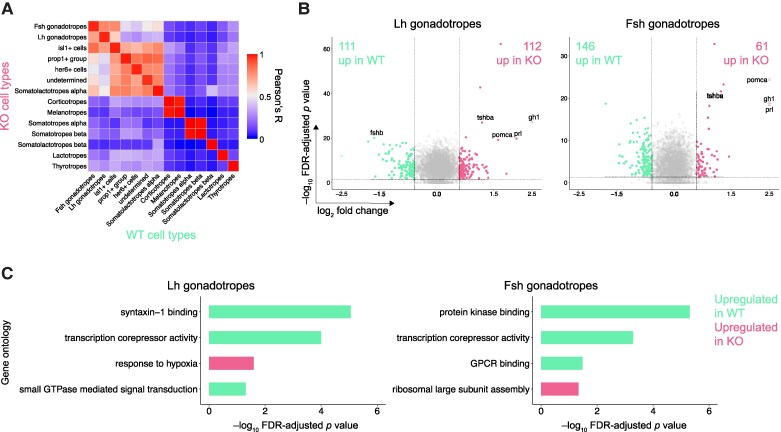
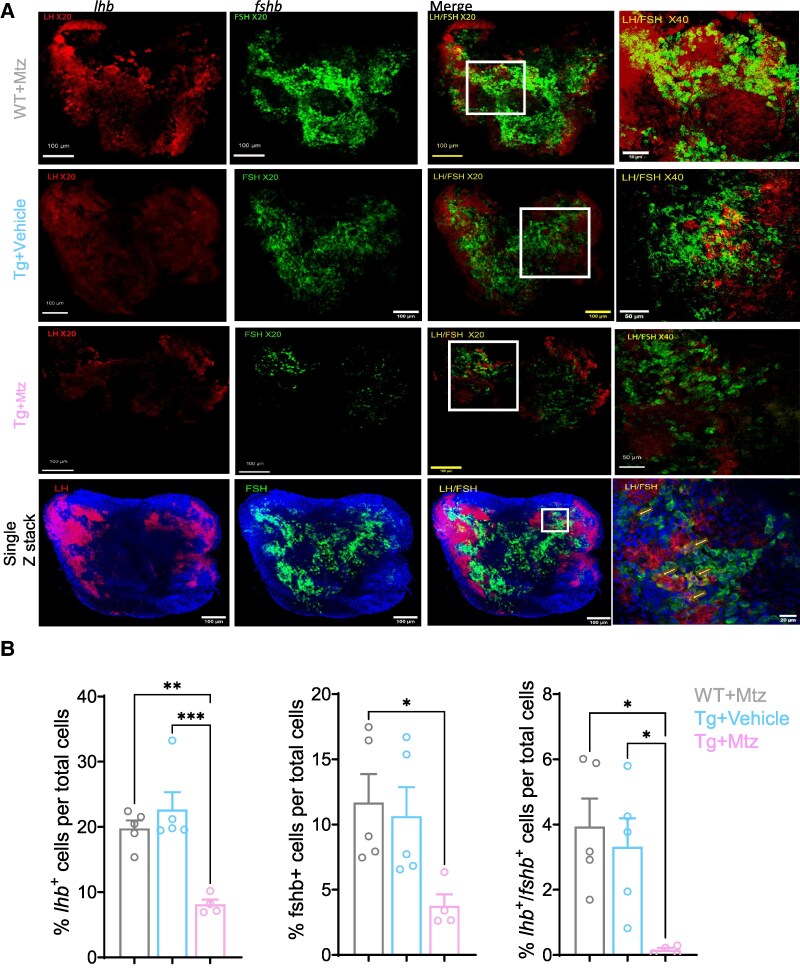
GnRH governs reproduction by regulating pituitary gonadotropins. Unlike most vertebrates, gnrh-/- zebrafish are fertile. To elucidate the role of the hypophysiotropic-Gnrh3 and other mechanisms regulating pituitary gonadotropes, we profiled the gene expression of all individual pituitary cells of wild-type and gnrh3-/- adult female zebrafish. The single-cell RNA sequencing showed that LH and FSH gonadotropes express the 2 gonadotropin beta subunits with a ratio of 140:1 (lhb:fshb) and 4:1 (fshb:lhb), respectively. Lh gonadotropes predominantly express genes encoding receptors for GnRH (gnrhr2), thyroid hormone, estrogen, and steroidogenic factor 1. No GnRH receptor transcript was enriched in FSH gonadotropes. Instead, cholecystokinin receptor-b and galanin receptor-1b transcripts were enriched in these cells. The loss of the Gnrh3 gene in gnrh3-/- zebrafish resulted in downregulation of fshb in LH gonadotropes and upregulation of pituitary hormones like TSH, GH, prolactin, and proopiomelanocortin-a. Likewise, targeted chemogenetic ablation of Gnrh3 neurons led to a decrease in the number of fshb+, lhb + and fshb+/lhb + cells. Our studies suggest that Gnrh3 directly acts on LH gonadotropes through Gnrhr2, but the outcome of this interaction is still unknown. Gnrh3 also regulates fshb expression in both gonadotropes, most likely via a non-GnRH receptor route. Altogether, while LH secretion and synthesis are likely regulated in a GnRH-independent manner, Gnrh3 seems to play a role in the cellular organization of the pituitary. Moreover, the coexpression of lhb and fshb in both gonadotropes provides a possible explanation as to why gnrh3-/- zebrafish are fertile.
GnRH 通过调节垂体促性腺激素来控制生殖。与大多数脊椎动物不同,gnrh-/-斑马鱼具有生育能力。为了阐明调节垂体促性腺激素的下丘脑促性腺激素-Gnrh3 和其他机制的作用,我们对野生型和 gnrh3-/-成年雌性斑马鱼的所有单个垂体细胞的基因表达进行了分析。单细胞 RNA 测序显示,LH 和 FSH 促性腺激素分别以 140:1(lhb:fshb)和 4:1(fshb:lhb)的比例表达 2 种促性腺激素β亚基。Lh 促性腺激素主要表达 GnRH(gnrhr2)、甲状腺激素、雌激素和类固醇生成因子 1 的受体基因。在 FSH 促性腺激素中没有富集 GnRH 受体转录本。相反,胆囊收缩素受体-b 和甘丙肽受体-1b 的转录本在这些细胞中富集。gnrh3-/-斑马鱼中 Gnrh3 基因的缺失导致 LH 促性腺激素中 fshb 的下调和 TSH、GH、催乳素和 proopiomelanocortin-a 等垂体激素的上调。同样,Gnrh3 神经元的靶向化学遗传消融导致 fshb+、lhb+和 fshb+/lhb+细胞数量减少。我们的研究表明,Gnrh3 通过 Gnrhr2 直接作用于 LH 促性腺激素,但这种相互作用的结果仍不清楚。Gnrh3 还可能通过非 GnRH 受体途径调节两种促性腺激素中的 fshb 表达。总的来说,虽然 LH 的分泌和合成可能以 GnRH 独立的方式调节,但 Gnrh3 似乎在垂体的细胞组织中发挥作用。此外,两种促性腺激素中 lhb 和 fshb 的共表达为 gnrh3-/-斑马鱼具有生育能力提供了可能的解释。