
18F-GP1 正电子发射断层扫描在血栓性心血管疾病中的定性和定量分析。
Qualitative and quantitative analysis of 18F-GP1 positron emission tomography in thrombotic cardiovascular disease.
机构信息
BHF Centre for Cardiovascular Science, University of Edinburgh, 47 Little France Crescent, Edinburgh, EH16 4TJ, UK.
Edinburgh Imaging, Queen's Medical Research Institute, Edinburgh, UK.
出版信息
Sci Rep. 2024 Nov 5;14(1):26792. doi: 10.1038/s41598-024-77151-w.
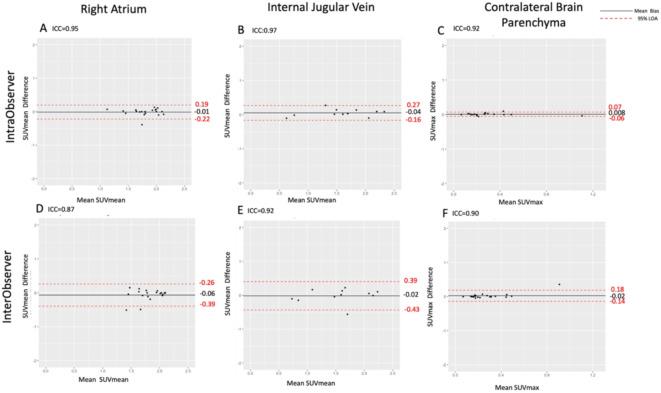
F-GP1 is a novel highly specific radiotracer that binds to activated platelets and thrombus. We aimed to establish the observer repeatability of coronary, carotid and cerebral F-GP1 uptake in patients presenting with acute myocardial infarction or ischaemic stroke. Forty-three patients presenting with acute myocardial infarction or ischaemic stroke underwent hybrid positron emission tomography (PET) and computed tomography (CT) angiography. Qualitative and quantitative assessment of F-GP1 uptake was performed on coronary arteries, carotid arteries and brain parenchyma. Qualitative uptake of F-GP1 had excellent intraobserver and interobserver agreement, with complete agreement for the presence or absence of visual F-GP1 uptake. For quantitative analysis, there were excellent intraclass correlation coefficients for intraobserver repeatability for coronary artery, carotid artery and brain parenchymal SUV and TBR measurements (all ≥ 0.92). Coronary artery and brain parenchymal analyses showed the strongest agreement in SUV values with mean biases of - 0.04 (limits of agreement - 0.21 to 0.20) and 0.02 (limits of agreement - 0.29 to 0.32) respectively. There was good interclass correlation coefficients for interobserver repeatability for coronary artery, carotid artery and brain parenchymal SUV and TBR measurements (all ≥ 0.89). The strongest interobserver agreement was seen with brain parenchymal SUV (mean SUV 1.95 ± 0.94) and TBR (mean TBR 9.55 ± 6.56) with mean biases of - 0.05 (limits of agreement - 0.37 to 0.27) and 0.04 (limits of agreement - 0.59 to 0.52) respectively. Visual qualitative and quantitative F-GP1 PET-CT image analyses provide robust and repeatable measurements of activated platelets and thrombi within the coronary arteries, carotid arteries and brain parenchyma.
F-GP1 是一种新型的高度特异性放射性示踪剂,可与激活的血小板和血栓结合。我们旨在建立观察者在急性心肌梗死或缺血性脑卒中患者中冠状动脉、颈动脉和脑实质 F-GP1 摄取的重复性。43 例急性心肌梗死或缺血性脑卒中患者行混合正电子发射断层扫描(PET)和计算机断层扫描(CT)血管造影。对冠状动脉、颈动脉和脑实质进行 F-GP1 摄取的定性和定量评估。F-GP1 摄取的定性具有极好的观察者内和观察者间一致性,对于视觉 F-GP1 摄取的存在或不存在具有完全一致的意见。对于定量分析,冠状动脉、颈动脉和脑实质 SUV 和 TBR 测量的观察者内重复性具有极好的组内相关系数(均≥0.92)。冠状动脉和脑实质分析在 SUV 值方面显示出最强的一致性,平均偏差分别为-0.04(界限为-0.21 至 0.20)和 0.02(界限为-0.29 至 0.32)。冠状动脉、颈动脉和脑实质 SUV 和 TBR 测量的观察者间重复性具有良好的组间相关系数(均≥0.89)。脑实质 SUV(平均 SUV 1.95±0.94)和 TBR(平均 TBR 9.55±6.56)的观察者间一致性最强,平均偏差分别为-0.05(界限为-0.37 至 0.27)和 0.04(界限为-0.59 至 0.52)。F-GP1 PET-CT 图像的视觉定性和定量分析为冠状动脉、颈动脉和脑实质内激活的血小板和血栓提供了稳健且可重复的测量。



 Zotero 插件