Park Jae Young, Ha Sang Hee, Jeong Soo, Chang Jun Young, Kang Dong-Wha, Kwon Sun U, Kim Bum Joon
Department of Neurology, Asan Medical Center, University of Ulsan College of Medicine, Seoul, Korea.
Department of Neurology, Gil Medical Center, Gachon University College of Medicine, Incheon, Korea.
J Clin Neurol. 2024 Nov;20(6):617-623. doi: 10.3988/jcn.2024.0139.
An intracranial vertebral artery dissecting aneurysm (iVADA) increases the risk of future subarachnoid hemorrhage, which is a severe complication with high rebleeding rates and poor outcomes. Identifying potential risk factors associated with iVADA growth is crucial for their effective management.
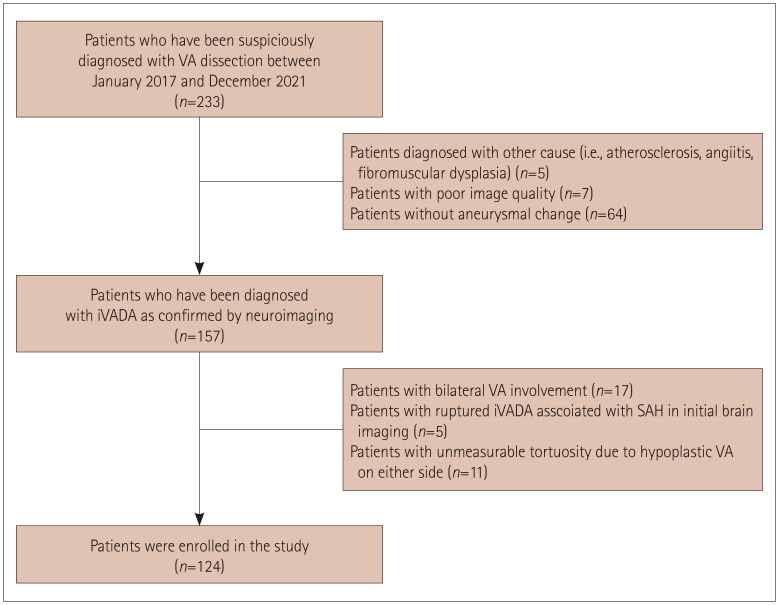
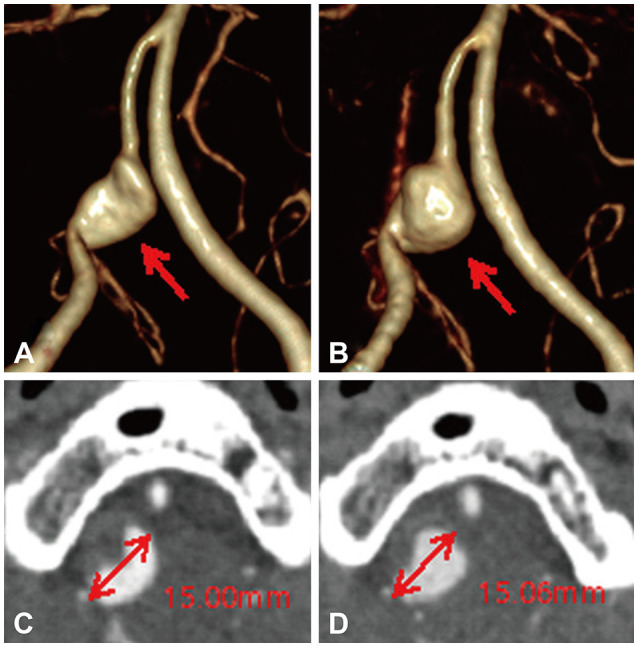
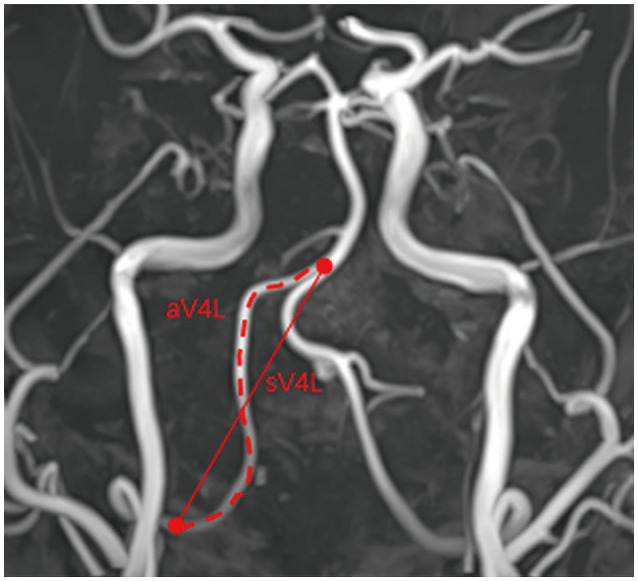
This observational study was carried out at a single center and included patients who had been diagnosed with iVADA based on neuroimaging findings. We divided the patients into two groups: with and without iVADA growth. Growth was defined as any enlargement of a dilated region or a morphological change in follow-up imaging. We measured the vertebral artery tortuosity index (VTI) in the contralateral vertebral artery (VA), defined as its actual length divided by its straight length. We investigated the factors associated with iVADA growth.
This study included 124 patients. The median follow-up period was 7 months. We observed iVADA growth in 54 patients (43.5%), who were more likely to be current smokers (33.3% vs. 14.3%, =0.012) and have a higher VTI (1.14±0.11 [mean±standard deviation] vs. 1.06±0.12, =0.035) compared with those without iVADA growth. A multivariate analysis revealed that the VTI (adjusted odds ratio=28.490, 95% confidence interval=1.025-792.046, =0.048) was independently associated with iVADA growth.
This study has identified an independent association between VA tortuosity and iVADA growth.
颅内椎动脉夹层动脉瘤(iVADA)会增加未来蛛网膜下腔出血的风险,蛛网膜下腔出血是一种严重并发症,再出血率高且预后较差。识别与iVADA生长相关的潜在风险因素对其有效管理至关重要。
本观察性研究在单一中心开展,纳入了根据神经影像学检查结果诊断为iVADA的患者。我们将患者分为两组:有iVADA生长组和无iVADA生长组。生长定义为随访影像中扩张区域的任何增大或形态改变。我们测量了对侧椎动脉(VA)的椎动脉迂曲指数(VTI),定义为其实际长度除以直线长度。我们调查了与iVADA生长相关的因素。
本研究纳入了124例患者。中位随访期为7个月。我们观察到54例患者(43.5%)出现iVADA生长,与无iVADA生长的患者相比,这些患者更有可能是当前吸烟者(33.3%对14.3%,P = 0.012)且VTI更高(1.14±0.11[均值±标准差]对1.06±0.12,P = 0.035)。多因素分析显示VTI(调整后的比值比 = 28.490,95%置信区间 = 1.025 - 792.046,P = 0.048)与iVADA生长独立相关。
本研究确定了椎动脉迂曲与iVADA生长之间的独立关联。