Chia Zheng-Jie, Kumarapperuma Hirushi, Zhang Ruizhi, Little Peter J, Kamato Danielle
Institute for Biomedicine and Glycomics, Griffith University, Nathan, QLD, Australia.
School of Pharmacy, The University of Queensland, Woolloongabba, QLD, Australia.
Acta Pharmacol Sin. 2025 Apr;46(4):795-804. doi: 10.1038/s41401-024-01413-6. Epub 2024 Nov 6.
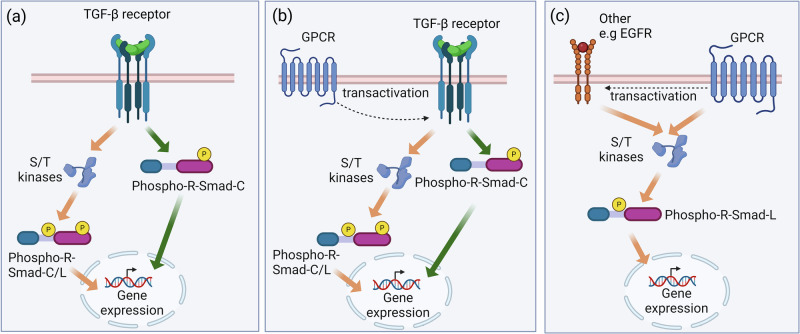
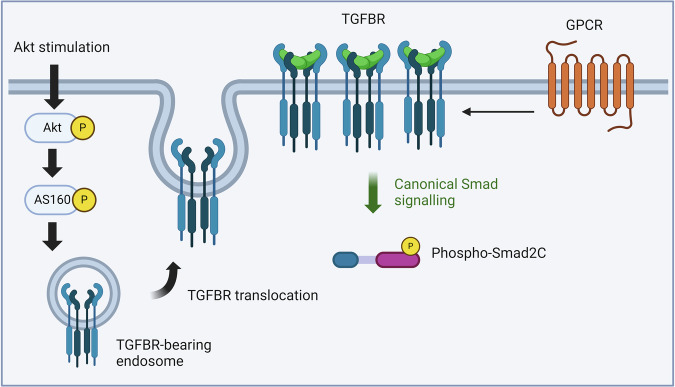
The Smad transcription factors are well known for their role at the core of transforming growth factor-β (TGF-β) signalling. However, recent evidence shows that the Smad transcription factors play a vital role downstream of other classes of receptors including G protein-coupled receptors (GPCR). The versatility of Smad transcription factors originated from the two regions that can be differently activated by the TGF-β receptor superfamily or through the recruitment of intracellular kinases stimulated by other receptors classes such as GPCRs. The classic GPCR signalling cascade is further expanded to conditional adoption of the Smad transcription factor under the stimulation of Akt, demonstrating the unique involvement of the Smad transcription factor in GPCR signalling pathways in disease environments. In this review, we provide a summary of the signalling pathways of the Smad transcription factors as an important downstream mediator of GPCRs, presenting exciting opportunities for discovering new therapeutic targets for diseases.
Smad转录因子因其在转化生长因子-β(TGF-β)信号传导核心中的作用而广为人知。然而,最近的证据表明,Smad转录因子在包括G蛋白偶联受体(GPCR)在内的其他类型受体的下游发挥着至关重要的作用。Smad转录因子的多功能性源于两个区域,这两个区域可被TGF-β受体超家族以不同方式激活,或通过募集由其他受体类型(如GPCR)刺激的细胞内激酶来激活。经典的GPCR信号级联反应在Akt刺激下进一步扩展为对Smad转录因子的条件性采用,这表明Smad转录因子在疾病环境中的GPCR信号通路中具有独特的参与作用。在本综述中,我们总结了Smad转录因子作为GPCR重要下游介质的信号通路,为发现疾病的新治疗靶点提供了令人兴奋的机会。