Vancouver Prostate Centre, Department of Urologic Sciences, University of British Columbia, Vancouver, Canada.
Michael Smith Genome Sciences Centre, BC Cancer, Vancouver, BC, Canada.
Sci Rep. 2024 Nov 6;14(1):26883. doi: 10.1038/s41598-024-78440-0.
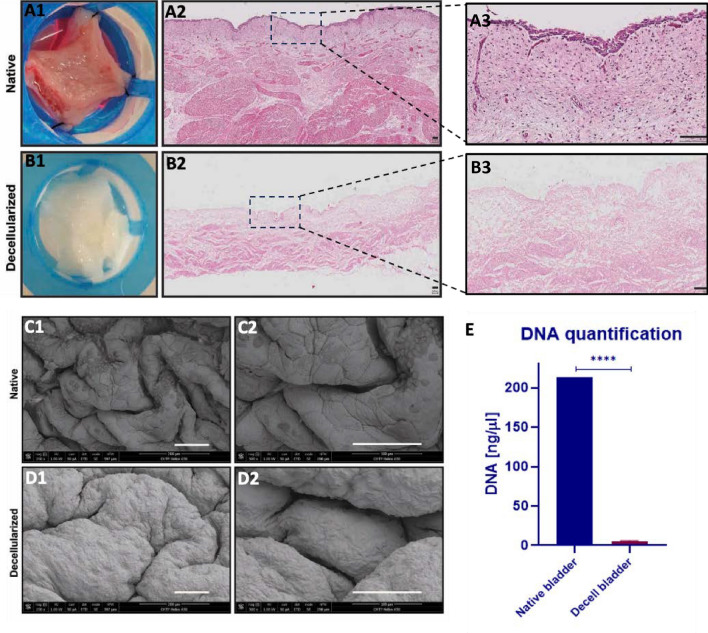
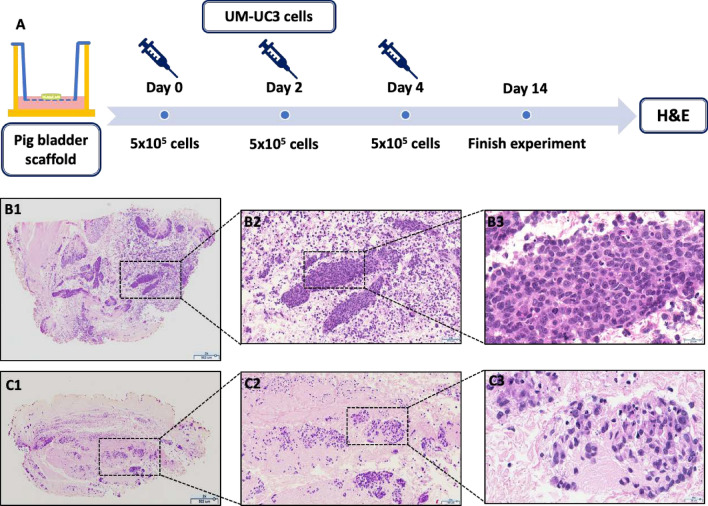
Bladder cancer (BCa) poses a significant health challenge, particularly affecting men with higher incidence and mortality rates. Addressing the need for improved predictive models in BCa treatment, this study introduces an innovative 3D in vitro patient-derived bladder cancer tumor model, utilizing decellularized pig bladders as scaffolds. Traditional 2D cell cultures, insufficient in replicating tumor microenvironments, have driven the development of sophisticated 3D models. The study successfully achieved pig bladder decellularization through multiple cycles of immersion in salt solutions, resulting in notable macroscopic and histological changes. This process confirmed the removal of cellular components while preserving the native extracellular matrix (ECM). Quantitative analysis demonstrated the efficacy of decellularization, with a remarkable reduction in DNA concentration, signifying the removal of over 95% of cellular material. In the development of the in vitro bladder cancer model, muscle invasive bladder cancer patients' cells were cultured within decellularized pig bladders, yielding a three-dimensional cancer model. Optimal results were attained using an air-liquid interface technique, with cells injected directly into the scaffold at three distinct time points. Histological evaluations showcased characteristics resembling in vivo tumors derived from bladder cancer patients' cells. To demonstrate the 3D cancer model's effectiveness as a drug screening platform, the study treated it with Cisplatin (Cis), Gemcitabine (Gem), and a combination of both drugs. Comprehensive cell viability assays and histological analyses illustrated changes in cell survival and proliferation. The model exhibited promising correlations with clinical outcomes, boasting an 83.3% reliability rate in predicting treatment responses. Comparison with traditional 2D cultures and spheroids underscored the 3D model's superiority in reliability, with an 83.3% predictive capacity compared to 50% for spheroids and 33.3% for 2D culture. Acknowledging limitations, such as the absence of immune and stromal components, the study suggests avenues for future improvements. In conclusion, this innovative 3D bladder cancer model, combining decellularization and patient-derived cells, marks a significant advancement in preclinical drug testing. Its potential for predicting treatment outcomes and capturing patient-specific responses opens new avenues for personalized medicine in bladder cancer therapeutics. Future refinements and validations with larger patient cohorts hold promise for revolutionizing BCa research and treatment strategies.
膀胱癌(BCa)是一个重大的健康挑战,尤其影响发病率和死亡率较高的男性。为了满足改善 BCa 治疗预测模型的需求,本研究引入了一种创新的 3D 体外患者来源的膀胱癌肿瘤模型,利用去细胞猪膀胱作为支架。传统的 2D 细胞培养在复制肿瘤微环境方面存在不足,推动了复杂 3D 模型的发展。本研究通过多次浸入盐溶液的循环成功实现了猪膀胱去细胞化,导致明显的宏观和组织学变化。该过程证实了细胞成分的去除,同时保留了天然细胞外基质(ECM)。定量分析表明去细胞化的效果显著,DNA 浓度显著降低,表明超过 95%的细胞物质被去除。在体外膀胱癌模型的开发中,肌层浸润性膀胱癌患者的细胞在去细胞化的猪膀胱内培养,产生了一个三维癌症模型。使用气液界面技术获得了最佳结果,将细胞直接注射到支架中三个不同的时间点。组织学评估展示了源自膀胱癌患者细胞的体内肿瘤的特征。为了证明 3D 癌症模型作为药物筛选平台的有效性,该研究用顺铂(Cis)、吉西他滨(Gem)和两种药物的联合药物对其进行了处理。全面的细胞活力测定和组织学分析表明了细胞存活和增殖的变化。该模型与临床结果具有良好的相关性,预测治疗反应的可靠性为 83.3%。与传统的 2D 培养和球体相比,3D 模型在可靠性方面具有优势,预测能力为 83.3%,球体为 50%,2D 培养为 33.3%。该研究承认存在局限性,例如缺乏免疫和基质成分,并提出了未来改进的途径。总之,这种创新的 3D 膀胱癌模型,结合去细胞化和患者来源的细胞,标志着临床前药物测试的重大进展。它在预测治疗结果和捕获患者特异性反应方面的潜力为膀胱癌治疗中的个性化医学开辟了新的途径。未来与更大的患者队列进行改进和验证有望彻底改变 BCa 研究和治疗策略。