Fenk Lorenz A, Riquelme Juan Luis, Laurent Gilles
Max Planck Institute for Brain Research, Frankfurt, Germany.
Max Planck Institute for Biological Intelligence, Martinsried, Germany.
Nature. 2024 Dec;636(8043):681-689. doi: 10.1038/s41586-024-08162-w. Epub 2024 Nov 6.
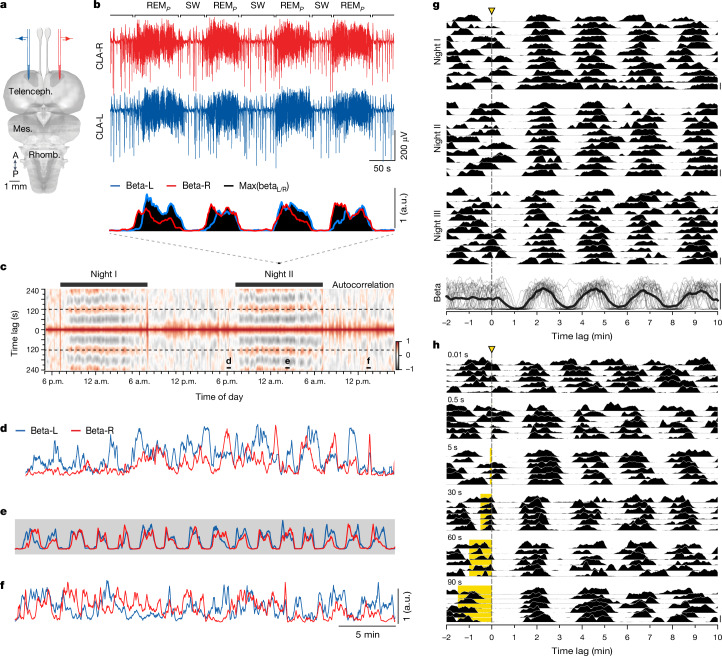
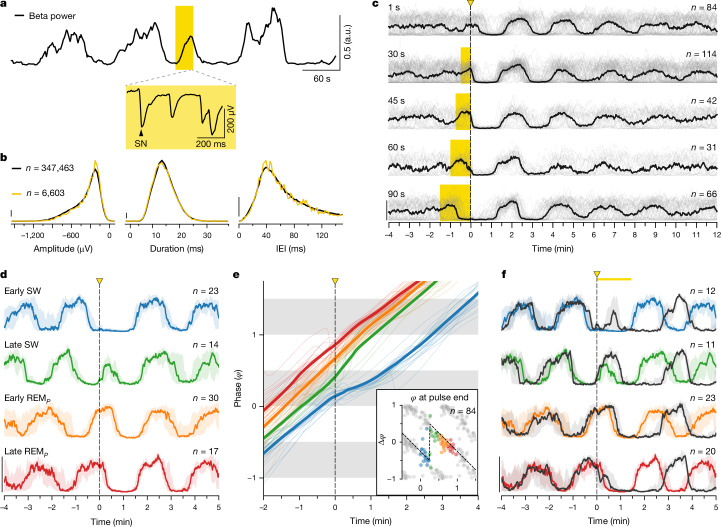
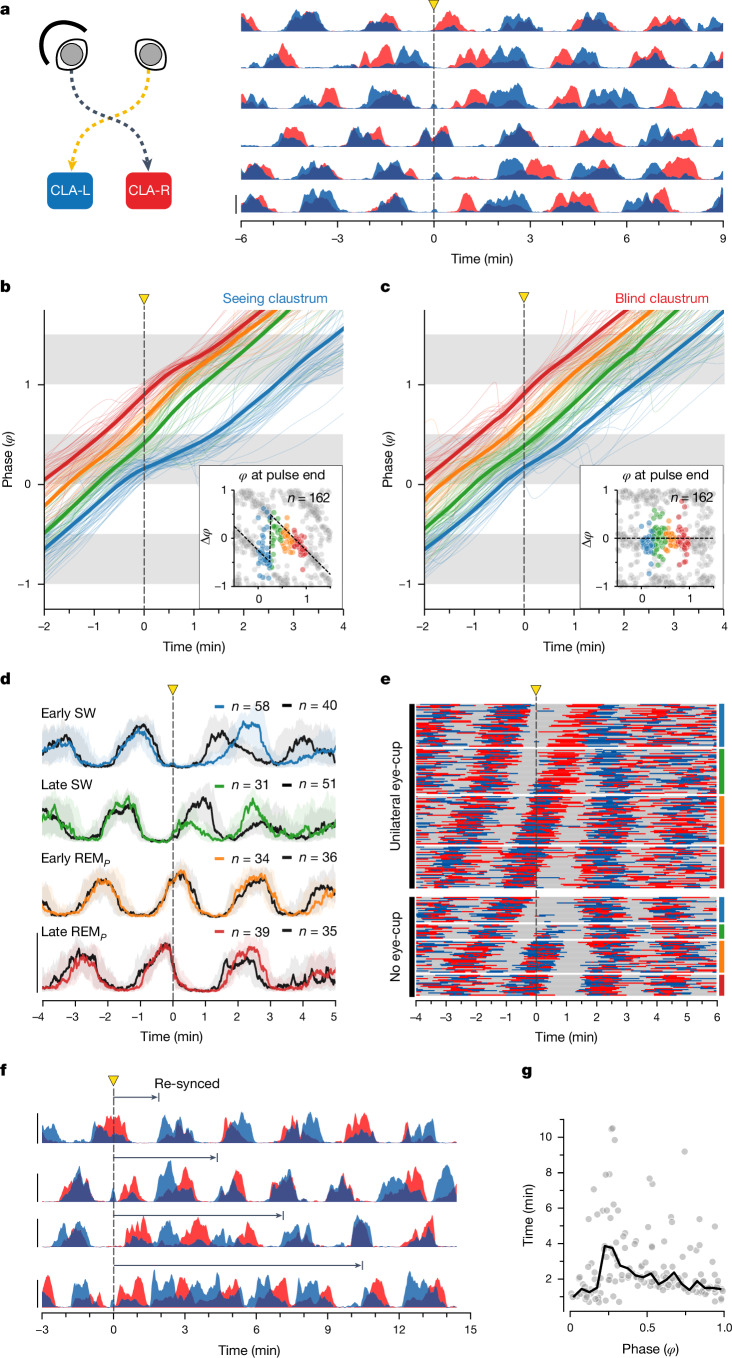
The mechanisms underlying the mammalian ultradian sleep rhythm-the alternation of rapid-eye-movement (REM) and slow-wave (SW) states-are not well understood but probably depend, at least in part, on circuits in the brainstem. Here, we use perturbation experiments to probe this ultradian rhythm in sleeping lizards (Pogona vitticeps) and test the hypothesis that it originates in a central pattern generator-circuits that are typically susceptible to phase-dependent reset and entrainment by external stimuli. Using light pulses, we find that Pogona's ultradian rhythm can be reset in a phase-dependent manner, with a critical transition from phase delay to phase advance in the middle of SW. The ultradian rhythm frequency can be decreased or increased, within limits, by entrainment with light pulses. During entrainment, Pogona REM (REM) can be shortened but not lengthened, whereas SW can be dilated more flexibly. In awake animals, a few alternating light/dark epochs matching natural REM and SW durations entrain a sleep-like brain rhythm, suggesting the transient activation of an ultradian rhythm generator. In sleeping animals, a light pulse delivered to a single eye causes an immediate ultradian rhythm reset, but only of the contralateral hemisphere; both sides resynchronize spontaneously, indicating that sleep is controlled by paired rhythm-generating circuits linked by functional excitation. Our results indicate that central pattern generators of a type usually known to control motor rhythms may also organize the ultradian sleep rhythm in a vertebrate.
哺乳动物超日睡眠节律(快速眼动(REM)和慢波(SW)状态的交替)背后的机制尚未完全了解,但可能至少部分取决于脑干中的神经回路。在这里,我们使用扰动实验来探究睡眠蜥蜴(鬃狮蜥)的这种超日节律,并检验其起源于中央模式发生器的假说,这种神经回路通常易受外部刺激的相位依赖性重置和夹带作用的影响。通过光脉冲,我们发现鬃狮蜥的超日节律可以以相位依赖的方式重置,在慢波中间存在从相位延迟到相位提前的关键转变。超日节律频率可以通过光脉冲夹带在一定范围内降低或增加。在夹带过程中,鬃狮蜥的快速眼动(REM)可以缩短但不能延长,而慢波(SW)可以更灵活地扩展。在清醒动物中,几个与自然快速眼动和慢波持续时间匹配的明暗交替时期会夹带一种类似睡眠的脑节律,这表明超日节律发生器被短暂激活。在睡眠动物中,向单眼发送的光脉冲会立即重置超日节律,但仅对侧半球会发生;两侧会自发重新同步,这表明睡眠由通过功能性兴奋连接的成对节律产生回路控制。我们的结果表明,通常已知控制运动节律的一类中央模式发生器也可能在脊椎动物中组织超日睡眠节律。