Wołoszkiewicz Joanna, Dabert Jacek, Kaźmierczak Sandra, Kloskowski Janusz
Institute of Zoology, Poznań University of Life Sciences, Wojska Polskiego 71C, 60-625, Poznań, Poland.
Department of Animal Morphology, Faculty of Biology, Adam Mickiewicz University, Uniwersytetu Poznańskiego 6, 61-614, Poznań, Poland.
Int J Parasitol Parasites Wildl. 2024 Oct 20;25:101008. doi: 10.1016/j.ijppaw.2024.101008. eCollection 2024 Dec.
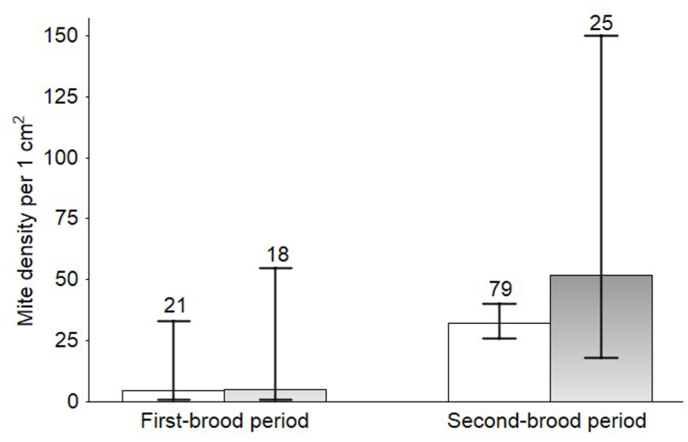
The effects of ectosymbiotic feather mites on avian host fitness and factors driving the variation in mite infestation levels, such as host mating and brood care system, are poorly understood. We investigated patterns of feather mite prevalence and abundance, and relationships between infestation and body condition in breeding Aquatic Warblers , a promiscuous songbird with female-only parental care. In plumage, the dominant mite species was whose prevalence more than doubled during the breeding season, to reach 95% (95% confidence limits 71-99) during the second-brood period. Approximately 5% of birds were co-infested with cf. . While mite prevalence did not differ between sexes, mite abundance was significantly greater in Aquatic Warbler females than in males, and it increased between the first- and the second-brood period irrespective of sex. No significant relationship was found between mite prevalence or abundance and host condition expressed as mass scaled to size. However, in breeding females, this relationship could be confounded by the effects of nest-dwelling ectoparasites present in some nests but only sporadically if at all detected on adult birds; 2% of adult birds were heavily infested with the hematophagous mite (Mesostigmata). Our findings indicate that the mating system may affect symbiont variability between and within host species. The high prevalence of feather mites on adult birds at the late stage of the breeding season supports the hypothesis that promiscuous species have high infestation levels. Greater mite loads on Aquatic Warbler females than males reveal a different pattern from previously studied birds. However, we did not identify any consequences of mite infestation for the female body condition or current breeding success; hence, the apparently commensal relationship does not imply costs of female promiscuity.
体表共生的羽螨对鸟类宿主健康的影响,以及诸如宿主交配和育雏系统等驱动螨类感染水平变化的因素,目前还知之甚少。我们调查了繁殖期水蒲苇莺(一种实行混交制且只有雌性参与亲代抚育的鸣禽)羽螨的感染率和丰度模式,以及感染情况与身体状况之间的关系。在羽毛上,优势螨种是 ,其感染率在繁殖季节增加了一倍多,在第二窝育雏期达到95%(95%置信区间71 - 99)。约5%的鸟同时感染了 cf. 。虽然螨类感染率在两性间没有差异,但水蒲苇莺雌性的螨类丰度显著高于雄性,且无论性别,在第一窝和第二窝育雏期之间螨类丰度都有所增加。未发现螨类感染率或丰度与以体重与体型比例表示的宿主状况之间存在显著关系。然而,在繁殖期雌性中,这种关系可能会因某些巢穴中存在巢居外寄生虫的影响而混淆,这些外寄生虫在成年鸟类身上只是偶尔被检测到;2%的成年鸟被吸血螨 (中气门亚目)严重感染。我们的研究结果表明,交配系统可能会影响宿主物种之间以及宿主物种内部共生体的变异性。繁殖季节后期成年鸟类羽螨的高感染率支持了混交制物种感染水平高的假说。水蒲苇莺雌性的螨类负荷高于雄性,这与之前研究的鸟类呈现出不同的模式。然而,我们没有发现螨类感染对雌性身体状况或当前繁殖成功率有任何影响;因此,这种明显的共生关系并不意味着雌性混交制的代价。