Mc Leer Anne, Mondet Julie, Magnat Nelly, Mersch Mailys, Giovannini Diane, Emprou Camille, Toffart Anne-Claire, Sturm Nathalie, Lantuéjoul Sylvie, Benito David
Université Grenoble Alpes, Grenoble, France.
Service d'Anatomie et Cytologie Pathologiques, Pôle de Biologie et Pathologie, CHU Grenoble Alpes, Grenoble, France.
JTO Clin Res Rep. 2024 Aug 29;5(12):100714. doi: 10.1016/j.jtocrr.2024.100714. eCollection 2024 Dec.
rearrangements occur in 1% to 2% NSCLCs. Since no clinically validated RET antibody is currently available, fluorescence in situ hybridization (FISH) is often used as a screening tool to identify patients likely to benefit from RET-targeted therapy. In this study, we performed a comprehensive review of publications in which -rearrangement testing was performed by FISH and compared the methods and results with our data.
The findings of an electronic search for publications using -FISH in lung cancer were compared with the results obtained at the Grenoble University Hospital where 784 , , -, and -negative NSCLCs were tested by break-apart FISH and confirmed by RNA-sequencing (RNA-seq).
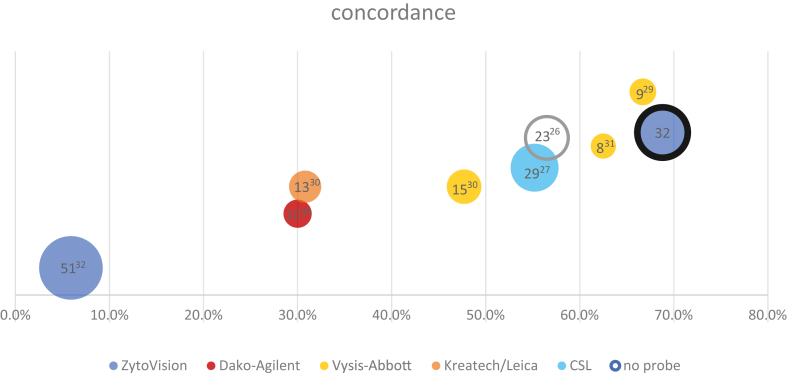
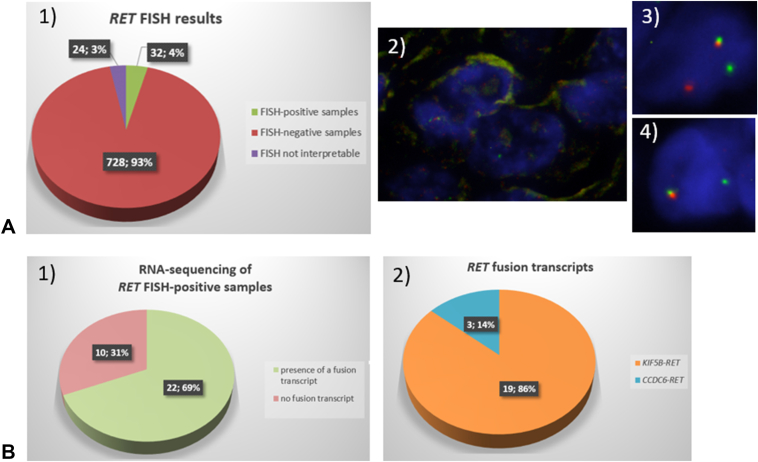
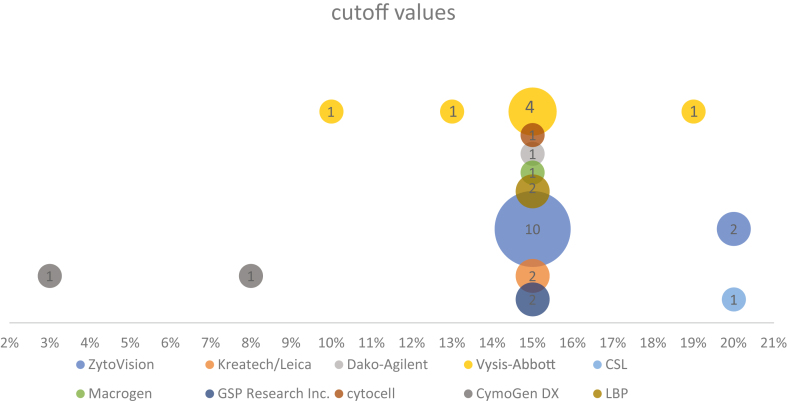
Out of the 85 publications using -FISH analysis, 52 pertained to patients with lung cancer. The most often used positivity threshold was 15%. Six publications compared -FISH with at least one other molecular technique on at least eight samples, and the concordance was variable, from 5.9% to 66.7% for FISH-positive cases. Regarding our data, out of the 784 analyzed samples, 32 (4%) were positive by -FISH. The concordance between -FISH and RNA-seq in -FISH positive samples was 69%.
Overall, both existing literature and our data suggest that -FISH testing can be used for rapid screening of rearrangements in NSCLC. Nevertheless, using an orthogonal technique such as RNA-seq to confirm -FISH-positive cases is essential for ensuring that only patients likely to benefit from -target therapy receive the treatment.
重排在1%至2%的非小细胞肺癌(NSCLC)中发生。由于目前尚无经临床验证的RET抗体,荧光原位杂交(FISH)常被用作筛选工具,以识别可能从RET靶向治疗中获益的患者。在本研究中,我们对通过FISH进行重排检测的出版物进行了全面综述,并将方法和结果与我们的数据进行了比较。
将使用肺癌-FISH的出版物的电子搜索结果与格勒诺布尔大学医院获得的结果进行比较,在该医院,784例 、 、 -和 -阴性的NSCLC通过断裂FISH检测,并通过RNA测序(RNA-seq)进行确认。
在85篇使用-FISH分析的出版物中,52篇涉及肺癌患者。最常用的阳性阈值为15%。6篇文章在至少8个样本上将-FISH与至少一种其他分子技术进行了比较,FISH阳性病例的一致性各不相同,从5.9%到66.7%不等。关于我们的数据,在784个分析样本中,32个(4%)通过-FISH呈阳性。-FISH阳性样本中-FISH与RNA-seq之间的一致性为69%。
总体而言,现有文献和我们的数据均表明,-FISH检测可用于NSCLC中重排的快速筛查。然而,使用诸如RNA-seq等正交技术来确认-FISH阳性病例对于确保只有可能从-靶向治疗中获益的患者接受治疗至关重要。