Center for Microbiology and Immunology, Lewis Katz School of Medicine, Temple University, Philadelphia, PA, USA.
Department of Microbiology and Immunology, Center for Advanced Microbial Processing, Institute for Molecular Medicine & Infectious Disease, Drexel University College of Medicine, Philadelphia, PA, USA.
Gut Microbes. 2024 Jan-Dec;16(1):2419567. doi: 10.1080/19490976.2024.2419567. Epub 2024 Nov 7.
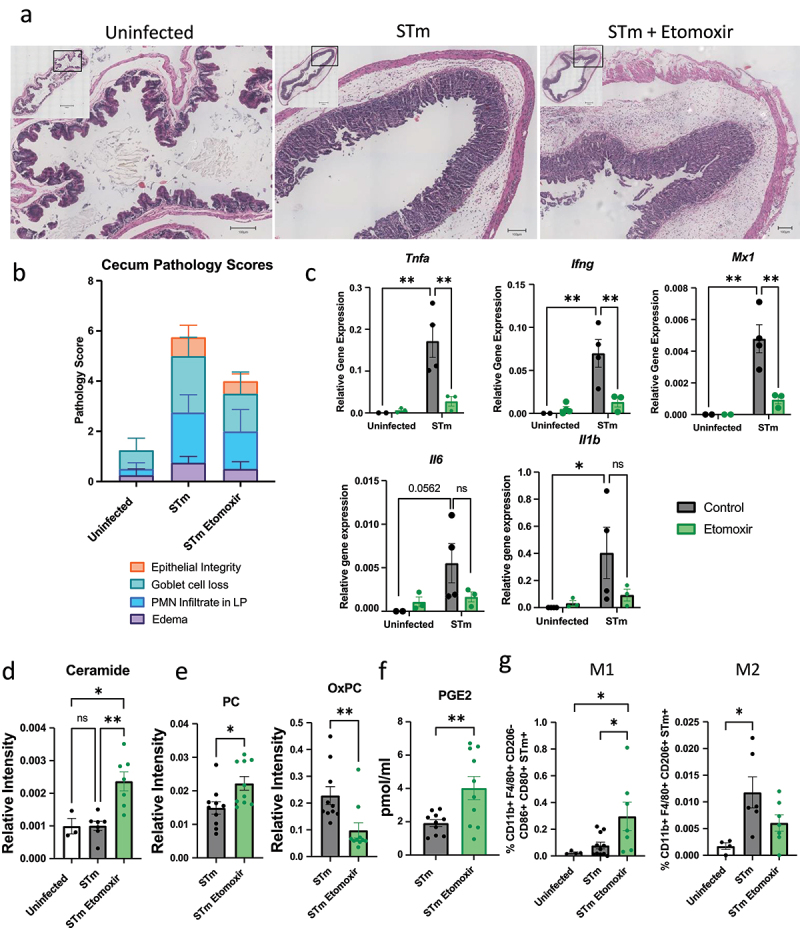
Typhimurium (STm) is a causative pathogen for robust inflammatory gastrointestinal disease and can lead to systemic infection. Eicosanoids, bioactive lipid mediators, play a crucial role in modulating both the induction and resolution of inflammatory responses during an infection. A subset of eicosanoids activates PPARs, nuclear receptor/transcription factors that regulate fatty acid metabolism, lipid body formation, and macrophage function. In this study, we determined that mice lacking PPARα exhibited reduced inflammatory hallmarks of STm infection, including lower inflammatory gene expression, cecal inflammation, and bacterial dissemination, along with a significant increase in cecal eicosanoid metabolism compared to wildtype C57BL/6 mice. In macrophages, STm favored M2b-polarized macrophages for intracellular infection, leading to reduced arachidonic acid and ceramide production. Inhibition of fatty acid oxidation via Etomoxir in STm-infected macrophages reduced bacterial burdens and promoted cell death. In Etomoxir-treated wildtype mice, STm infection increased ceramide production, decreased inflammatory gene expression in the cecum, and increased the number of STm-containing M1 macrophages in mesenteric lymph nodes. These findings revealed a novel role for the lipid-immune signaling axis in infections, providing significant insights into the lipid-mediated regulation of inflammation during bacterial infections in the gut.
鼠伤寒沙门氏菌(STm)是一种能引起强烈炎症性胃肠道疾病的病原体,可导致全身感染。类二十烷酸,生物活性脂质介质,在调节感染过程中炎症反应的诱导和消退中起着至关重要的作用。一部分类二十烷酸激活了 PPARs,核受体/转录因子,调节脂肪酸代谢、脂体形成和巨噬细胞功能。在这项研究中,我们发现缺乏 PPARα 的小鼠表现出 STm 感染的炎症特征减少,包括炎症基因表达、盲肠炎症和细菌传播降低,与野生型 C57BL/6 小鼠相比,盲肠类二十烷酸代谢显著增加。在巨噬细胞中,STm 有利于细胞内感染的 M2b 极化巨噬细胞,导致花生四烯酸和神经酰胺产生减少。在 STm 感染的巨噬细胞中通过 Etomoxir 抑制脂肪酸氧化可降低细菌负荷并促进细胞死亡。在 Etomoxir 处理的野生型小鼠中,STm 感染增加了神经酰胺的产生,降低了盲肠中炎症基因的表达,并增加了肠系膜淋巴结中含有 STm 的 M1 巨噬细胞的数量。这些发现揭示了脂质-免疫信号轴在感染中的新作用,为肠道细菌感染期间脂质介导的炎症调节提供了重要的见解。