Picton Leonie, George Johnson, Bell J Simon, Ilomäki Jenni
Centre for Medicine Use and Safety, Faculty of Pharmacy and Pharmaceutical Sciences Monash University Parkville Victoria Australia.
School of Public Health, Faculty of Medicine, Nursing and Health Sciences Monash University Melbourne Victoria Australia.
Health Sci Rep. 2024 Nov 6;7(11):e70165. doi: 10.1002/hsr2.70165. eCollection 2024 Nov.
This Australian population-based study investigated statin intensity after hospitalization for ischemic stroke in a matched cohort of people living with and without dementia.
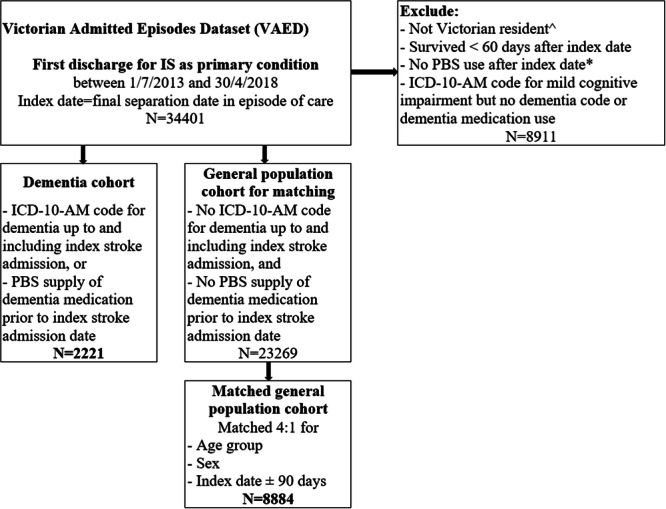
We identified all patients aged ≥ 30 years hospitalized in the state of Victoria, Australia, for ischemic stroke from July 1, 2013 to April 30, 2018 from the Victorian Admitted Episodes Data set. People with dementia were matched 1:4 for sex, 5-year age group and index date ± 90 days with people without dementia. Records of statin dispensing within 60 days postdischarge were extracted from prescription claims data. The intensity of the first postdischarge statin dispensing was determined. Odds ratios for high versus low-moderate intensity and no statin dispensing were estimated using multinomial logistic regression adjusted for factors including age, sex, and comorbidity.
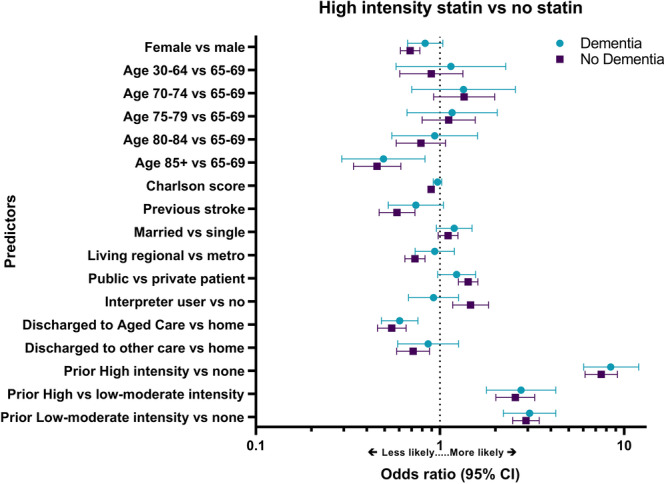
The cohorts comprised 11,105 people (dementia: = 2221; without dementia: = 8884 and 52% were female. Compared to people without dementia, people with dementia had 35% (95% confidence interval [CI]: 24%-44%) lower odds of receiving a high intensity versus a low-moderate intensity statin and 54% (95% CI: 48%-59%) lower odds of receiving a high intensity versus no statin. Compared to men, women with and without dementia had 16% (95% CI: 5%-25%) lower odds of receiving a high- versus low-moderate intensity statin and 28% (95% CI: 19%-35%) lower odds of receiving a high intensity versus no statin.
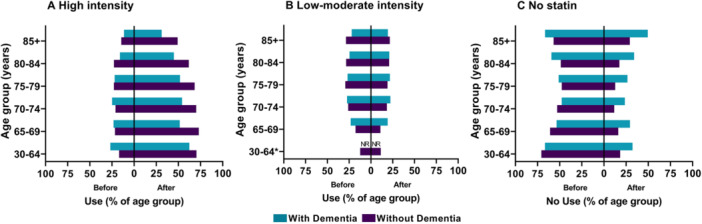
People living with dementia are less likely to receive high-intensity statins post-discharge compared to people without dementia. There is a gender gap in receipt of guideline-recommended high-intensity statin therapy for secondary prevention after ischemic stroke.
Guidelines recommend all people with reasonable life expectancy receive a high-intensity statin after stroke to reduce the risk of recurrent stroke and other adverse cardiovascular events. More research is needed to understand why people living with dementia might not receive guideline recommended care, and how statin use and statin intensity impact the health outcomes of people living with dementia and stroke.
这项基于澳大利亚人群的研究,在患有和未患痴呆症的匹配队列中,调查了缺血性中风住院后的他汀类药物治疗强度。
我们从维多利亚州入院病例数据集里,识别出2013年7月1日至2018年4月30日期间,在澳大利亚维多利亚州因缺血性中风住院的所有年龄≥30岁的患者。患有痴呆症的人与未患痴呆症的人按1:4的比例进行性别、5岁年龄组和索引日期±90天的匹配。出院后60天内的他汀类药物配药记录从处方报销数据中提取。确定出院后首次他汀类药物配药的强度。使用多项逻辑回归估计高强度与低 - 中等强度以及未使用他汀类药物的比值比,并对年龄、性别和合并症等因素进行调整。
队列包括11105人(痴呆症患者:=2221人;无痴呆症患者:=8884人,52%为女性)。与未患痴呆症的人相比,患痴呆症的人接受高强度他汀类药物而非低 - 中等强度他汀类药物的几率低35%(95%置信区间[CI]:24% - 44%),接受高强度他汀类药物而非未使用他汀类药物的几率低54%(95% CI:48% - 59%)。与男性相比,患有和未患痴呆症的女性接受高强度而非低 - 中等强度他汀类药物的几率低16%(95% CI:5% - 25%),接受高强度而非未使用他汀类药物的几率低28%(95% CI:19% - 35%)。
与未患痴呆症的人相比,痴呆症患者出院后接受高强度他汀类药物的可能性较小。在缺血性中风二级预防中,接受指南推荐的高强度他汀类药物治疗存在性别差异。
指南建议所有预期寿命合理的人在中风后接受高强度他汀类药物治疗,以降低复发性中风和其他不良心血管事件的风险。需要更多研究来了解为什么痴呆症患者可能未接受指南推荐的治疗,以及他汀类药物的使用和治疗强度如何影响痴呆症和中风患者的健康结局。