Department of Trauma Surgery and Orthopedics, University Hospital Frankfurt, Goethe University Frankfurt, Frankfurt, Main, Germany.
Center for Musculoskeletal Surgery, Charité - Universitätsmedizin Berlin, corporate member of Freie Universität Berlin and Humboldt-Universität Zu Berlin, Berlin, Germany.
PLoS One. 2024 Nov 12;19(11):e0311985. doi: 10.1371/journal.pone.0311985. eCollection 2024.
The accurate estimation of residual growth is crucial for the appropriate timing of growth-guiding surgery in patients with axial leg deviations. Skeletal age methods such as the Modified and the Abbreviated Modified Fels Knee System were developed on historical patient cohorts and the applicability to the modern pediatric population with axial leg deviation has not yet been evaluated.
QUESTIONS/PURPOSES: Are both final adult height prediction methods (the Modified Fels Knee System (FKS) and the Abbreviated Modified Fels Knee System (aFKS)) accurate to determine SA and the final adult height on long leg radiographs in patients with axial leg deviations?Which multiplier table shows highest association between predicted and true final adult body height?Do FKS- and aFKS- skeletal age determination methods improve final adult body height prediction accuracy compared to the simple use of chronological age?
A single center, retrospective study of 31 patients who underwent temporary hemiepiphysiodesis due to axial leg deviations in the frontal plane between 2018 and 2020 was conducted. Skeletal age at the time of surgery was determined on an anterior-posterior long leg X-ray using FKS and aFKS. Adult height predictions were calculated using three different multiplier tables (Paley et al., Sanders-Greulich and Pyle (SGP), Sanders-Peak Height Velocity (PHV)). The accuracy of adult height prediction was determined by comparing the mean differences and mean absolute differences between predicted and true adult height.
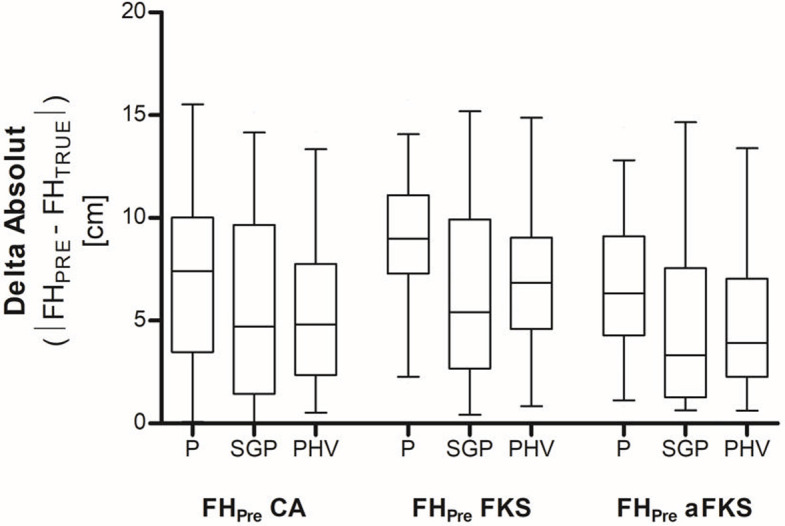
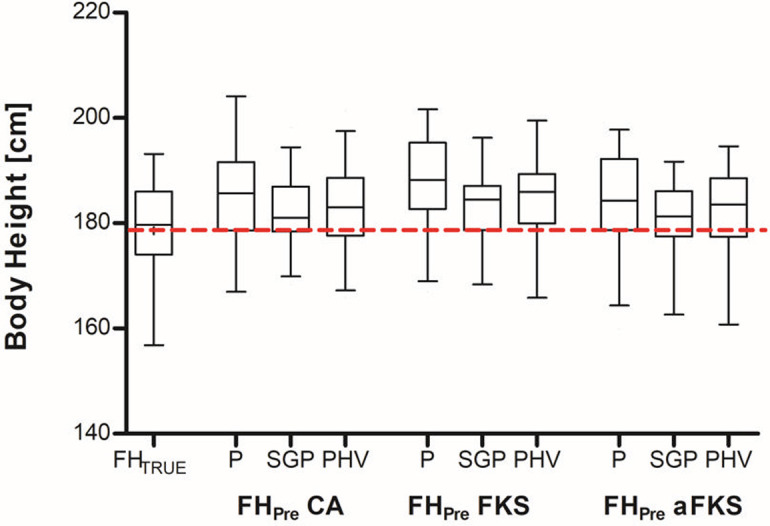
All adult height predictions overestimated the true adult height. The final height prediction using aFKS and the SGP multiplier showed the lowest overestimation (mean 3.2 cm, SD 5.5 cm). The PHV multiplier table showed the highest correlation between predicted and true adult height (FHPRE_FKS_PHV: r = 0.913, p < 0.001 and FHPRE_aFKS_PHV: r = 0.862, p < 0.001). The simple use of chronological age at the time of surgical intervention (CASI) with the Paley multiplier table showed the highest median delta absolute values and lowest correlations with true adult height (median 7.4 cm, 25%-75% percentile: 3.5-10.0 cm, r = 0.838, p < 0.001). Nevertheless, no significant differences in delta absolute values between various adult height predictions methods could be shown.
Overall, the results of the present retrospective cohort study show that there was no significant improvement in final height prediction accuracy when using the FKS or the aFKS method compared to the simple use of chronological age. One reason could be that patients with varus/valgus malalignment have specific growth characteristics that are not accounted for in multiplier tables or the FKS and aFKS method. Since there is no significant difference in prediction accuracy between the methods, the choice of method may depend on other factors, such as clinical preference or availability of resources. However, due to the small sample size, the study cannot definitively rule out potential differences between the prediction methods, and larger studies are required to validate these findings.
准确估计残余生长对于轴向腿部偏斜患者生长指导手术的适当时机至关重要。骨骼年龄方法,如改良和简化改良 Fels 膝关节系统,是在历史患者队列上开发的,其在现代儿科人群中伴轴向腿部偏斜的适用性尚未得到评估。
问题/目的:两种最终成年身高预测方法(改良 Fels 膝关节系统(FKS)和简化改良 Fels 膝关节系统(aFKS))是否都能准确确定 SA 和伴有轴向腿部偏斜的患者的最终成年身高?哪种倍增表显示出预测和真实最终成年身高之间的最高关联?与简单使用实际年龄相比,FKS 和 aFKS 骨骼年龄测定方法是否能提高最终成年身高预测的准确性?
对 2018 年至 2020 年间因轴向腿部偏斜在额状面行临时半骺阻滞术的 31 例患者进行了单中心回顾性研究。使用 FKS 和 aFKS 在前后位长骨 X 光片上确定手术时的骨骼年龄。使用三种不同的倍增表(Paley 等、Sanders-Greulich 和 Pyle(SGP)、Sanders-Peak Height Velocity(PHV))计算成年身高预测值。通过比较预测值与真实成年身高之间的平均差异和平均绝对差异,确定成年身高预测的准确性。
所有成年身高预测均高估了真实成年身高。使用 aFKS 和 SGP 倍增表的最终身高预测显示出最低的高估(平均 3.2cm,SD 5.5cm)。PHV 倍增表显示出预测和真实成年身高之间的最高相关性(FHPRE_FKS_PHV:r=0.913,p<0.001 和 FHPRE_aFKS_PHV:r=0.862,p<0.001)。在手术干预时简单使用实际年龄(CASI)和 Paley 倍增表显示出最高的中位数绝对差值和与真实成年身高的最低相关性(中位数 7.4cm,25%-75%:3.5-10.0cm,r=0.838,p<0.001)。尽管如此,各种成年身高预测方法之间的绝对差值没有显著差异。
总的来说,本回顾性队列研究的结果表明,与简单使用实际年龄相比,使用 FKS 或 aFKS 方法并没有显著提高最终身高预测的准确性。原因之一可能是存在内翻/外翻畸形的患者具有在倍增表或 FKS 和 aFKS 方法中未考虑到的特定生长特征。由于各方法之间的预测准确性没有显著差异,因此方法的选择可能取决于其他因素,如临床偏好或资源可用性。然而,由于样本量较小,该研究不能明确排除预测方法之间的潜在差异,需要更大的研究来验证这些发现。