Islam A B Azharul, Ellis David, Chari Natasha, Mccomb Katie, Poushi Maisha Zaman, Donkov Ivo
Urology, West Middlesex University Hospital, London, GBR.
Surgery, Dhaka Medical College & Hospital, Dhaka, BGD.
Cureus. 2024 Nov 13;16(11):e73585. doi: 10.7759/cureus.73585. eCollection 2024 Nov.
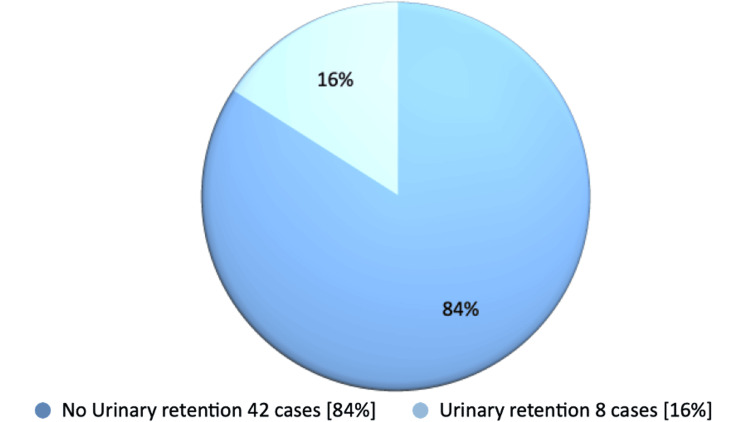
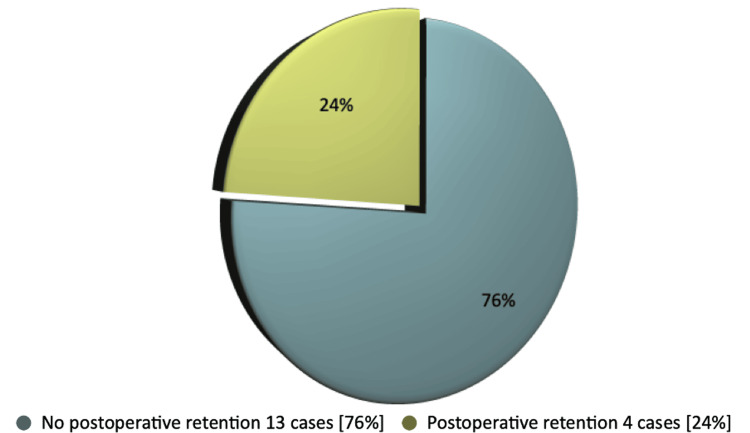
Objective Our study was designed to evaluate the postoperative urinary retention (UR) and success rate of the GreenLight Laser (Boston Scientific, Marlborough, MA, USA) photoselective vaporization of the prostate (GLL.PVP) procedure for Benign Prostatic Hyperplasia (BPH) patients, both with and without high-risk factors. Methodology We conducted a retrospective follow-up study of postoperative patients who underwent GLL.PVP for BPH. We collected data from clinical health records, including notes from the lower urinary tract symptoms (LUTS) clinic, trial without catheter (TWOC) clinic, and emergency department presentations with UR. The analysis examined several parameters, including the patient's age, high-risk factors, prostate volume, and both preoperative and postoperative objective voiding parameters. These voiding parameters included post-void residual (PVR) and maximum flow rate (Qmax). Additionally, the analysis looked into whether the patient had a catheter or experienced urinary retention prior to the surgery. Results A total of 50 GreenLight Laser PVP surgeries were performed over a 14-month period from May 2023 to July 2024 at West Middlesex University Hospital in London. Most of the patients were between the ages of 60 and 80. Prior to the surgery, data indicated that 17 patients (34%) were using long-term catheters, whereas 33 patients (66%) were not. Additionally, 25 patients (50%) were identified as having high-risk factors, which included being on anticoagulation therapy, a history of urinary retention, and a prostate volume exceeding 100 cc. Notably, the patient without h/o urinary retention had an average preoperative PVR of 150 mL and an average Qmax of 7 mL/second In our 3-6 month retrospective postoperative follow-up study, we found that eight cases (16%) developed urinary retention, while 42 cases (84%) did not, with an average PVR volume of 105 mL and an average Qmax of 13.5 mL/second. In patients with preoperative urinary retention, 13 cases (76%) did not develop UR postoperatively whereas four cases (24%) developed. Conclusion Our study conclusively found that 42 cases (84%) of patients did not experience urinary retention (UR) in the follow-up after undergoing the GLL PVP operation, irrespective of any history of urinary retention or other high-risk factors. This unequivocally demonstrates the operation's efficacy. Furthermore, our findings revealed that three-quarters of patients with a preoperative history of urinary retention also did not develop UR post-surgery. The GLL.PVP procedure is safe and effective, leading to rapid improvements in voiding parameters.
目的 我们的研究旨在评估绿激光(美国波士顿科学公司,马尔伯勒,马萨诸塞州)前列腺光选择性汽化术(GLL.PVP)治疗良性前列腺增生(BPH)患者术后尿潴留(UR)情况及成功率,无论患者有无高危因素。方法 我们对接受GLL.PVP治疗BPH的术后患者进行了回顾性随访研究。我们从临床健康记录中收集数据,包括下尿路症状(LUTS)门诊、无导尿管试验(TWOC)门诊记录以及因尿潴留到急诊科就诊的记录。分析检查了多个参数,包括患者年龄、高危因素、前列腺体积以及术前和术后的客观排尿参数。这些排尿参数包括残余尿量(PVR)和最大尿流率(Qmax)。此外,分析还调查了患者术前是否留置导尿管或有尿潴留情况。结果 在2023年5月至2024年7月的14个月期间,伦敦西米德尔塞克斯大学医院共进行了50例绿激光前列腺汽化术。大多数患者年龄在60至80岁之间。术前数据显示,17例患者(34%)长期使用导尿管,而33例患者(66%)未使用。此外,25例患者(50%)被确定有高危因素,包括接受抗凝治疗、有尿潴留病史以及前列腺体积超过100立方厘米。值得注意的是,无尿潴留病史的患者术前平均残余尿量为150毫升,平均最大尿流率为7毫升/秒。在我们为期3至6个月的术后回顾性随访研究中,我们发现8例患者(16%)发生了尿潴留,而42例患者(84%)未发生,平均残余尿量为105毫升,平均最大尿流率为13.5毫升/秒。术前有尿潴留的患者中,13例(76%)术后未发生尿潴留,而4例(24%)发生了尿潴留。结论 我们的研究最终发现,42例患者(84%)在接受GLL PVP手术后的随访中未出现尿潴留,无论其有无尿潴留病史或其他高危因素。这明确证明了该手术的疗效。此外,我们的研究结果显示,四分之三术前有尿潴留病史的患者术后也未发生尿潴留。GLL.PVP手术安全有效,能使排尿参数迅速改善。