Health Research and Extension Center, Postgraduate Program in Public Health, Department of Health, Universidade Estadual de Feira de Santana, Feira de Santana, BA, Brazil; PhD in Public Health, Universidade Estadual de Feira de Santana, Feira de Santana, BA, Brazil.
Health Research and Extension Center, Postgraduate Program in Public Health, Department of Health, Universidade Estadual de Feira de Santana, Feira de Santana, BA, Brazil; PhD in Medicine and Human Health, Escola Baiana de Medicina e Saúde Pública, Salvador, BA, Brazil.
Clinics (Sao Paulo). 2024 Nov 13;79:100531. doi: 10.1016/j.clinsp.2024.100531. eCollection 2024.
The newborn's intestinal microbiota can vary with gestational age. Reliable analyses of stool samples require establishing the steps of collection, packaging, transportation, and storage.
To describe the development of a protocol and test an algorithm for the sequence of actions and procedures for the collection, packaging, transportation, and storage of stool samples from Preterm Newborn (PTNB) admitted to a Neonatal Intensive Care Unit (NICU).
This is a descriptive, observational study linked to a non-randomized controlled clinical trial conducted in the NICU of two public hospitals covenanted to the Unified Health System of a large city in inland northeastern Brazil. The methodology adopted in its development followed the Brazilian Ministry of Health Preparation Guide recommendations.
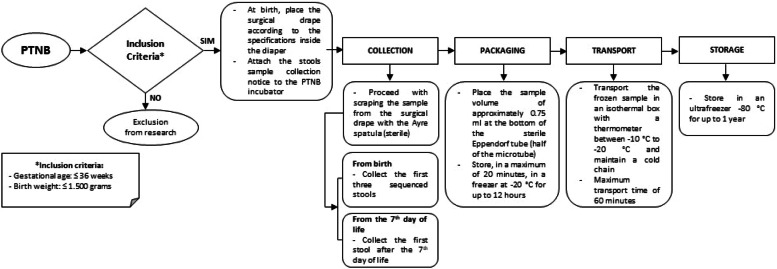
The flow of actions and procedures was consistent with scientific evidence. The sequence of work process steps to implement the proposed protocol was tested and resulted in a graphical representation of an algorithm compatible with the reality of Brazilian public hospitals.
Following the protocol steps with the description of the rules of conduct and recommendations regarding the collection, packaging, transportation, and storage of stool samples from PTNBs ensured the preservation and integrity of the bacterial DNA in the stools sample. The details of the recommendations will allow their reproducibility and improvement by professionals and researchers with similar study objects.
World Health Organization (WHO) under Universal Trial Number (UTN) code U1111-1266-2295, under register RBR-3mm7cs in the Brazilian Registry of Clinical Trials (REBEC).
新生儿的肠道微生物群可以随胎龄而变化。要可靠地分析粪便样本,需要建立收集、包装、运输和储存的步骤。
描述制定早产儿(PTNB)粪便样本收集、包装、运输和储存的操作和程序序列的方案,并对其进行测试。
这是一项描述性、观察性研究,与巴西东北部内陆一个大城市的两个公立医院的非随机对照临床试验相关联,这些医院都与统一卫生系统有合作。其开发采用的方法遵循了巴西卫生部准备指南的建议。
行动和程序的流程与科学证据一致。测试了实施拟议方案的工作流程步骤的序列,并生成了与巴西公立医院实际情况兼容的算法图形表示。
按照协议步骤进行操作,并对 PTNB 的粪便样本收集、包装、运输和储存的行为规则和建议进行描述,确保了粪便样本中细菌 DNA 的保存和完整性。这些建议的详细信息将允许专业人员和研究人员在具有类似研究对象的情况下进行重现和改进。
世界卫生组织(WHO)在通用试验编号(UTN)下注册,编号为 U1111-1266-2295,在巴西临床试验注册中心(REBEC)的注册号为 RBR-3mm7cs。