Department of Transfusion Medicine, Key Laboratory of Jiangxi Province for Transfusion Medicine, The First Affiliated Hospital, Jiangxi Medical College, Nanchang University, Nanchang, China.
Biol Direct. 2024 Nov 14;19(1):116. doi: 10.1186/s13062-024-00564-0.
Tumor Mutational Burden (TMB) have emerged as pivotal predictive biomarkers in determining prognosis and response to immunotherapy in colorectal cancer (CRC) patients. While Whole Exome Sequencing (WES) stands as the gold standard for TMB assessment, carry substantial costs and demand considerable time commitments. Additionally, the heterogeneity among high-TMB patients remains poorly characterized.
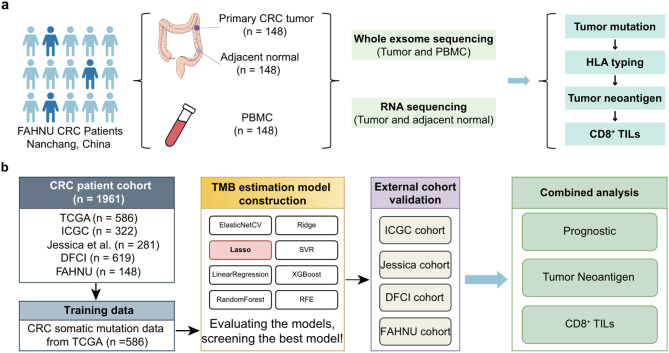
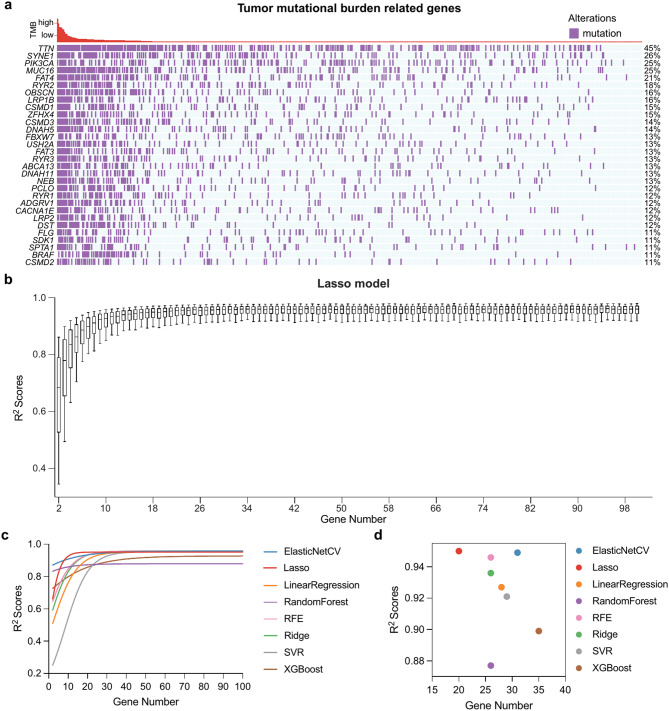
We employed eight advanced machine learning algorithms to develop gene-panel-based models for TMB estimation. To rigorously compare and validate these TMB estimation models, four external cohorts, involving 1,956 patients, were used. Furthermore, we computed the Pearson correlation coefficient between the estimated TMB and tumor neoantigen levels to elucidate their association. CD8 tumor-infiltrating lymphocyte (TIL) density was assessed via immunohistochemistry.
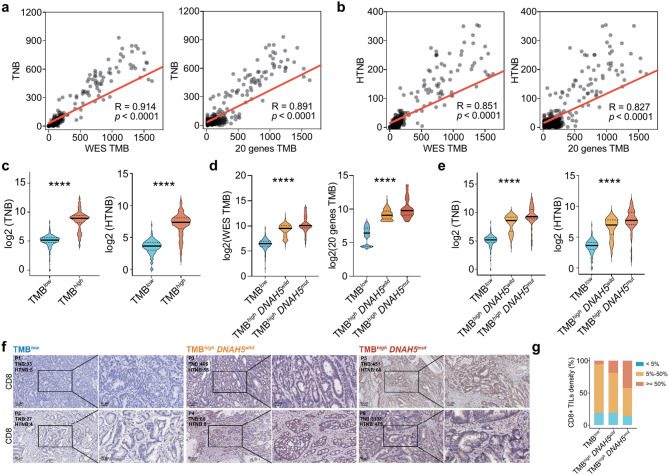
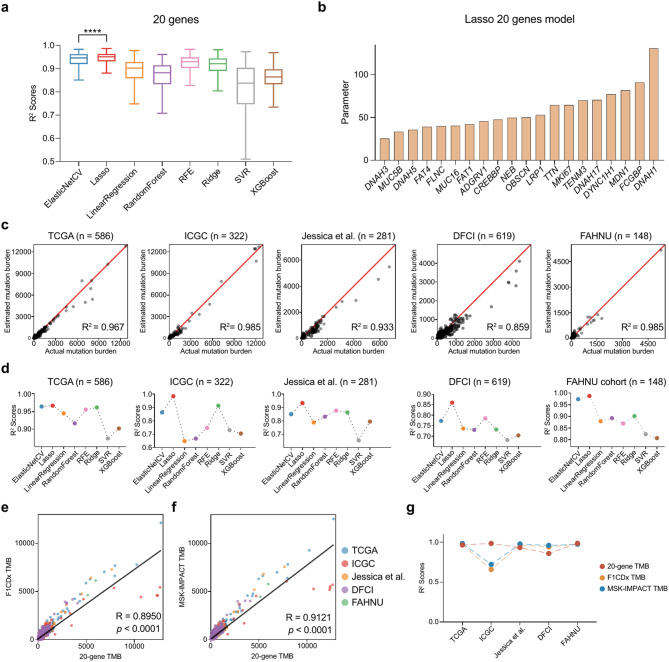
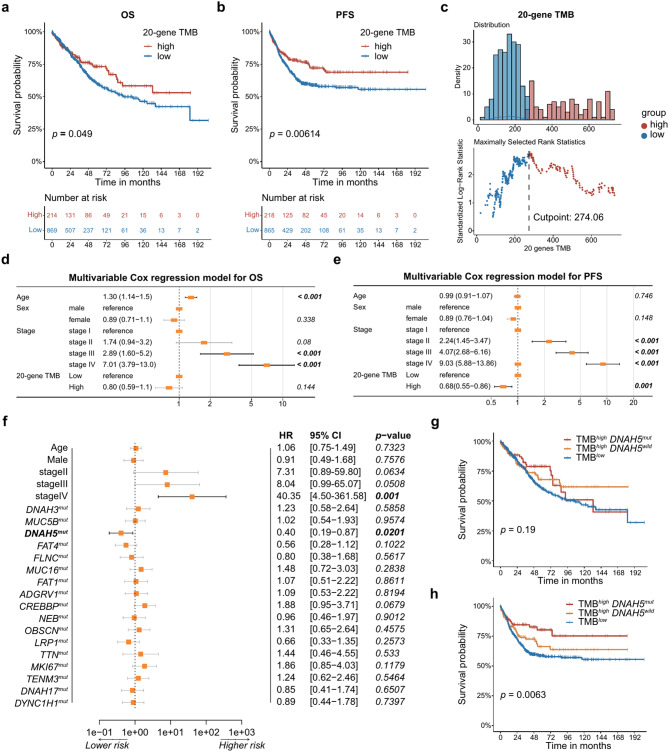
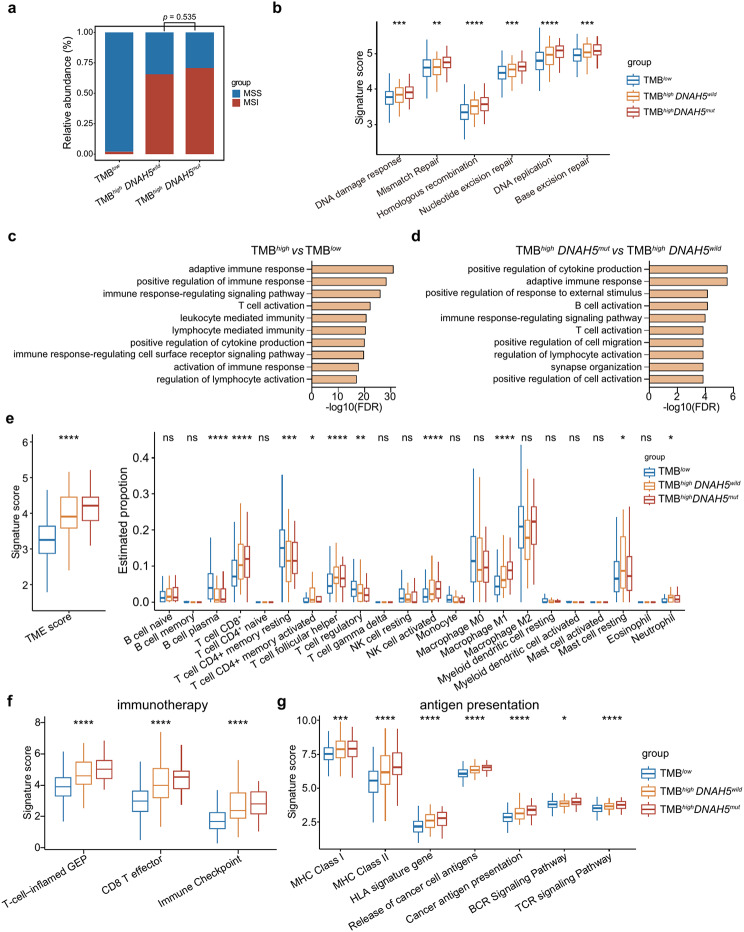
The TMB estimation model based on the Lasso algorithm, incorporating 20 genes, exhibiting satisfactory performance across multiple independent cohorts (R ≥ 0.859). This 20-gene TMB model proved to be an independent prognostic indicator for the progression-free survival (PFS) of CRC patients (p = 0.001). DNAH5 mutations were associated with a more favorable prognosis in high-TMB CRC patients, and correlated strongly with tumor neoantigen levels and CD8 TIL density.
The 20-gene model offers a cost-efficient approach to precisely estimating TMB, providing prognosis in patients with CRC. Incorporating DNAH5 within this model further refines the categorization of patients with elevated TMB. Utilizing the 20-gene model facilitates the stratification of patients with CRC, enabling more precise treatment planning.
肿瘤突变负担(TMB)已成为预测结直肠癌(CRC)患者预后和免疫治疗反应的关键生物标志物。全外显子组测序(WES)是评估 TMB 的金标准,但成本高昂,需要大量时间投入。此外,高 TMB 患者的异质性仍未得到充分描述。
我们使用了八种先进的机器学习算法来开发基于基因面板的 TMB 估计模型。为了严格比较和验证这些 TMB 估计模型,我们使用了四个外部队列,共涉及 1956 名患者。此外,我们计算了估计的 TMB 与肿瘤新生抗原水平之间的 Pearson 相关系数,以阐明它们之间的关联。通过免疫组织化学评估 CD8 肿瘤浸润淋巴细胞(TIL)密度。
基于 Lasso 算法、包含 20 个基因的 TMB 估计模型在多个独立队列中表现出令人满意的性能(R≥0.859)。该 20 基因 TMB 模型被证明是 CRC 患者无进展生存期(PFS)的独立预后指标(p=0.001)。在高 TMB CRC 患者中,DNAH5 突变与更有利的预后相关,与肿瘤新生抗原水平和 CD8 TIL 密度密切相关。
该 20 基因模型提供了一种经济高效的方法,可以精确估计 TMB,为 CRC 患者提供预后。在该模型中纳入 DNAH5 进一步细化了 TMB 升高患者的分类。使用 20 基因模型有助于对 CRC 患者进行分层,实现更精确的治疗计划。