Marchocki Zibi, Tone Alicia, Virtanen Carl, de Borja Richard, Clarke Blaise, Brown Theodore, May Taymaa
Department of Surgical Oncology, Division of Gynecologic Oncology, Princess Margaret Cancer Centre, University Health Network, Toronto, ON, Canada.
Department of Obstetrics and Gynecology, University of Toronto, Toronto, ON, Canada.
J Ovarian Res. 2022 May 2;15(1):50. doi: 10.1186/s13048-022-00983-5.
Patients treated with neoadjuvant chemotherapy (NACT) for advanced high-grade serous ovarian carcinoma (HGSC) have a higher rate and shorter time to platinum-resistant recurrence compared to patients treated with primary cytoreductive surgery (PCS) and adjuvant chemotherapy. The purpose of this study is to determine the impact of NACT on somatic mutation status in platinum-sensitive and resistant HGSC. Patients with advanced HGSC who had a documented response to platinum-based NACT, a banked blood sample, and a banked tumor sample before and after NACT were identified. Whole exome and/or targeted deep sequencing was performed in matched normal and pre/post-NACT tumor samples from 3 platinum-resistant and 2 platinum-sensitive patients to identify somatic non-synonymous mutations at each time point.
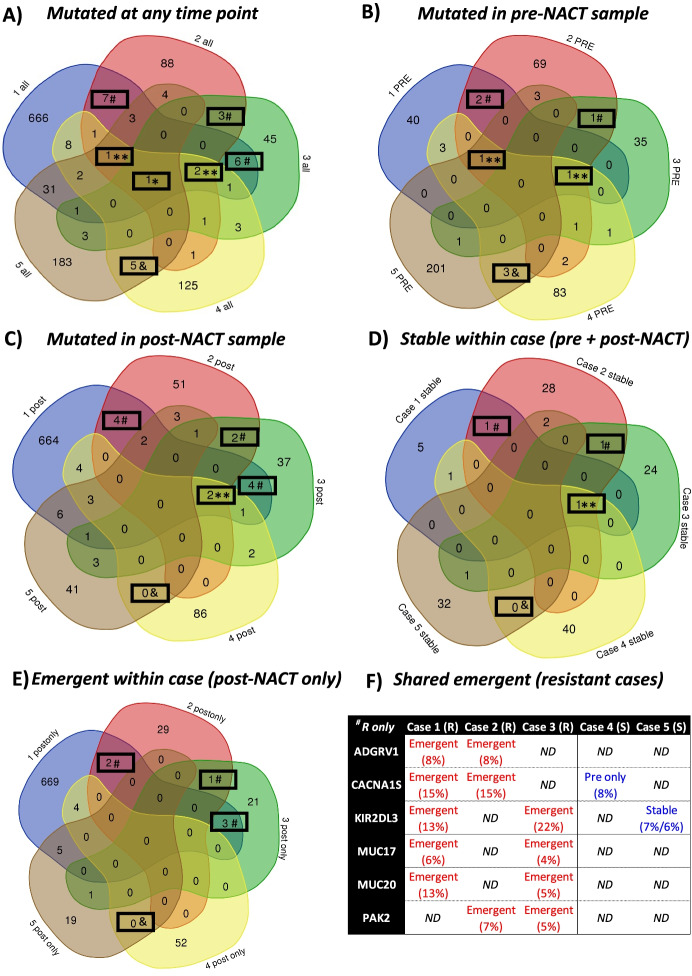
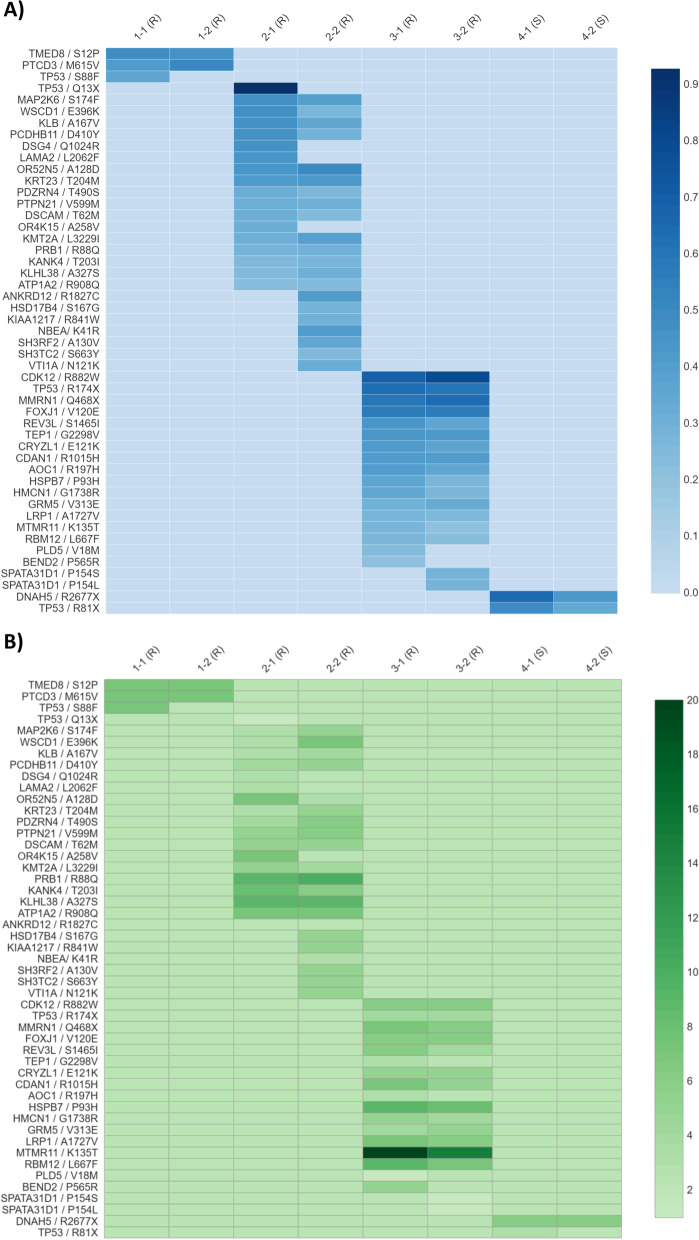
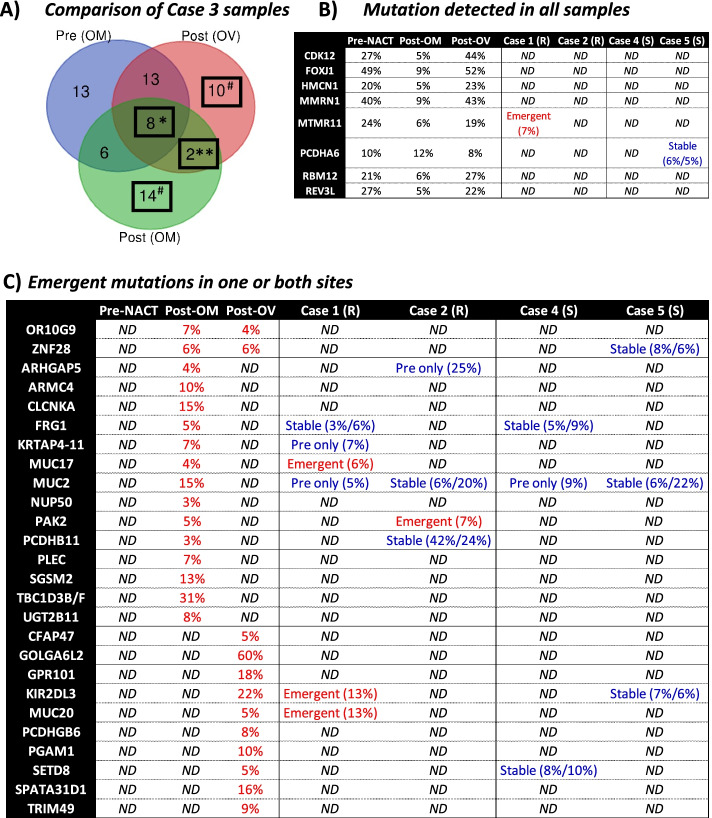
When comparing exonic non-synonymous mutations in pre-NACT and post-NACT samples from the same patient, an average of 41% (1-68%) of genes were mutated at both time points. There were no trends detected in the mutational burden following exposure to NACT in platinum-resistant vs. platinum-sensitive cases. The majority of mutated genes were unique to each case. We identified several genes that were commonly mutated in pre-NACT samples specific to platinum-resistant (CSPG4, SLC35G5, TUBA3D) or sensitive (CYP2D6, NUTM1, DNAH5) cases. Four mutated genes emerged exclusively in the platinum-resistant cases (ADGRV1, MUC17, MUC20, PAK2) following NACT.
Patients with advanced HGSC present with significant intra-tumor heterogeneity. NACT significantly impacts the somatic mutation status irrespective of the time to recurrence. The mutated genes detected in chemo-naive pre-NACT tumor samples from either resistant or sensitive cases could potentially have a role in the prediction of chemotherapy response in patients scheduled to receive NACT; larger studies are required to further validate these genes.
与接受初次肿瘤细胞减灭术(PCS)及辅助化疗的患者相比,接受新辅助化疗(NACT)治疗的晚期高级别浆液性卵巢癌(HGSC)患者铂耐药复发率更高且时间更短。本研究的目的是确定NACT对铂敏感和耐药HGSC体细胞突变状态的影响。确定了对铂类NACT有记录反应、有储存的血液样本以及NACT前后有储存肿瘤样本的晚期HGSC患者。对3例铂耐药和2例铂敏感患者匹配的正常样本以及NACT前后的肿瘤样本进行全外显子组和/或靶向深度测序,以确定每个时间点的体细胞非同义突变。
比较同一患者NACT前和NACT后样本中的外显子非同义突变时,两个时间点平均有41%(1%-68%)的基因发生突变。在铂耐药与铂敏感病例中,未检测到NACT后突变负担的趋势。大多数突变基因在每个病例中都是独特的。我们确定了几个在铂耐药(CSPG4、SLC35G5、TUBA3D)或敏感(CYP2D6、NUTM1、DNAH5)病例的NACT前样本中常见突变的基因。NACT后,铂耐药病例中出现了四个仅有的突变基因(ADGRV1、MUC17、MUC20、PAK2)。
晚期HGSC患者存在显著的肿瘤内异质性。NACT显著影响体细胞突变状态,与复发时间无关。在耐药或敏感病例的未经化疗的NACT前肿瘤样本中检测到的突变基因可能在预测接受NACT患者的化疗反应中发挥作用;需要更大规模的研究来进一步验证这些基因。