Mental Health & Behavior Research Group, College of Medicine and Health Sciences, University of Rwanda, Kigali, Rwanda.
Ubuntu Centre for Peace, Kigali, Rwanda.
Trials. 2024 Nov 16;25(1):773. doi: 10.1186/s13063-024-08632-6.
The community-based social healing (CBSH) model, developed by Ubuntu Centre for Peace, aims to support individuals with traumatic experiences and mental health challenges in achieving better mental health. CBSH combines BREATH-BODY-MIND™ (BBM) practices with collective narrative and rituals, facilitated by Community Healing Assistants in therapeutic groups. A previous pilot study involving 1889 Rwandan CBSH participants showed significant mental health improvements, including reductions in depression, anxiety, and PTSD, along with enhanced work productivity, and decreased intimate partner violence. The trial investigates the CBSH model's impact on Ubuntu and mental health. Ubuntu, a concept that encompasses humanness, compassion, and interconnectedness, is deeply rooted in the African philosophy.
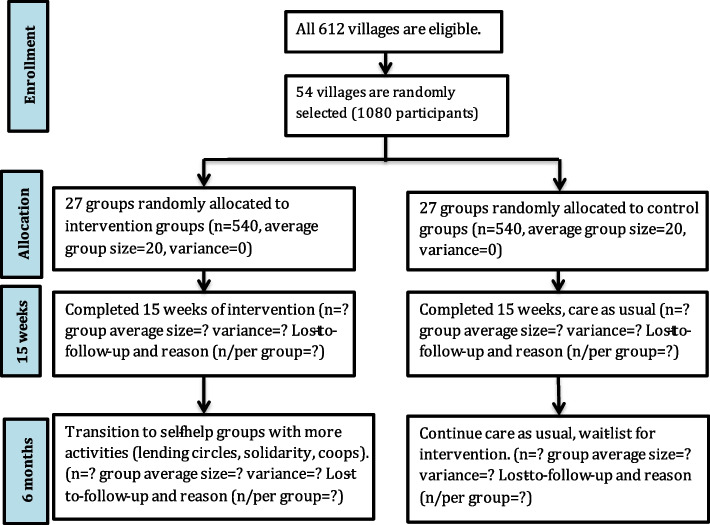
METHODS/DESIGN: This cluster randomized controlled trial will involve 54 villages randomly selected in the Kirehe district, with 1080 participants randomly allocated equally to the CBSH intervention or a wait-list control group. While the trial will be conducted at the village (cluster) level, both primary and secondary outcomes will be measured individually for participants within each cluster. The Primary outcome "Ubuntu" will be measured using a context-adapted Ubuntu measurement scale. Secondary outcomes include psychosocial indicators which will be assessed through standardized tools such as the Patient Health Questionnaire for depression (PHQ-9), Generalized Anxiety Disorder-7 (GAD-7), Posttraumatic Stress Disorder Checklist for DSM-5 (PCL-5), Warwick-Edinburgh Mental Wellbeing scale (WEMWS), Connor-Davidson Resilience scale (CD-RISK-10), Somatic Symptom Severity Scale (PHQ-15), Revised Conflict Tactics scale (CTS2S), and Adapted Social Capital Assessment Tool (SASCAT).
This trial aims to evaluate the CBSH model's impacts on Ubuntu, mental health, and social functioning among trauma-affected Rwandans, including those impacted by the 1994 Genocide against the Tutsi, mass killings, sexual abuse, and domestic violence. The findings could be of value to the Ubuntu Centre for Peace, policymakers, healthcare practitioners, and other stakeholders, by highlighting the significance of promoting Ubuntu as a foundation for addressing mental health challenges and the consequences of psychosocial trauma.
ISRCTN ISRCTN17659369. Registered on February 09, 2024.
Ubuntu 中心开发的基于社区的社会疗愈(CBSH)模式旨在帮助经历创伤和心理健康挑战的个体改善心理健康。CBSH 将 BREATH-BODY-MIND(BBM)实践与集体叙事和仪式相结合,由社区疗愈助理在治疗小组中进行促进。先前的一项涉及 1889 名卢旺达 CBSH 参与者的试点研究表明,该模式显著改善了心理健康,包括降低抑郁、焦虑和创伤后应激障碍,同时提高了工作生产力,减少了亲密伴侣暴力。该试验旨在研究 CBSH 模式对 Ubuntu 和心理健康的影响。Ubuntu 是一个包含人性、同情和相互联系的概念,深深植根于非洲哲学。
方法/设计:这项整群随机对照试验将涉及基里谢区随机选择的 54 个村庄,1080 名参与者随机平均分配到 CBSH 干预组或等待名单对照组。虽然试验将在村庄(集群)层面进行,但将为每个集群中的参与者单独测量主要和次要结果。主要结果“Ubuntu”将使用经过上下文调整的 Ubuntu 测量量表进行测量。次要结果包括社会心理指标,将通过标准化工具进行评估,如抑郁患者健康问卷(PHQ-9)、广泛性焦虑障碍-7(GAD-7)、DSM-5 创伤后应激障碍检查表(PCL-5)、沃里克-爱丁堡心理健康量表(WEMWS)、康纳-戴维森韧性量表(CD-RISK-10)、躯体症状严重程度量表(PHQ-15)、修订后的冲突策略量表(CTS2S)和适应社会资本评估工具(SASCAT)。
该试验旨在评估 CBSH 模式对受创伤影响的卢旺达人民的 Ubuntu、心理健康和社会功能的影响,包括受 1994 年图西族种族灭绝、大规模杀戮、性虐待和家庭暴力影响的人。该研究结果对 Ubuntu 中心、政策制定者、医疗保健从业者和其他利益相关者具有重要意义,突显了推广 Ubuntu 作为解决心理健康挑战和心理社会创伤后果的基础的重要性。
ISRCTN ISRCTN86625024。于 2024 年 2 月 9 日注册。