Department of Internal Medicine, Kyungpook National University Hospital, Daegu, Korea.
Department of Pathology, School of Medicine, Kyungpook National University, Daegu, Korea.
Korean J Intern Med. 2024 Nov;39(6):906-916. doi: 10.3904/kjim.2024.097. Epub 2024 Nov 1.
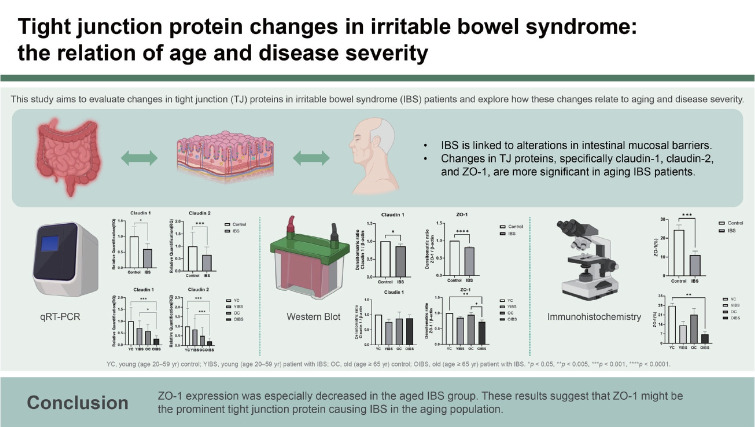
BACKGROUND/AIMS: The etiology of irritable bowel syndrome (IBS) is associated with intestinal mucosal barrier damage. However, changes in the tight junction (TJ) proteins in IBS have not been fully elucidated. This study aimed to evaluate TJ protein changes in IBS patients and the relationship between aging and disease severity.
Thirty-six patients with IBS fulfilling the Rome IV criteria and twenty-four controls were included. To evaluate the change of TJ in the colonic mucosa, quantitative reverse transcription polymerase chain reaction, western blot, and immunohistochemistry (IHC) were performed, respectively.
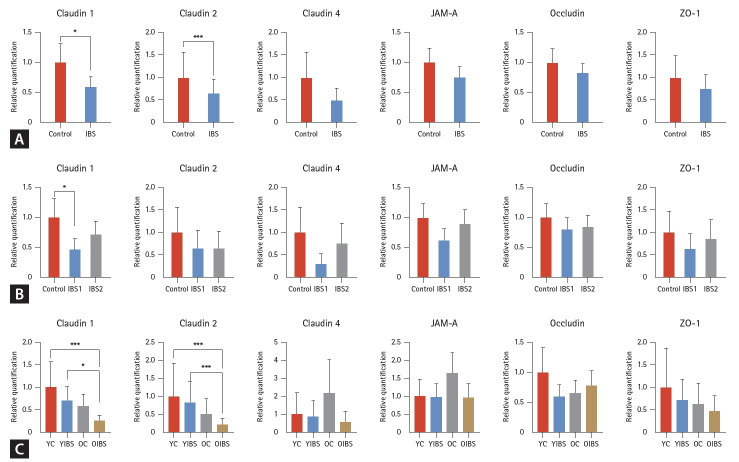
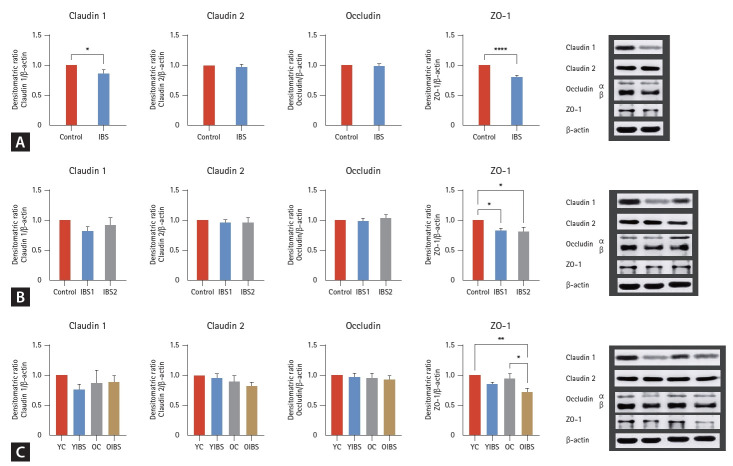
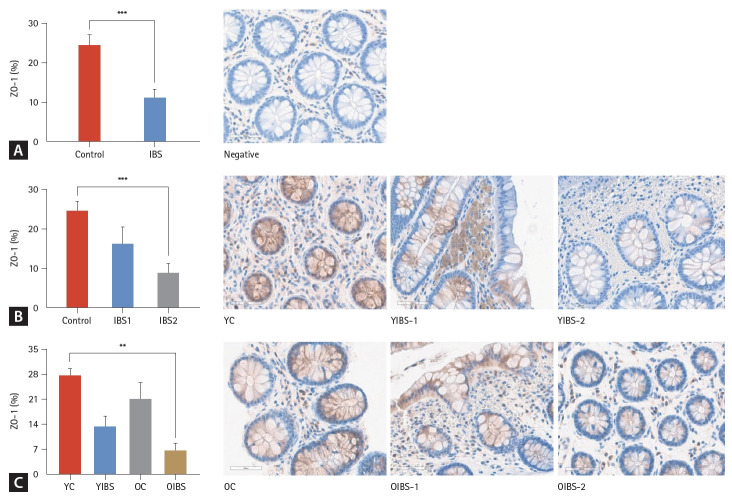
The entire IBS group (n = 36) exhibited decreased levels of claudin-1 and -2 mRNA compared to the control group (n = 24), with statistical significance (p < 0.05). Additionally, in western blot analyses, both claudin-1 and ZO-1 levels were significantly reduced in the IBS group compared to the control group (n = 24) (p < 0.05). IHC analysis further revealed that ZO-1 expression was significantly lower in the IBS group than in the control group (p < 0.001). This trend of reduced ZO-1 expression was also observed in the moderate-to-severe IBS subgroup (p < 0.001). Significantly, ZO-1 expression was notably lower in both the young- (p = 0.036) and old-aged (p = 0.039) IBS groups compared to their respective age-matched control groups. Subtype analysis indicated a more pronounced decrease in ZO-1 expression with advancing age.
ZO-1 expression was especially decreased in the aged IBS group. These results suggest that ZO-1 might be the prominent TJ protein causing IBS in the aging population.
背景/目的:肠易激综合征(IBS)的病因与肠黏膜屏障损伤有关。然而,IBS 中紧密连接(TJ)蛋白的变化尚未完全阐明。本研究旨在评估 IBS 患者 TJ 蛋白的变化及其与年龄和疾病严重程度的关系。
纳入 36 例符合罗马 IV 标准的 IBS 患者和 24 例对照者。为了评估结肠黏膜 TJ 的变化,分别进行了定量逆转录聚合酶链反应、western blot 和免疫组织化学(IHC)。
整个 IBS 组(n=36)与对照组(n=24)相比,claudin-1 和 -2 mRNA 水平降低,差异有统计学意义(p<0.05)。此外,western blot 分析显示,IBS 组 claudin-1 和 ZO-1 水平均明显低于对照组(n=24)(p<0.05)。IHC 分析进一步显示,IBS 组 ZO-1 表达明显低于对照组(p<0.001)。在中重度 IBS 亚组中也观察到 ZO-1 表达降低的趋势(p<0.001)。重要的是,与各自年龄匹配的对照组相比,年轻(p=0.036)和老年(p=0.039)IBS 组的 ZO-1 表达均明显降低。亚型分析表明,随着年龄的增长,ZO-1 表达下降更为明显。
ZO-1 表达在老年 IBS 组中明显降低。这些结果表明,ZO-1 可能是导致老年人群 IBS 的主要 TJ 蛋白。