Siso Deniz, Wee Hwabok, Ponnuru Padmavathi, Lewis Gregory S, Du Jing, Updegrove Gary F, Armstrong April D, Vidt Meghan E
Orthopaedics and Rehabilitation, Penn State College of Medicine, Hershey, PA, USA.
Mechanical Engineering, Penn State University, University Park, PA, USA.
Shoulder Elbow. 2024 Aug 2:17585732241269193. doi: 10.1177/17585732241269193.
This retrospective study investigated associations of rotator cuff muscle atrophy (MA) and fatty infiltration (FI) with glenoid morphology.
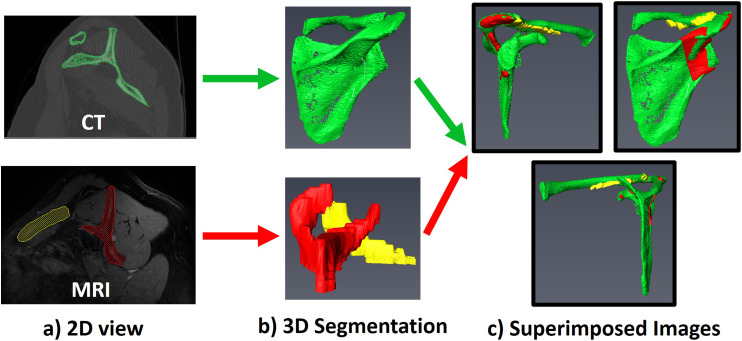
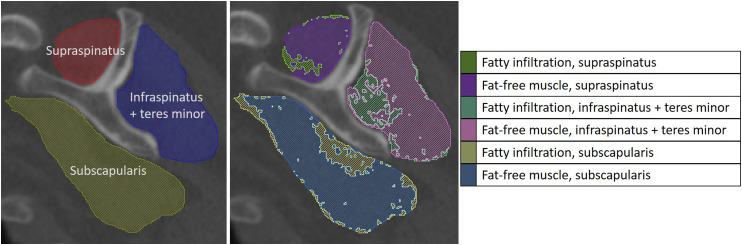
Patients with primary glenohumeral osteoarthritis who presented to Penn State Bone and Joint Institute's orthopaedic clinic from September 2002 to December 2019 as total shoulder arthroplasty (TSA) candidates were evaluated. MA was determined by the cross-sectional area of each rotator cuff muscle on pre-operative MR and CT scans. Fat-free muscle and FI areas were quantified using Hounsfield units (HU). Glenoid morphology was assessed using glenoid version and inclination and modified Walch classification.
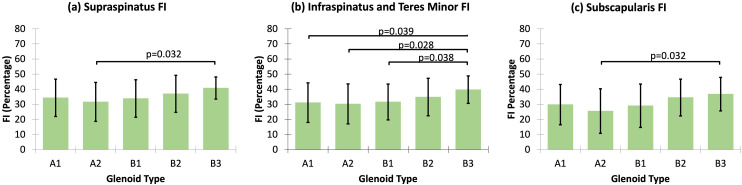
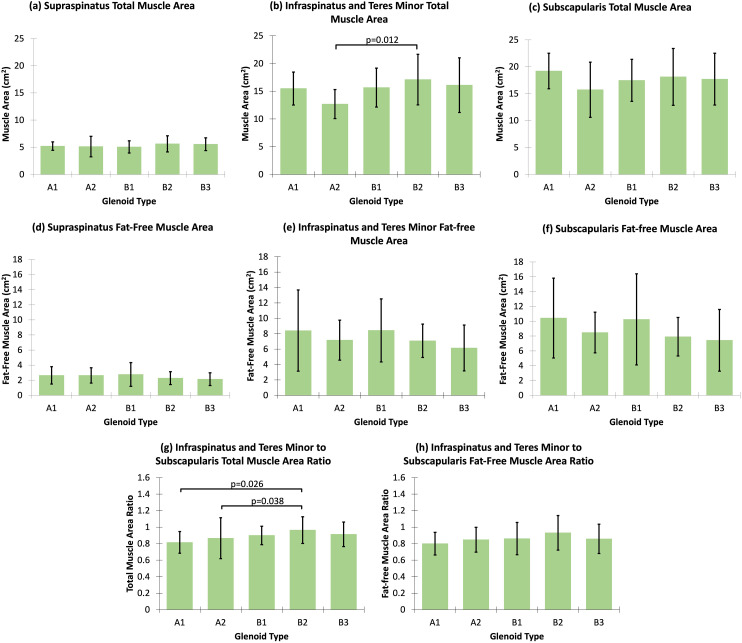
Sixty-one patients (61 shoulders) were evaluated. B3 glenoids had a greater percent FI of supraspinatus (40.8 ± 7.3) versus A2 glenoids (31.6 ± 12.9, = 0.032); infraspinatus and teres minor muscles (49.7 ± 9.1) versus A1 (31.1 ± 13.1, = 0.039), A2 (30.2 ± 13.3, = 0.028), and B1 glenoids (31.6 ± 11.9, = 0.038); and subscapularis (36.7 ± 11.1) versus A2 glenoids (25.5 ± 14.7, = 0.032). B2 glenoids had a larger area ratio of infraspinatus and teres minor to subscapularis (0.96 ± 0.16) than A1 (0.82 ± 0.13, = 0.026) and A2 glenoids (0.57 ± 0.25, = 0.038).
B3 glenoids had a greater FI of all rotator cuff muscles. B2 glenoids had a larger relative size of infraspinatus and teres minor muscles than subscapularis.
本回顾性研究调查了肩袖肌萎缩(MA)和脂肪浸润(FI)与肩胛盂形态的相关性。
对2002年9月至2019年12月期间到宾夕法尼亚州立大学骨与关节研究所骨科门诊就诊、作为全肩关节置换术(TSA)候选患者的原发性肩肱关节骨关节炎患者进行评估。MA通过术前磁共振成像(MR)和计算机断层扫描(CT)扫描上各肩袖肌的横截面积来确定。使用亨氏单位(HU)对无脂肪肌肉和FI区域进行量化。使用肩胛盂版本、倾斜度和改良Walch分类法评估肩胛盂形态。
共评估了61例患者(61个肩关节)。B3型肩胛盂的冈上肌FI百分比(40.8±7.3)高于A2型肩胛盂(31.6±12.9,P = 0.032);冈下肌和小圆肌的FI百分比(49.7±9.1)高于A1型(31.1±13.1,P = 0.039)、A2型(30.2±13.3,P = 0.028)和B1型肩胛盂(31.6±11.9,P = 0.038);肩胛下肌的FI百分比(36.7±11.1)高于A2型肩胛盂(25.5±14.7,P = 0.032)。B2型肩胛盂的冈下肌和小圆肌与肩胛下肌的面积比(0.96±0.16)大于A1型(0.82±0.13,P = 0.026)和A2型肩胛盂(0.57±0.25,P = 0.038)。
B3型肩胛盂所有肩袖肌的FI更高。B2型肩胛盂的冈下肌和小圆肌相对大小大于肩胛下肌。