Li Luhe, Hong Fangfang, Badde Stephanie, Landy Michael S
Department of Psychology, New York University.
Department of Psychology, University of Pennsylvania.
bioRxiv. 2025 Jan 13:2024.03.08.584189. doi: 10.1101/2024.03.08.584189.
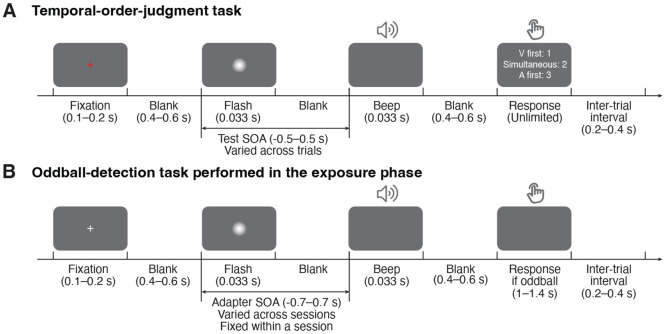
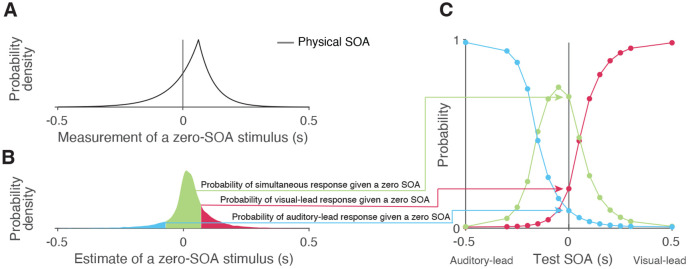
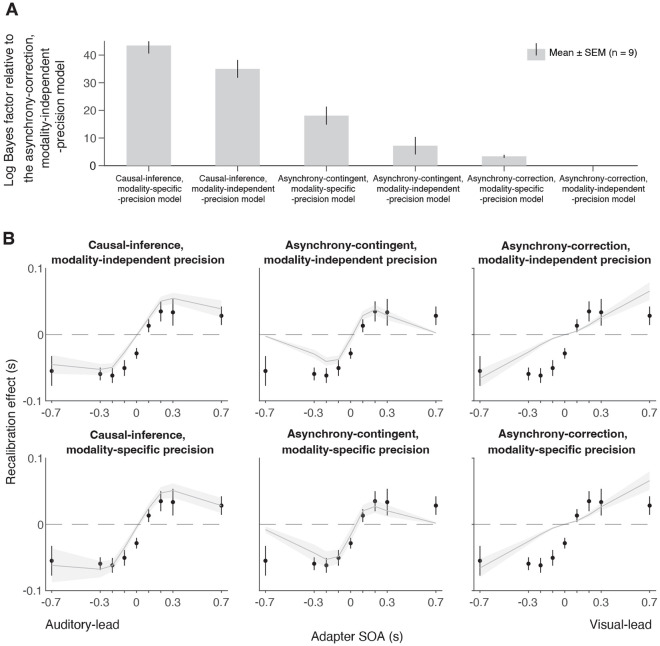
Cross-modal temporal recalibration guarantees stable temporal perception across ever-changing environments. Yet, the mechanisms of cross-modal temporal recalibration remain unknown. Here, we conducted an experiment to measure how participants' temporal perception was affected by exposure to audiovisual stimuli with consistent temporal delays. Consistent with previous findings, recalibration effects plateaued with increasing audiovisual asynchrony and varied by which modality led during the exposure phase. We compared six observer models that differed in how they update the audiovisual temporal bias during the exposure phase and whether they assume modality-specific or modality-independent precision of arrival latency. The causal-inference observer shifts the audiovisual temporal bias to compensate for perceived asynchrony, which is inferred by considering two causal scenarios: when the audiovisual stimuli have a common cause or separate causes. The asynchrony-contingent observer updates the bias to achieve simultaneity of auditory and visual measurements, modulating the update rate by the likelihood of the audiovisual stimuli originating from a simultaneous event. In the asynchrony-correction model, the observer first assesses whether the sensory measurement is asynchronous; if so, she adjusts the bias proportionally to the magnitude of the measured asynchrony. Each model was paired with either modality-specific or modality-independent precision of arrival latency. A Bayesian model comparison revealed that both the causal-inference process and modality-specific precision in arrival latency are required to capture the nonlinearity and asymmetry observed in audiovisual temporal recalibration. Our findings support the hypothesis that audiovisual temporal recalibration relies on the same causal-inference processes that govern cross-modal perception.
跨模态时间重新校准可确保在不断变化的环境中保持稳定的时间感知。然而,跨模态时间重新校准的机制仍然未知。在此,我们进行了一项实验,以测量参与者的时间感知如何受到暴露于具有一致时间延迟的视听刺激的影响。与先前的研究结果一致,随着视听异步性的增加,重新校准效应趋于平稳,并且在暴露阶段由主导的模态不同而有所变化。我们比较了六种观察者模型,这些模型在暴露阶段更新视听时间偏差的方式以及它们是否假设到达潜伏期的模态特异性或模态非特异性精度方面存在差异。因果推理观察者会移动视听时间偏差以补偿感知到的异步性,这是通过考虑两种因果情况来推断的:当视听刺激有共同原因或单独原因时。异步 contingent 观察者更新偏差以实现听觉和视觉测量的同步性,通过视听刺激源自同时发生事件的可能性来调节更新率。在异步校正模型中,观察者首先评估感官测量是否异步;如果是这样,她会根据测量到的异步性大小成比例地调整偏差。每个模型都与到达潜伏期的模态特异性或模态非特异性精度配对。贝叶斯模型比较表明,因果推理过程和到达潜伏期的模态特异性精度都是捕捉视听时间重新校准中观察到的非线性和不对称性所必需的。我们的研究结果支持这样的假设,即视听时间重新校准依赖于与跨模态感知相同的因果推理过程。