Trainor Alex R, MacDonald Debra S, Penney Jay
Department of Biomedical Sciences, AVC, University of Prince Edward Island, Charlottetown, PE, Canada.
Front Neurosci. 2024 Nov 1;18:1506358. doi: 10.3389/fnins.2024.1506358. eCollection 2024.
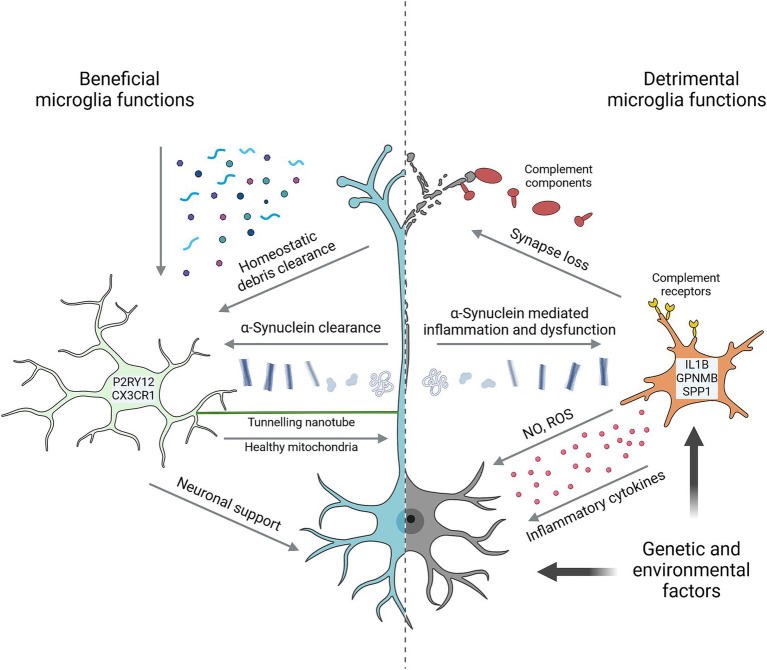
The prevalence of neurodegenerative disorders such as Parkinson's disease are increasing as world populations age. Despite this growing public health concern, the precise molecular and cellular mechanisms that culminate in neurodegeneration remain unclear. Effective treatment options for Parkinson's disease and other neurodegenerative disorders remain very limited, due in part to this uncertain disease etiology. One commonality across neurodegenerative diseases is sustained neuroinflammation, mediated in large part by microglia, the innate immune cells of the brain. Initially thought to simply react to neuron-derived pathology, genetic and functional studies in recent years suggest that microglia play a more active role in the neurodegenerative process than previously appreciated. Here, we review evidence for the roles of microglia in Parkinson's disease pathogenesis and progression, with a particular focus on microglial functions that are perturbed by disease associated genes and mutations.
随着世界人口老龄化,帕金森病等神经退行性疾病的患病率正在上升。尽管公众对这一日益严重的健康问题愈发关注,但导致神经退行性变的精确分子和细胞机制仍不清楚。帕金森病和其他神经退行性疾病的有效治疗选择仍然非常有限,部分原因在于这种不确定的疾病病因。神经退行性疾病的一个共同特征是持续的神经炎症,这在很大程度上是由小胶质细胞介导的,小胶质细胞是大脑的固有免疫细胞。最初人们认为小胶质细胞只是对神经元衍生的病理变化做出反应,但近年来的基因和功能研究表明,小胶质细胞在神经退行性过程中发挥的作用比之前认为的更为积极。在这里,我们综述了小胶质细胞在帕金森病发病机制和进展中作用的证据,特别关注受疾病相关基因和突变干扰的小胶质细胞功能。