Kavutarapu Sasi Krishna, Ankathi Suman Kumar, Thiagarajan Shivakumar, Deshmukh Anuja, Nair Deepa, Pai Prathamesh Srinivas, Chaukar Devendra Arvind, Pantvaidya Gouri
Dept of Head and Neck Surgery, Tata Memorial Hospital, Homi Bhabha National Institute, 12, Thfloorfloor, Homi Bhabha Block, Parel, Mumbai India.
Dept of Radiodiagnosis, Tata Memorial Hospital, Homi Bhabha National Institute, Mumbai, India.
Indian J Surg Oncol. 2024 Dec;15(4):684-692. doi: 10.1007/s13193-024-01955-5. Epub 2024 Jun 3.
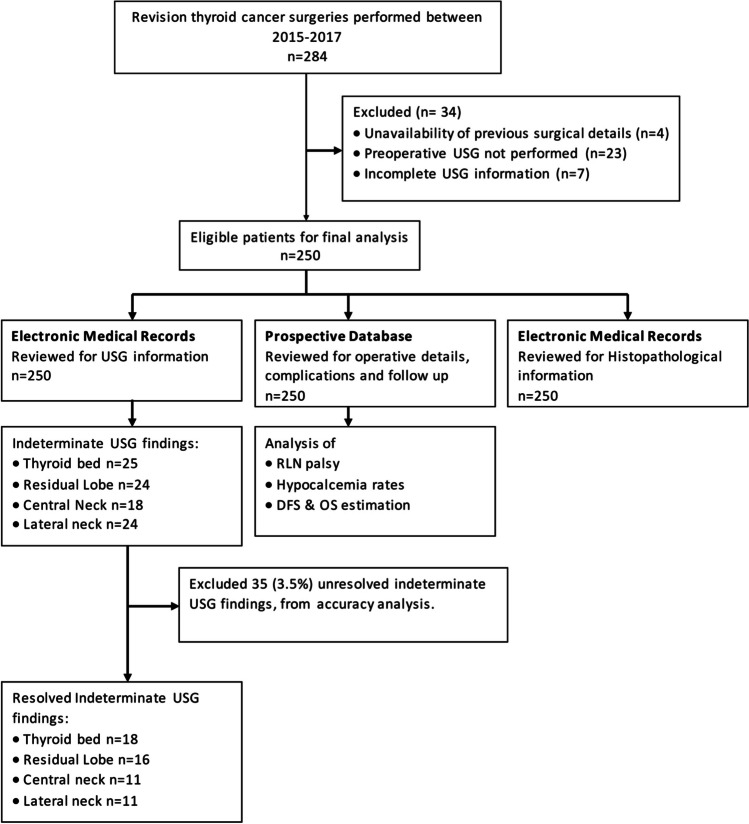
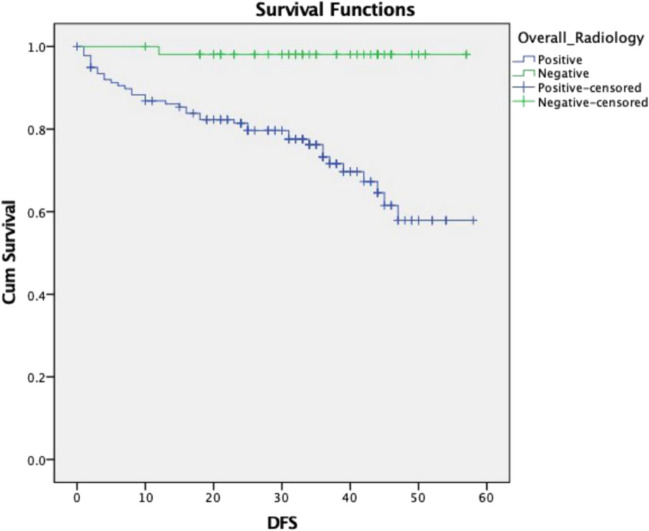
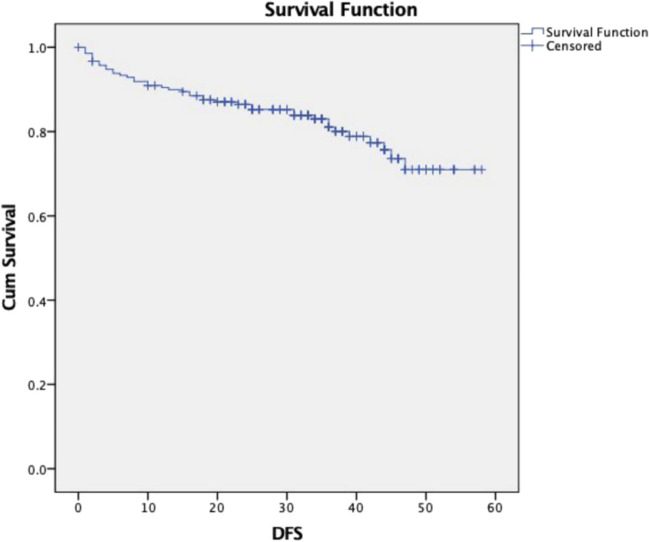
Revision thyroid surgery for residual/recurrent disease is known to have higher complication rates because of parathyroid injury and recurrent laryngeal nerve (RLN) damage. The aim of this study is to evaluate the accuracy of USG in predicting recurrent disease and disease outcomes in patients undergoing reoperation for recurrent/residual thyroid cancer. We performed a retrospective analysis of all thyroid reoperations from 2015 to 2017. Preoperative USG findings were categorized as per prespecified disease stations in the neck and compared with histopathology to calculate sensitivity, specificity, positive predictive value, and negative predictive value of USG. Survival analysis was performed using Kaplan-Meier curves. Two hundred fifty patients were included in the analysis. In a reoperative setting, USG had an overall sensitivity, specificity, accuracy, positive predictive value, and negative predictive value of 89%, 77%, 89%, 94%, and 60%, respectively. We found a significantly lower disease-free survival in patients who had radiologically detected recurrent disease as compared to disease detected only on histopathology. USG has a reasonable accuracy in determining status of lesions in patients undergoing revision thyroid surgeries.
由于甲状旁腺损伤和喉返神经(RLN)损伤,已知因残留/复发性疾病而进行的甲状腺再次手术具有更高的并发症发生率。本研究的目的是评估超声检查(USG)在预测复发性甲状腺癌患者再次手术时疾病复发及疾病转归方面的准确性。我们对2015年至2017年期间所有甲状腺再次手术进行了回顾性分析。术前USG检查结果根据颈部预先指定的疾病部位进行分类,并与组织病理学结果进行比较,以计算USG的敏感性、特异性、阳性预测值和阴性预测值。使用Kaplan-Meier曲线进行生存分析。共有250例患者纳入分析。在再次手术的情况下,USG的总体敏感性、特异性、准确性、阳性预测值和阴性预测值分别为89%、77%、89%、94%和60%。我们发现,与仅在组织病理学检查中发现疾病的患者相比,经放射学检查发现复发性疾病的患者无病生存率显著降低。USG在确定接受甲状腺再次手术患者的病变状态方面具有合理的准确性。