Anderson Heather A, Parks Sidney M, Kulp Marjean T, Mitchell G Lynn
The Ohio State University College of Optometry, Columbus, Ohio, USA.
Ophthalmic Physiol Opt. 2025 Jan;45(1):14-22. doi: 10.1111/opo.13419. Epub 2024 Nov 18.
To determine whether classification of accommodative insufficiency (AI) based on the subjective push-up test is indicative of reduced amplitude measured objectively.
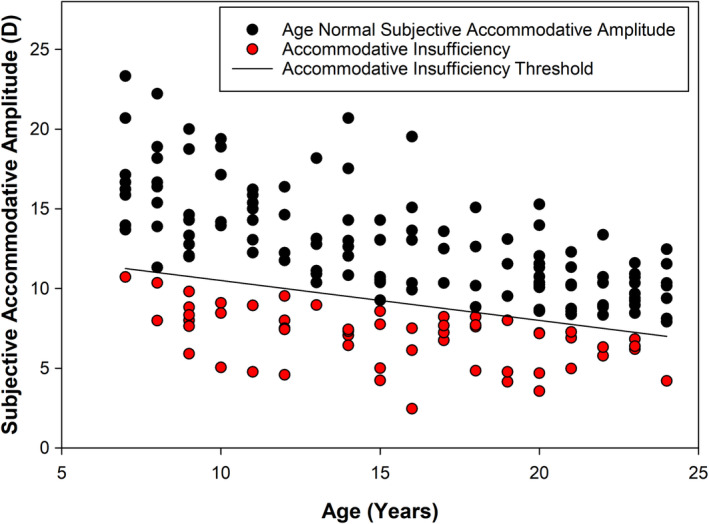
Monocular subjective accommodative amplitude was measured in participants 7-24 years of age with the push-up test; a 0.9 mm letter was moved towards the eye until first sustained blur occurred. Monocular objective amplitude was measured with the same target and an autorefractor for demands from 2.5 to 30 D. The maximum response was termed the amplitude. Near point of convergence (NPC) was measured in a subset of participants. Participants were classified into groups using subjective amplitude: normal amplitude or AI (amplitude < ((15 - 0.25 × age) - 2)). Objective amplitude was plotted by age for each group and one-way ANCOVA used to evaluate differences while controlling for age. For NPC measures, a t-test compared the magnitude of the break between those with and without AI.
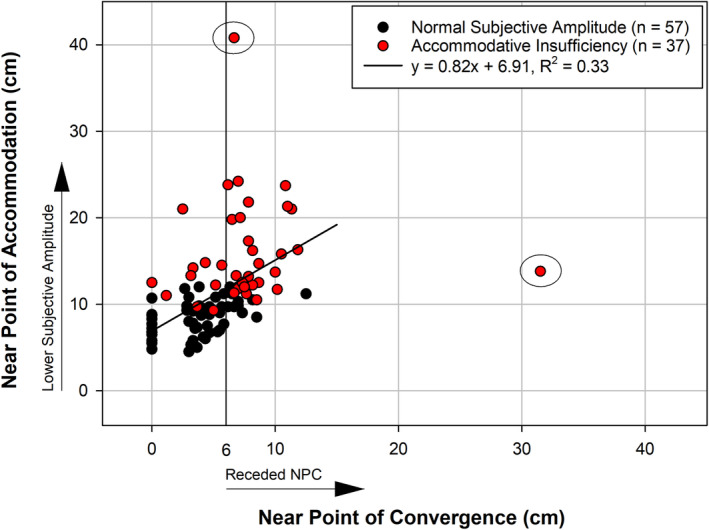
Fifty-five of 185 participants were classified as having AI. Objective amplitude decreased with age (0.20 D/year) and there was no significant difference in the age-adjusted mean amplitudes for the two groups (AI: 7.62 D, CI = 7.19, 8.04; Normal: 7.86 D, CI = 7.58, 8.15; p = 0.11). For the subset with NPC measures, participants classified as having AI had significantly more receded break values than those without AI (7.7 ± 5 vs. 3.7 ± 3 cm, p < 0.001).
Factors other than accommodative ability may be contributing to lower subjective amplitude findings in individuals meeting the criterion for AI.
确定基于主观上推试验的调节不足(AI)分类是否表明客观测量的幅度降低。
对7至24岁的参与者进行单眼主观调节幅度的上推试验测量;将一个0.9毫米的字母向眼睛移动,直到首次出现持续模糊。使用相同目标和自动验光仪测量单眼客观幅度,需求范围为2.5至30 D。最大反应称为幅度。在一部分参与者中测量集合近点(NPC)。根据主观幅度将参与者分为几组:正常幅度或AI(幅度<((15 - 0.25×年龄) - 2))。按年龄绘制每组的客观幅度,并使用单因素协方差分析在控制年龄的同时评估差异。对于NPC测量,采用t检验比较有和没有AI的参与者之间的破裂幅度大小。
185名参与者中有55名被分类为患有AI。客观幅度随年龄下降(每年0.20 D),两组经年龄调整后的平均幅度无显著差异(AI:7.62 D,CI = 7.19,8.04;正常:7.86 D,CI = 7.58,8.15;p = 0.11)。对于进行NPC测量的子集,被分类为患有AI的参与者的破裂值比没有AI的参与者显著更靠后(7.7±5对3.7±3厘米,p < 0.001)。
除调节能力外的其他因素可能导致符合AI标准的个体主观幅度测量结果较低。