Department of Biochemistry, Faculty of Pharmacy, Mansoura University, Mansoura, 35516, Egypt.
Metab Brain Dis. 2024 Nov 18;40(1):10. doi: 10.1007/s11011-024-01457-x.
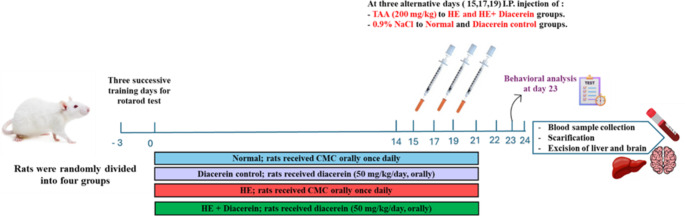
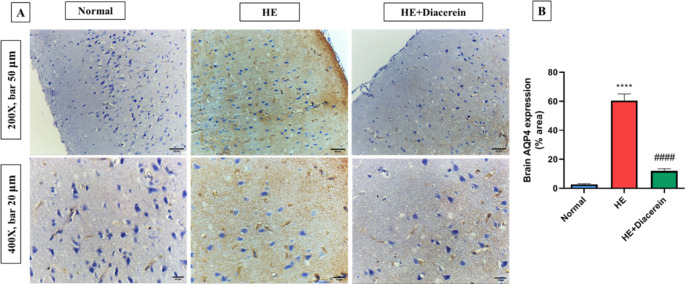
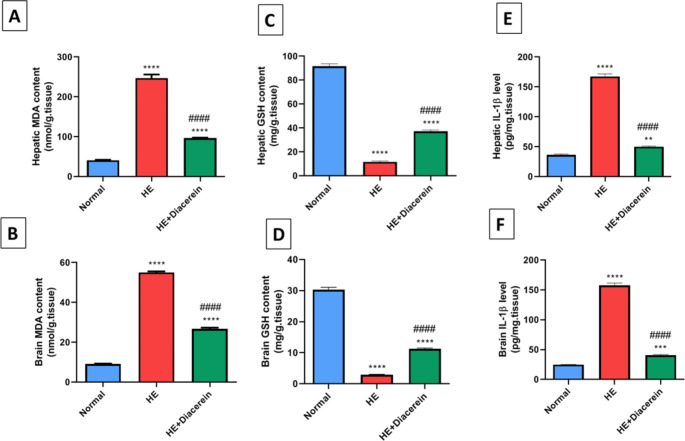
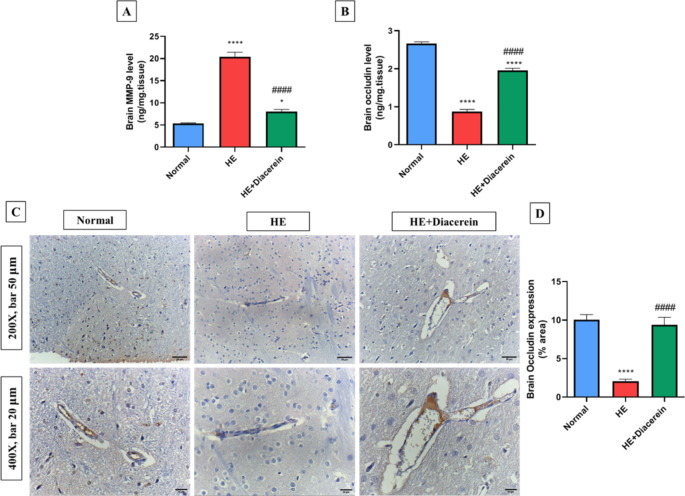
Astrocyte swelling, blood brain barrier (BBB) dissipation and the subsequent brain edema are serious consequences of persistent hyperammonemia in hepatic encephalopathy (HE) in which if inadequately controlled it will lead to brain death. The current study highlights the potential neuroprotective effect of diacerein against thioacetamide (TAA)-induced HE in acute liver failure rat model. HE was induced in male Sprague-Dawley rats via I.P. injection of TAA (200 mg/kg) for three alternative times/week at 3 week of the experiment. Diacerein (50 mg/kg) was gavaged for 14 days prior to induction of HE and for further 7 days together with TAA injection for an overall period of 21 days. Diacerein attenuated TAA-induced HE in acute liver failure rat model; as proofed by significant lowering of serum and brain ammonia concentrations, serum AST and ALT activities and significant attenuation of both brain and hepatic MDA contents and IL-1β with marked increases in GSH contents (P < 0.0001). The neuroprotective effect of diacerein was demonstrated by marked improvement of motor and cognitive deficits, brain histopathological changes; hallmarks of HE. As shown by immunohistochemical results, diacerein markedly downregulated brain TLR4 expression which in turn significantly increased the GFAP expression, and significantly decreased AQP4 expression; the astrocytes swelling biomarkers (P < 0.0001). Moreover, diacerein preserved BBB integrity via downregulation of MMP-9 mediated digestion of tight junction proteins such as occludin (P < 0.0001). Collectively, diacerein ameliorated cerebral edema and maintained BBB integrity via modulation of TLR4/AQP4/MMP-9 axis thus may decrease the progression of HE induced in acute liver failure.
星形胶质细胞肿胀、血脑屏障 (BBB) 破坏以及随后的脑水肿是肝性脑病 (HE) 中持续性高氨血症的严重后果,如果得不到有效控制,将导致脑死亡。本研究强调了二乙酰瑞林对急性肝衰竭大鼠模型中硫代乙酰胺 (TAA) 诱导的 HE 的潜在神经保护作用。通过每周三次腹腔注射 TAA (200mg/kg) 在实验的第 3 周诱导 HE。在诱导 HE 之前,二乙酰瑞林 (50mg/kg) 灌胃 14 天,并与 TAA 注射一起再进行 7 天,总疗程为 21 天。二乙酰瑞林减轻了急性肝衰竭大鼠模型中的 TAA 诱导的 HE;这可以通过显著降低血清和脑氨浓度、血清 AST 和 ALT 活性以及显著降低脑和肝 MDA 含量和 IL-1β来证明,同时显著增加 GSH 含量 (P < 0.0001)。二乙酰瑞林的神经保护作用表现为运动和认知功能障碍、脑组织病理变化的显著改善;这些都是 HE 的标志。免疫组化结果显示,二乙酰瑞林显著下调了脑 TLR4 表达,从而显著增加了 GFAP 表达,显著降低了 AQP4 表达;这是星形胶质细胞肿胀的生物标志物 (P < 0.0001)。此外,二乙酰瑞林通过下调 MMP-9 介导的紧密连接蛋白(如 occludin)的消化来保护 BBB 完整性 (P < 0.0001)。总之,二乙酰瑞林通过调节 TLR4/AQP4/MMP-9 轴来改善脑水肿并维持 BBB 完整性,从而可能减缓急性肝衰竭引起的 HE 的进展。