Gannan Medical University, Ganzhou City, 341000, Jiangxi Province, China.
Department of Rehabilitation Medicine, First Affiliated Hospital of Gannan Medical University, Ganzhou City, 341000, Jiangxi Province, China.
Arthritis Res Ther. 2024 Nov 18;26(1):202. doi: 10.1186/s13075-024-03438-y.
Knee osteoarthritis (KOA) is characterized by mitochondrial damage and increased inflammation. Circulating cell-free mitochondrial DNA (ccf-mtDNA), which originates from damaged mitochondria, is an endogenous damage-associated molecular pattern (DAMPs) molecule that may trigger inflammation and is recognized as a potential biomarker for various diseases. In this study, we investigated the potential association between plasma ccf-mtDNA content and its use as a diagnostic biomarker in patients with KOA.
We collected plasma samples from patients with KOA and healthy controls (HC). Subsequently, quantitative real-time polymerase chain reaction (qRT-PCR) was used to detect ccf-mtDNA content in the plasma samples. We used the Kellgren-Lawrence (K-L) classification criteria to classify patients with KOA into four grades: I-IV. Disease severity in patients with KOA was assessed using the Western Ontario and McMaster Universities Osteoarthritis Index (WOMAC). Next, Spearman analysis was performed to observe the correlation between ccf-mtDNA content and the K-L classification and WOMAC score. Logistic regression analysis was used to evaluate the relationship between ccf-mtDNA and KOA risk.
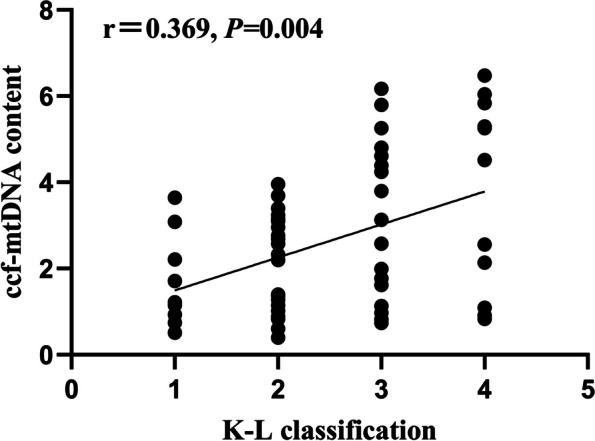
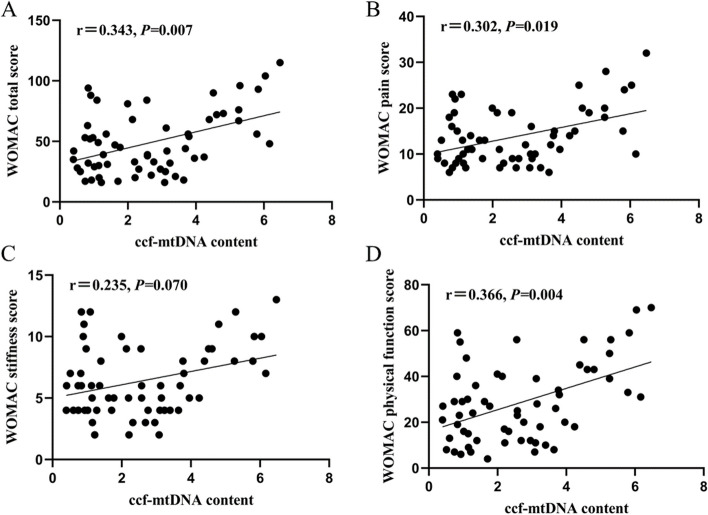
In total, we enrolled 60 patients with KOA and HC who were matched for age, sex, and body mass index (BMI). We found that plasma ccf-mtDNA contents were significantly higher in patients with KOA (median, 2.44; quartile range, 1.10-3.79) than in HC (median, 1.08; quartile range, 0.52-2.12) (P < 0.0001). Plasma ccf-mtDNA content sequentially increased following the KOA class I-IV group (P = 0.040) and positively correlated with the K-L classification (r = 0.369, P = 0.004) and WOMAC scores (r = 0.343, P = 0.007). The ccf-mtDNA content did not significantly differ between patients with bilateral and those with single KOA (P = 0.083). Patients with high levels of ccf-mtDNA had a significantly increased risk of KOA compared with those with low levels of ccf-mtDNA (odds ratio [OR], 4.15, 95% confidence interval [CI], 1.71-10.07; P = 0.002). Quartile analysis revealed a significant dose-dependent association (P trend < 0.001).
Our study's findings showed that plasma ccf-mtDNA was highly expressed in patients with KOA compared with HC. Furthermore, ccf-mtDNA content is significantly associated with the severity and risk of KOA. Therefore, its detection may provide insight into the prevention and treatment of KOA.
膝骨关节炎(KOA)的特征是线粒体损伤和炎症增加。循环无细胞线粒体 DNA(ccf-mtDNA)来源于受损的线粒体,是一种内源性损伤相关分子模式(DAMPs)分子,可能引发炎症,并被认为是各种疾病的潜在生物标志物。在这项研究中,我们研究了血浆 ccf-mtDNA 含量与作为 KOA 患者诊断生物标志物的潜在相关性。
我们收集了 KOA 患者和健康对照(HC)的血浆样本。随后,使用实时定量聚合酶链反应(qRT-PCR)检测血浆样本中的 ccf-mtDNA 含量。我们使用 Kellgren-Lawrence(K-L)分类标准将 KOA 患者分为四级:I-IV 级。KOA 患者的疾病严重程度采用 Western Ontario 和 McMaster 大学骨关节炎指数(WOMAC)进行评估。然后,进行 Spearman 分析以观察 ccf-mtDNA 含量与 K-L 分类和 WOMAC 评分之间的相关性。使用逻辑回归分析评估 ccf-mtDNA 与 KOA 风险之间的关系。
我们共纳入了 60 名 KOA 患者和年龄、性别和体重指数(BMI)相匹配的 HC。我们发现 KOA 患者的血浆 ccf-mtDNA 含量明显高于 HC(中位数,2.44;四分位距,1.10-3.79)(P<0.0001)。血浆 ccf-mtDNA 含量随 KOA 分级 I-IV 组递增(P=0.040),与 K-L 分级呈正相关(r=0.369,P=0.004)和 WOMAC 评分(r=0.343,P=0.007)。双侧和单侧 KOA 患者的 ccf-mtDNA 含量无显著差异(P=0.083)。与低水平 ccf-mtDNA 的患者相比,高水平 ccf-mtDNA 的患者发生 KOA 的风险显著增加(比值比[OR],4.15,95%置信区间[CI],1.71-10.07;P=0.002)。四分位分析显示出显著的剂量依赖性关联(P 趋势<0.001)。
我们的研究结果表明,与 HC 相比,KOA 患者的血浆 ccf-mtDNA 表达水平较高。此外,ccf-mtDNA 含量与 KOA 的严重程度和风险显著相关。因此,其检测可能为 KOA 的预防和治疗提供新的思路。