Dzobo Mathias, Dzinamarira Tafadzwa, Strauss Michael, Mashamba-Thompson Tivani
School of Health Systems and Public Health, Faculty of Health Sciences, University of Pretoria, Pretoria, South Africa (Dzobo, Dzinamarira, and Mashamba-Thompson).
Health Economics and HIV/AIDS Research Division (HEARD), University of KwaZulu Natal, Durban, South Africa (Strauss).
AJOG Glob Rep. 2024 Oct 17;4(4):100414. doi: 10.1016/j.xagr.2024.100414. eCollection 2024 Nov.
Cervical cancer screening using HPV self-sampling presents a valuable opportunity to enhance access for underserved and never-screened women in Zimbabwe. However, to ensure the successful implementation of this innovative approach, it is crucial to understand the preferences of key stakeholders, particularly women, with regard to the various components of an HPV self-sampling intervention.
This study aimed to elicit rural women's preferences for HPV self-sampling.
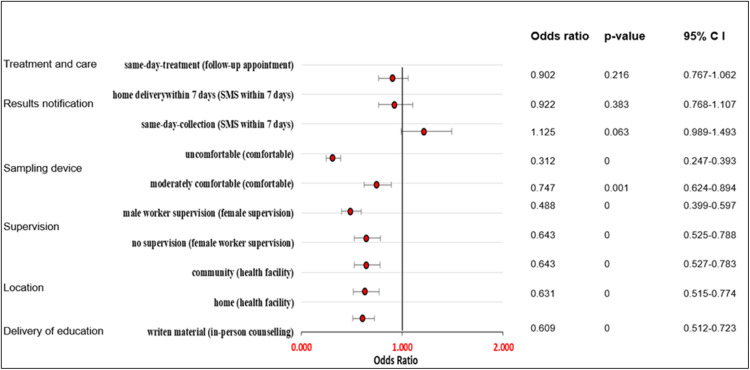
A DCE questionnaire was administered to 215 women in Chidamoyo, Hurungwe Rural District. Women were asked to choose between two hypothetical screening choices defined by education, location of services, supervision of self-sampling, comfort of sampling device, results notification and care after HPV results. Data were analysed using fixed and mixed logistic regression models.
Results indicated that the comfort of the sampling device had the most significant impact on women's preferences for HPV self-sampling. Women prioritised facility-based self-sampling, female-supervised self-sampling, and face-to-face education on cervical cancer and screening methods. The methods of results notification and care after HPV results did not significantly impact women's choices. The mixed effects results showed preference heterogeneity in some of the attributes. Interaction analyses suggested that preferences were largely homogenous across the following subgroups: never-screened, previously screened, young and older women. The stratified analysis also showed that preferences were consistent among the four subgroups.
Our findings highlight the importance of face-to-face education, comfortable and user-friendly sampling devices, female health worker supervision and health facility-based self-sampling for cervical cancer screening via HPV self-sampling. These insights could guide the design of patient-centric interventions to ensure high uptake and increased screening coverage.
使用人乳头瘤病毒(HPV)自我采样进行宫颈癌筛查为津巴布韦服务不足和从未接受过筛查的女性提供了一个增加筛查机会的宝贵途径。然而,为确保这一创新方法的成功实施,了解关键利益相关者(尤其是女性)对HPV自我采样干预各个组成部分的偏好至关重要。
本研究旨在了解农村女性对HPV自我采样的偏好。
对胡伦圭农村地区奇达莫约的215名女性进行了一项离散选择实验(DCE)问卷调查。要求女性在两种假设的筛查选择之间进行选择,这两种选择由教育程度、服务地点、自我采样的监督、采样设备的舒适度、结果通知以及HPV检测结果后的护理来定义。使用固定和混合逻辑回归模型对数据进行分析。
结果表明,采样设备的舒适度对女性对HPV自我采样的偏好影响最为显著。女性优先选择在医疗机构进行自我采样、由女性监督的自我采样以及关于宫颈癌和筛查方法的面对面教育。HPV检测结果的通知方式和检测结果后的护理方法对女性的选择没有显著影响。混合效应结果显示在某些属性上存在偏好异质性。交互分析表明,在以下亚组中偏好基本一致:从未接受过筛查的女性、曾接受过筛查的女性、年轻女性和年长女性。分层分析还表明,四个亚组的偏好是一致的。
我们的研究结果强调了面对面教育、舒适且用户友好的采样设备、女性卫生工作者的监督以及基于医疗机构的自我采样对于通过HPV自我采样进行宫颈癌筛查的重要性。这些见解可为以患者为中心的干预措施设计提供指导,以确保高接受率并扩大筛查覆盖范围。