Große Cornelia, Grau Jan, Herzberg Martin, Nies Dietrich H
Molecular Microbiology, Martin-Luther-University Halle-Wittenberg, 06120 Halle (Saale), Germany.
Computer Sciences, Martin-Luther-University Halle-Wittenberg, 06120 Halle (Saale), Germany.
Metallomics. 2024 Dec 2;16(12). doi: 10.1093/mtomcs/mfae057.
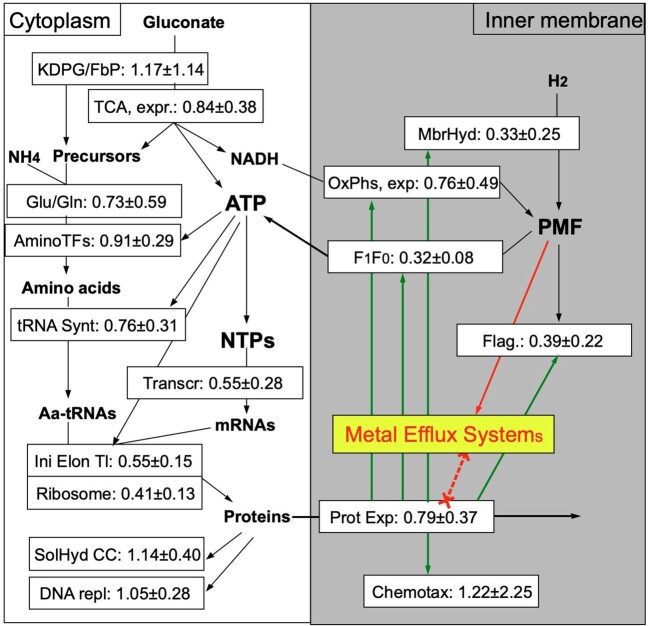
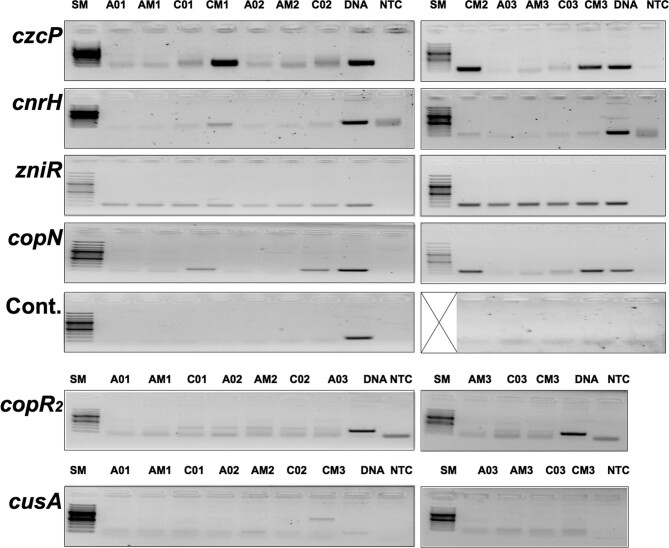
Cupriavidus metallidurans is able to thrive in metal-rich environments but also survives metal starvation. Expression of metal resistance determinants in C. metallidurans was investigated on a global scale. Cupriavidus metallidurans was challenged with a MultiTox metal mix specifically designed for the wildtype strain CH34 and its plasmid-free derivative AE104, including treatment with ethylenediamintetraacetate (EDTA), or without challenge. The sense and antisense transcripts were analyzed in both strains and under all three conditions by RNASeq. A total of 10 757 antisense transcripts (ASTs) were assigned to sense signals from genes and untranslated regions, and 1 319 of these ASTs were expressed and were longer than 50 bases. Most of these (82%) were dual-use transcripts that contained antisense and sense regions, but ASTs (16%) were also observed that had no sense regions. Especially in metal-treated cells of strains CH34 and AE104, up- or down-regulated sense transcripts were accompanied by antisense transcription activities that were also regulated. The presence of selected asRNAs was verified by reverse transcription polymerase chain reaction (RT-PCR). Following metal stress, expression of genes encoding components of the respiratory chain, motility, transcription, translation, and protein export were down-regulated. This should also affect the integration of the metal efflux pumps into the membrane and the supply of the energy required to operate them. To solve this dilemma, transcripts for the metal efflux pumps may be stabilized by interactions with ASTs to allow their translation and import into the membrane. Alternatively, metal stress possibly causes recruitment of RNA polymerase from housekeeping genes for preferential expression of metal resistance determinants.
嗜金属贪铜菌能够在富含金属的环境中茁壮生长,但也能在金属饥饿的情况下存活。对嗜金属贪铜菌中金属抗性决定因素的表达进行了全球范围的研究。用专门为野生型菌株CH34及其无质粒衍生物AE104设计的多毒素金属混合物对嗜金属贪铜菌进行挑战,包括用乙二胺四乙酸(EDTA)处理或不进行挑战。通过RNA测序分析了两种菌株在所有三种条件下的正义和反义转录本。总共10757个反义转录本(AST)被分配到来自基因和非翻译区的正义信号,其中1319个AST被表达且长度超过50个碱基。其中大多数(82%)是包含反义区域和正义区域的两用转录本,但也观察到没有正义区域的AST(16%)。特别是在菌株CH34和AE104的金属处理细胞中,上调或下调的正义转录本伴随着也受到调节的反义转录活性。通过逆转录聚合酶链反应(RT-PCR)验证了选定的反义RNA的存在。金属胁迫后,编码呼吸链、运动性、转录、翻译和蛋白质输出成分的基因表达下调。这也应该会影响金属外排泵整合到膜中以及操作它们所需能量的供应。为了解决这一困境,金属外排泵的转录本可能通过与AST的相互作用而稳定,以允许它们的翻译和导入膜中。或者,金属胁迫可能导致从管家基因招募RNA聚合酶,以优先表达金属抗性决定因素。